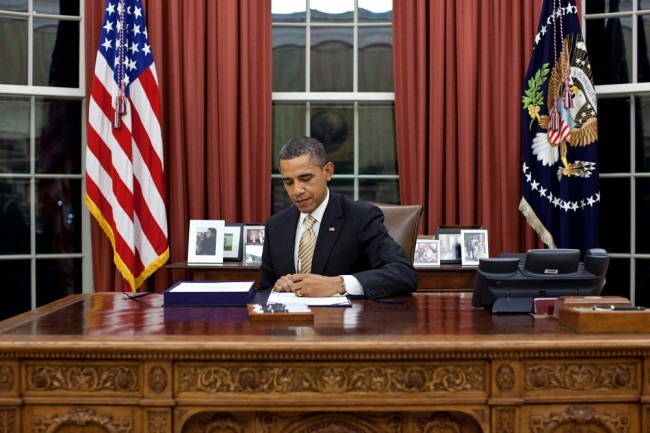
 On February 5, US President Barack Obama floated the idea of adding a $10 per barrel tax on oil. What is meant by a tax on oil is anyone’s guess; the concept itself is so formless and ill conceived you can pencil in any interpretation that turns your crank and you’ll be as far ahead as the rest of us. At the very least, the proposal should be a poster child for the law of unintended consequences.
It’s hard to know where to even start trying to analyze the chaos this would cause. Little is known, but Obama does say that the tax would be “paid by oil companies”. What does this mean? Producers? Refiners? Passed on to customers like fuel tax? Absorbed by producers off the top? The explanation that comes nearest to having its feet on the ground would be that producing companies might pay 10 dollars for every barrel of oil produced. That would seem simple enough if the US were an unreachable island, however the US imports a lot of oil (9 million barrels per day), and administering that tax to imported volumes would be a bewilderingly complex administrative hurdle (who produced the oil? Would that producer pay, from the other side of the world? If barrels are imported by traders, as many are, would the traders foot the bill?), but administrative hurdles have never deterred governments before. So let’s go with that expectation as a starting point, and speculate a bit on what the proposal would look like on the ground once the dust settles.
It would look like a pile of rubble. Energy companies are on their knees now, surely even the White House must be aware of that, and expecting oil companies to eat that cost would finish off the few companies that are still standing. By way of evidence, check out how many companies are in financial trouble with a credit agency recently downgrading ratings on half a trillion in energy debt and that’s with oil at $30 per barrel. Most oil costs far more than $40 to find and produce, so the consequences of the government taking a further $10 out of the pot shouldn’t be too hard to imagine.
Already, hundreds of billions of capital has left the energy industry due to low oil prices and that amount is climbing every day as new downward-revised 2016 capital plans are unveiled. This outflow hasn’t hurt production in the shortfall because many companies are still drilling to generate cash to survive, a surprising number, while others are completing projects started several years ago and can’t be left half complete. Together, these new production additions are keeping the world in a marginal surplus position. But the significant number of large-scale production projects being cancelled will create a hole in productive capability in a few years, because a steady stream of meaningful projects are required to offset the 2-4 million barrels per day lost globally every year through natural declines.
That eventual and inevitable production shortfall will lead to price spikes, the expectation of which is possibly the reason Obama somehow considers this proposal not to be crazy – a $10 levy on $100/barrel oil isn’t so bad. The problem is that the levy would, in the short term, scare away whatever capital is still available – investors aren’t exactly stampeding into the sector now – and the industry would be totally decimated just in time for the price spike. And when it spikes, the US economy will suffer mightily because the green revolution won’t even be remotely close to providing energy for the world’s biggest economy.
It’s hard to imagine that someone could think that this proposal will do what it’s intended without napalming vast sectors of the economy.
And finally, here in Canada, this proposal should provide crystal-clear, absolute proof that Canada needs access to oil markets other than the US. A $10/barrel tax would shut in the oil sands and most other oil production at today’s prices (or anywhere near them). While environmentalists and fossil fuel haters no doubt rejoice at the thought, it’s important to look beyond the naïve world-view that would consider this chain of events to be good. Because anyone that would like to see this policy implemented is more interested in destruction than progress. To quote Ross Perot once more, “The activist is not the one who says the river is dirty. The activist is the one who cleans it up.”
A sensible green-focused energy policy would be aimed at planning the massive infrastructure requirements that will be needed to eventually move away from fossil fuels, or at the very least pretend to be thinking about them. This Obama oil tax plan would dramatically impact the fossil fuel business, that is certain, just as Russia is currently impacting Syrian neighborhoods. The living standard we enjoy is based on low priced energy – travel, food transportation, modern farming capabilities, and on and on. A sensible environmentalist would hope that the transition to green energy would be in a managed, not cataclysmic, way. For those that don’t care about the distinction, let’s hope that they never get near the levers of power. And let’s hope this tax never gets off the ground for similar reasons.
Read more insightful analysis from Terry Etam here