Imagine being the manufacturer of one of the most highly in demand items on Amazon today, and having the ability to produce a large amount in order to fulfill that demand but are stifled by the fact that your local post office only allows you to ship 50 items a week. So in order to get your products to your customers at the same price as your competitors (that may not have the 50 item per week limit) you have to pay extra for expedited shipping. This takes revenue off the top and effectively forces you to sell your products at a discount to your competitors. This is how the Canadian oil industry is currently suffering due to lack of pipeline capacity.
The Canadian oil industry can benefit tremendously from pipeline projects that are currently “in the pipeline”. These pending projects have the potential to significantly increase export capacity, which in turn will alleviate the unfavorable differential that reduces the prices received by Canadian producers compared to world benchmarks. Smaller differentials would equate to higher realized prices, and all of Canada stands to share in the benefits from our world renowned responsibly produced oil resources.
Currently, there are three important Canadian oil pipeline projects which could have major impacts to the oil industry. These projects include Enbridge’s Line 3 Replacement, TransCanada’s Keystone XL and Kinder Morgan’s (now the Government of Canada’s) Trans Mountain Pipeline Expansion. Overall, these three pending pipelines have the potential to add about 1.8 million bbl/d of market access to Canadian oil producers.
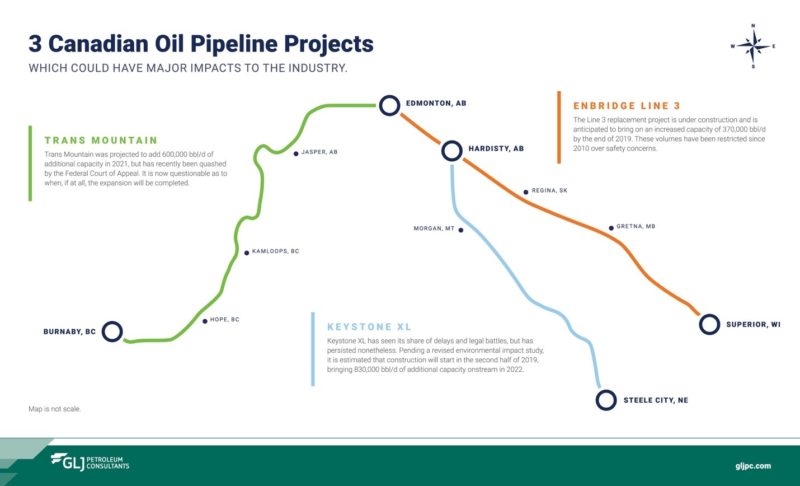
The Line 3 replacement project is under construction and is anticipated to bring on an increased capacity of 370,000 bbl/d by the end of 2019. These volumes have been restricted since 2010 over safety concerns.
Keystone XL has seen its share of delays and legal battles but the proponent, TransCanada Pipelines, has persisted so far. Pending a revised environmental impact study, it is estimated that construction will start in the second half of 2019, bringing 830,000 bbl/d of additional capacity onstream in 2022.
Trans Mountain was projected to add 600,000 bbl/d of additional export capacity in 2021, however this has recently been quashed by the Federal Court of Appeal. The Trans Mountain construction saga remains on political life-support, but final cost, timing and actual construction look less predictable than ever.
Removing transport bottlenecks and reducing the amount of crude shipped by rail will decrease the overall costs associated with getting oil to larger markets and will thus reduce the differential between prices received for Canadian oil and benchmark prices like WTI. Current analyst estimates place the costs due to bottlenecks for Canadian crude anywhere from $0.50 to $3 /bbl (depending on location and oil quality) due to competition for pipeline capacity. These premiums paid on transport are further exacerbated in rail transport costs, which are estimated to be $3 to $6 /bbl higher than pipeline transport costs.
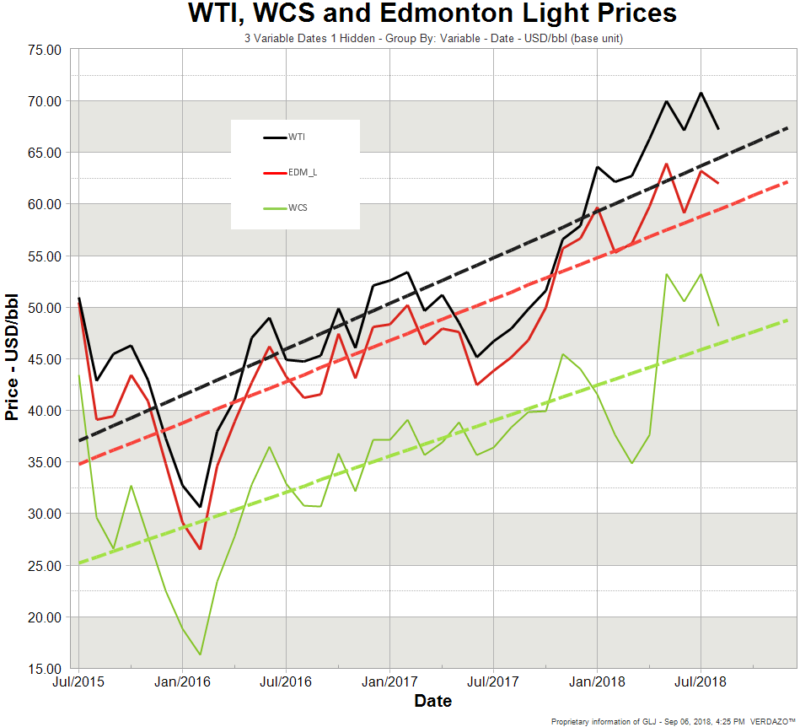
Current market differentials between Edmonton Light and WTI are in the range of $8+ USD/bbl and the Western Canadian Select (WCS) differential to WTI is in the range of $23+ USD/bbl. Building additional pipeline capacity would remove much of the bottleneck for Canadian oil to get to market and could therefore eliminate a significant portion of these large differentials – adding dollars to the Canadian economy.
A recent study released by the Canadian Energy Research Institute estimates that for every Canadian dollar increase to the price of WTI, the Canadian GDP rises by almost $1.7 billion. If transportation was available for Canada to receive world prices for our oil sales, it is easy to envision the positive impact on Canada’s GDP to be upwards of $10 Billion dollars per year. This is a very large forgone opportunity to federal governments, provincial governments, businesses and citizens.
Despite setbacks and delays with the three major pipeline projects in the works, Canadian producers, as always, are optimistic and innovative. Patience and careful investment will be rewarded.
Justin Mogck is Director of Commodities Research at GLJ Petroleum Consultants focusing on commodity price forecasting, corporate evaluations and economic modeling. He is actively involved in technically focused energy markets & commodity analysis and forecasting for GLJ; Justin has also developed expertise in both conventional and unconventional evaluations, and has a variety of A&D experience throughout the North American energy industry