You might look out at the vast landscape of ultra weird crap going on all around you, and think something odd is going on here that even AI couldn’t make up. And yet I look at the same thing and think “It’s all coming together.”
Sort of. I’m referring to a specific aspect that is coming together, not things in general, or, because it’s just everywhere, politics. You would cross the street to avoid anyone that thought the political landscape is “coming together”. I’ll avoid politics to the extent possible for the same reason I don’t eat staples.
If you’re here, you care about energy, so just a few points to launch you into the holiday season.
First, when I say it is “coming together”, consider these three headlines that appeared on the BOE Report home page, simultaneously:
- World’s larges AI chip builder Taiwan wants Canadian LNG
- Half US at high risk of power shortfall in next decade, regulator says
- Canada pushes out target for net-zero electricity grid by 15 years
Quite a trio, hey? Five years ago, none of this was supposed to be happening, we were force-fed a news flow that insisted none of the above would happen. And yet now, as forecast by a not-Nostradamus and not-normal seer some five years ago, the ‘energy transition’ is turning out to be perhaps more of a marketing exercise than an actual thing. Actually, despite the fact that I’m blowing my own horn there a bit, many of us in the energy industry understood the complexity and depth of the existing system, and that no one could even reasonably quantify the costs and challenges of replacing it. As Peter Zeihan says, “oil is civilization.” It just is.
I will dip into the political realm here for a second, and despite the overwhelming temptation it will not be to catalogue dumb things. That’s shooting fish in a barrel. The political aspect here is, for energy workers, maybe the written equivalent of sitting down at the end of the year in a comfortable chair with a good drink and reflecting on something that’s gone right in an otherwise utterly bonkers year.
Canada is facing a productivity problem, and the world can see it, and does see it, because smartasses continuously post snappy little infographics that show just how bad it is. We are falling behind, and it doesn’t feel good to know that.
But maybe, just maybe, for once, we can look at some data that will make an energy worker feel good for once. We, the ones that stuff pipelines full of fuel and wires full of electrons, sometimes lose sight of the importance and vitality of what we do, and that the energy industry really should be considered an essential service, and treated as one.
Here are some recent national statistics. Thus far in 2024, Canada has produced about 5.7 million barrels per day of oil, and just over 18 billion cubic feet per day of natural gas. Blah blah blah, a bunch of numbers. What is a million barrels a day in functional terms? How can that ever be a relevant statistic to the average person, or more specifically, a relevant statistic to the urban cousin of yours that you will argue with over the holidays about the role of hydrocarbons? And likewise, what is a billion cubic feet per day of natural gas? Who thinks in terms of a volume of gas?
Mercifully, there are ways to make sense of these big numbers, and use the results of such clarification to dazzle and/or infuriate your holiday guests, depending on whether they hit the dinner table full of peace or full of booze-fueled fighting Irish. Here are some numbers to pour on them like gravy.
According to the Careers In Energy site, using data from Statistics Canada, there are approximately 212,000 workers in the Canadian energy industry.
Taking Canada’s production statistics from above, (5.7 million b/d oil, 18.3 bcf/d natural gas), we can calculate the energy sector’s productivity: each Canadian energy worker produces about 27 b/d of oil, and 86 mcf/d of natural gas, or just under 100 GJ/d.
I know, more numerical soup; let’s look at what people get from those quantities.
Chevron has an excellent page entitled “What’s in a barrel of oil?” One barrel of oil produces all of these things:
- enough gasoline to move a 25 mpg car for 400 miles
- Enough distillate fuel to move a large truck for 40 miles
- Enough liquefied gas like propane to fill a dozen small canisters
- A gallon of asphalt
- Enough petrochemicals for a bunch of other minor stuff, the list approaching singular absurdity (wax crayons, candles, briquettes, plus one of: 39 polyester shirts, 23 hula hoops, 540 toothbrushes…and many more)
On the natural gas side, the average worker’s 100 GJ/d of natural gas is roughly equal to the average Canadian household consumption per year.
So considering only the bigger components, in different permutations, a Canadian energy sector worker produces on an average single day, enough fuel to:
- Move 54 cars (averaging 25 mpg) each for 200 miles, which in real world terms is like moving 27 curling teams to Edmonton and back in a single day
- Move four big trucks for 250 miles, which is in real world terms like a bunch of Amazon delivery routes in a single day
- Provide enough natural gas for an average Canadian home for an entire year
- Provide enough residual petrochemicals for 14,580 toothbrushes (ok, that’s not a relevant component, but hey I guarantee it will send a fossil fuel argument into hyperdrive)
And that is why an “energy transition” is a project that will remain a job description for your grandchildren’s grandchildren, and it is also indirectly why our federal government was unable to find anyone willing to present a critical financial update last Monday without going to the fourth tier of the bench (ok ok, I swore off the politics…but it’s true).
Energy workers, consider yourselves in the eye of the storm all around you, calm in the knowledge that energy is the key to everything, that it is the basis of civilization and innovation, and that there is nothing but great honour in providing it, no matter how many flying cups you may have to dodge over the holidays for saying so.
Merry Christmas and Happy Holidays everyone.
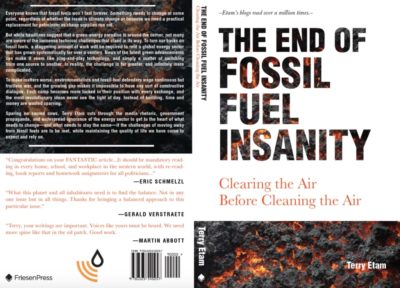
It’s all happening as expected, more or less – an energy transition isn’t quite so simple. Find out what readers knew years ago in The End of Fossil Fuel Insanity – the energy story for those that don’t live it, and want to find out. And laugh. Available at Amazon.ca, Indigo.ca, or Amazon.com.
Read more insightful analysis from Terry Etam here, or email Terry here.