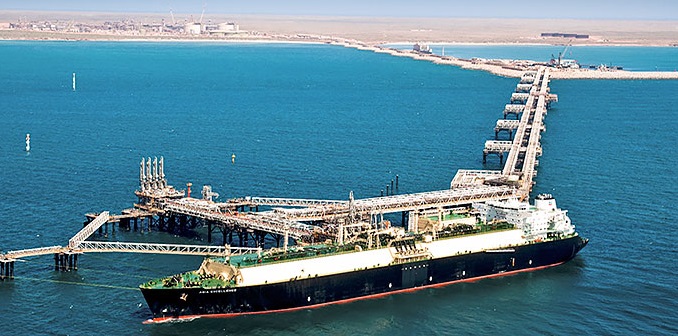
 Australia is set to issue a gas market review that could curb exports of liquefied natural gas from its east coast, where three operators led by firms such as Shell and Santos send cargoes to Asia and beyond.
The review, which industry watchers expect Canberra to release as soon as this week, could include a policy for local supply to be prioritised by LNG exporters in the populous east, the main source of domestic demand, they said.
“The government’s trying to solve a tricky problem, because they want… a situation where the domestic market and the international market are both met with… gas that is reasonably priced,” said Tony Wood, an energy analyst at the Grattan Institute in Melbourne.
The review is likely to be a framework, with detailed measures expected in early 2026, industry sources said, speaking on condition of anonymity.
While all three consortia could be affected, industry observers said Gladstone LNG (GLNG), operated by Santos and backed by South Korea’s Kogas, TotalEnergies and Malaysia’s Petronas may face the toughest scrutiny.
GLNG has relied heavily on third-party domestic gas to meet export commitments, taking large volumes from the local market to fill contracts its own coal seam gas fields cannot supply, and has argued that any new domestic gas commitments would “completely undermine” its contracts.
The other two eastern exporters, Australia Pacific LNG (APLNG), led by Origin Energy with ConocoPhillips and Sinopec, and Queensland Curtis LNG (QCLNG), led by Shell with partners CNOOC and Tokyo Gas, have met contracts with supply from their own fields and sold surplus gas as spot cargoes or in the domestic market.
Both have called for the three eastern producers to contribute equally to the domestic market, until new gas sources come online.
“In the longer term, targeted investment in gas field development near demand centres is critical to ensure supply security,” APLNG said in an August submission to the review.
The Labor government has pledged to honour existing contracts, but in August Shell criticised the approach for uncontracted volumes from its facility and APLNG to serve as a backstop for what it called systemic supply failures in southern states.
“A simpler model for reservation… will strengthen the domestic market, support a vibrant export industry and encourage future investment,” Shell said in a statement sent to Reuters.
Such a model would be underpinned by active measures to increase supply, rather than the current rules that focus only on uncontracted volumes, it added.
GLNG did not immediately respond to a request for comment.
Projects in the west and north of Australia, the world’s third-largest LNG exporter, are not affected by the review.
EXPORT AND PRICE CONTROLS
Australia’s east coast LNG industry is built around Queensland coal seam gas fields and six export trains at Gladstone.
Since exports began in 2015, Australian spot gas prices for power have surged, and manufacturers complain of scarce long-term contracts, even as traditional sources of southern gas supply have waned.
Both the energy market operator and competition watchdog have warned of gas shortages since 2017, when the government adopted a mechanism to divert cargoes to the domestic market and avert potential shortage.
Successive governments have imposed controls on exports and prices since.
“Both buyers and sellers want a genuine market, not constant government intervention,” Wood said.
“The longer-term solution is simply more supply,” said Tor McCaul, managing director of Comet Ridge, which produces gas in Queensland, selling some to Santos and developing more for the domestic market via specific permits.
(Reporting by Helen Clark; Editing by Tony Munroe and Clarence Fernandez)