Quite the year so far, hey? Waking up to scan the news is like slowly prying one eye open for a peek, expecting sheer mayhem, and breathing a sigh of relief if there is only a minor cataclysmic event. Less than two weeks and we’ve had Venezuela and now Iran seize the world’s attention for different but related reasons, and who knows where will be next. It is mind-blowing to think that the next powder keg could be Greenland, a place whose every defining trait screams the exact opposite of powder keg. It’s a giant block of ice that makes a library look wild. And yet here we are. The incredible bravery of the people of Iran and Ukraine, fighting for their existence like no one should have to, barely even dents the headlines, so manic is the rest of the world.
The info flow focus drifts into a million shards of political fragmentation, all sharp enough to cut you to the bone. Ordinary people are displaying extraordinary fears and concerns that the world has spun off its axis into a steady stream of “this can’t be happening” moments.
Some of these fears might even be true. You will go crazy trying to figure it out, but go ahead if you must. There are options. One is to focus on things we know that are going to be trouble, and worry about those. While these problem areas might not have an easy solution, there are ways to mitigate the pain.
One of the reasons that the world seems so crazy is because it was asleep at the wheel for some time, drifting into some very dangerous or unsettling situations, at least from a western perspective. Other regions of the world would think this is not a problem at all. But we do, and I live here. And so away we go.
Here in the west, we’ve become decoupled from the nature of things, particularly industrial things, because we decided some decades ago to follow conventional economic wisdom with respect to national competitive advantages, offloading manufacturing to countries with low labour costs. Who needs a factory anymore, we have Wall Street. Who needs welders any more, we have social scientists. Who needs tungsten, China has all we need.
Oh wait, not so fast on the tungsten thing. That, and many other critical metals and minerals, are now coming into focus as global battlefields, because the west has also shed its ability to mine and process these critical elements.
The inability to produce things in the west creates obvious problems. No factories, no factory jobs. No welders, and not much construction or metalwork happens. No tungsten and…[much head scratching]…well who cares about that last one I guess, when was the last time anyone had to run to the store for tungsten, or when was a building’s construction halted because an exasperated project manager shouted We’re all out of tungsten, everyone go home.
Here’s lesson one out of that mini-scenario: Making smart ass comments about that which we don’t realize we need is a very big, very serious, very pervasive problem. It is mockery from a perch of comfort, just as when someone is dismissed as blue collar or a trucker or a farmer or a tradesperson who has been defined for far too long as someone not bright enough for university. The attitude is a mental disease.
Author Craig Tisdale put it far more eloquently: “For the past three decades, Western economies have operated under the tacit Neoclassical assumption that control over intellectual property, financial instruments, and software code constitutes the apex of value creation. In this worldview, the physical processes of industrialism, the dirty, energy-intensive work of mining, refining, smelting, and alloying, were viewed as commoditised, low-margin utilities that could be outsourced to low-cost jurisdictions without strategic peril.”
Which brings us to lesson two: Tungsten is ridiculously valuable to us, and to allow cagey and clever economic opponents to control supply is wildly dangerous.
Tungsten is used in a truly impressive array of machinery, and our world would grind to a halt without it. Tungsten is used in cutting tools and drills, meaning it is a necessity for almost anything made of metal. It is used in the lighting industry and the x-ray industry, as well as in electrical switches, relays, and connectors. Without tungsten, industrial processes grind to a halt.
That is terrifying for governments to accept, though there is yet another use for tungsten whose absence scares them more: tungsten is a vital component of aerospace components and defence equipment/systems.
This whole discussion isn’t just about tungsten; it is about a rapidly spreading realization that many industrial inputs that have been taken for granted forever might not be there when we need them, and that is a very big problem.
Blame economists. Or economic theory, anyway. One of the most elementary economic concepts is supply and demand curves; when demand for something rises, the price of the item rises until supply increases to meet the new demand, and find a new “equilibrium point”. This often works quite well.
But not universally. So economists added a layer of analysis, the ‘elasticity’ of certain items, which refers to the sensitivity of customers to price swings. An elastic product will have demand react strongly to even small price changes, whereas inelastic demand means that demand can remain strong even as prices rise sharply.
And that’s all well and good. But those concepts have now run into a new brick wall whereby price changes may or may not have any impact on supply at all. Which brings us to metal demand.
In an excellent analysis of the copper situation entitled “The Red Metal Singularity”, author Shanaka Anselm Perera illuminates just how far we are from healthy supply levels, even though no one seems to care because “we just need a few more mines.” As Perera puts it, “…three breaks have occurred simultaneously in the copper supply chain, and the breaks are mutually reinforcing. The first is geological: ore grades have declined by more than half in fifteen years, requiring twice the energy and water and capital to produce the same tonne of metal. The second is temporal: the time from copper discovery to first production has extended from six years to eighteen, meaning today’s prices cannot summon supply until the 2040s. The third is the smelter bottleneck that transforms the first two into acute crisis: when concentrate scarcity drives TC/RCs negative, smelters cannot survive, capacity shuts, refined copper disappears from the market, and the shortage that models project for 2030 arrives in 2026.”
Mining giant Robert Friedland points out that copper is central both to economic growth and national security. “Over the next 18 years, humanity will need to mine as much copper as it has over the past 10,000 years combined to sustain even modest economic growth.”
Power is turning out to be the same. Rapid increases in power demand create a huge push to create new power sources, but those projects as well run into a brick wall: regulatory issues. Grid issues. Environmental issues.
We see the last issue as plain as day in the data centre frenzy. Hundreds of billions of dollars are being waved about, promised to anyone that can deliver a data centre. Some are being built, but only a fraction of demand. Alberta, for example, has a demand queue of some 16 gigawatts of electricity demand, much of it data-centre related, in a province that has a total existing power market of 10 GW. That new demand is staggering; one and a half times the entire province’s consumption. (Structurally, in Alberta, another big issue is that natural gas is not easily available at large scale, and certainly not at the posted AECO price. Almost no one will drill new gas wells just for AECO’s miserable profile, a fact that endlessly baffles industrial parties looking to set up shop here. Captive gas already on the system under long term transportation contract trades for AECO, as does gas committed to those contracts. But you just can’t get any of it, no matter who you are. (Raw gas is available everywhere, processed gas is not. That is a crucially important nuance few grasp at the outset.) Check with your local monopoly for full details.)
The race to get into AI via data centres shows no signs of abating; if anything, it is accelerating. Both the US and China have pledged to win the AI race (whatever that means) and thus are pushing forward as fast as possible.
The tendency to oversimplify extends to energy. We assume there is lots because all we read about is an oil glut, and how much capacity is being added every year, etc. Yet, with the onslaught of the AI/data centre age, even AI poster child Elon Musk has stated we won’t have enough energy for what we want to do. The reasoning is the same as copper; there may be endless resources of very low grade copper in the earth, but that doesn’t mean it will be there when we need it, and the same holds true for energy. While the price signal works for some products, like natural gas (high prices lead to a drilling frenzy that increases supply), the same is not true for power, not when it takes years and years to construct more power generating equipment.
The noise and mayhem of current politics masks a lot of what is going on underneath the surface. What is going on is a global jockeying for stuff – metals, materials, energy. The US thinks it has the energy nut cracked, going from an importer to a net exporter of both oil and natural gas. The long term sustainability of that status is open to question, but for now, that is how it stands. But the need for vastly more energy is clearly visible, and thus nuclear is back on the table, in a big way, to power the data centres a decade out.
Craig Tindale again, making this pertinent point: “The Federal Reserve operates on a premise that has governed Western economic thought for forty years: that the management of money is distinct from the management of matter. Inside the Federal Reserve, inflation is treated as a thermal imbalance of aggregate demand, addressed through adjustments to the cost of credit.…the Federal Reserve’s…independence can be preserved only if the mandate itself evolves to reflect conditions of strategic rivalry and material constraint.”
What that means is that existing institutions like the Federal Reserve have evolved to believe that inflation is battled by twiddling with interest rates, increasing the cost of money to slow business activity and thereby limit overall price increases (the “basket of consumer goods” approach). But this strategy is ill-equipped – actually does not even realize the existence of – inflation due to physical shortages of critical metals and minerals, shortages that cannot be rectified by the price signal. If a new mine takes 20 years to build (if it can be built at all), that timeline does not change if the price of copper doubles this year due to shortages. All that it means is that thieves will get more and more creative and less and less intelligent when it comes to stealing copper. For every 20 percent increase in record copper prices, you will see a corresponding increase in news stories about dumb and dumber copper-theft deaths. (In an age of infinite camera capabilities, CAN NO ONE MONITOR SCRAP COPPER PURCHASERS??)
Production of industrial products is only as good as the weakest link. There might not be much gallium used in a radar defence system, but there is no radar defence system with no gallium. The same rationale with different metals holds for everything from smartphones to computer chips to airplanes. If China controls the supply, either via mine ownership or processing capability, that is a very big problem. So wheels are in motion to reorient the world to avoid that risk, from the US perspective. Such actions run deep and far and wide, and don’t always look like it.
This might sound like a bunch of arm-waving over nothing, but these are the sorts of considerations that need to be studied if one wants to understand what is going on in the world. You don’t have to, of course, you can watch Orange Man Bad’s latest tweets and lose your mind. Up to you.
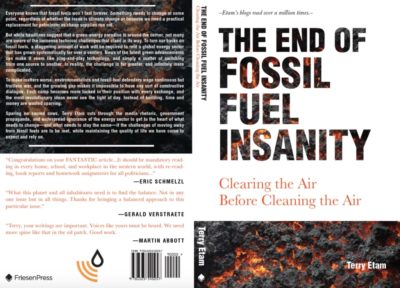
OK, so you missed the present-giving season. Go shopping anyway. At the peak of the energy wars, The End of Fossil Fuel Insanity challenged the narrative, facing into the storm. And now everyone is coming around to this realization as well. Read the energy story for those that don’t live in the energy world, but want to find out. And laugh. Available at Amazon.ca, Indigo.ca, or Amazon.com.
Email Terry here. (His personal energy site, Public Energy Number One, is on hiatus until there are more hours in the day.)