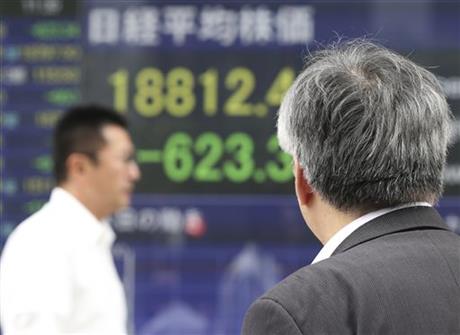
 An escalating conflict in the Middle East rattled global markets on Monday, as the prospect of a long-drawn fight drove energy prices higher and hammered travel stocks and regional assets.
Israel attacked Lebanon in response to strikes by Hezbollah, while Tehran fired missiles and drones at Israel, Gulf states and a British air base in far-away Cyprus.
U.S. President Donald Trump said the military campaign against Iran could continue for the next four weeks, according to an interview on Sunday with the Daily Mail.
Here are some of the assets that have seen the biggest moves since the conflict started Saturday:
OIL, NATURAL GAS AND ENERGY COMPANIES
Crude prices surged as the conflict shut down oil and gas facilities across the Middle East and disrupted shipping in the crucial Strait of Hormuz, through which about 20% of global oil supply passes.
Shares of U.S. and European energy companies, including Exxon Mobil and Shell, were some of the biggest gainers, tracking a more than 8% jump in crude oil prices.
“We expect potential duration and physical volume impact of the military escalation will keep upward pressure on both commodity price and energy equities, reducing the risk of 2026 oil price weakness,” Piper Sandler analysts said in a note.
Natural gas prices also spiked after Qatar halted its production of liquefied natural gas. Qatari LNG accounts for about 20% of global supply.
Shares of natural gas companies like CNX Resources, Williams Companies rose more than 1% each, while the United States Natural Gas Fund ETF added 3.7%.
AIRLINES AND TRAVEL COMPANIES
Ryanair, IAG, American Airlines and United Airlines were among airline stocks that dropped after key Middle Eastern hubs were closed.
Airline stocks often fall when crude prices rise because elevated oil usually means higher jet fuel costs, which is one of airlines’ biggest expenses.
The S&P 1500 Passenger Airlines index was down almost 3%.
“Prior conflicts have led to an immediate hit in passenger demand to the impacted region. This tends to be combined with an ‘indirect’ impact on demand and bookings confidence across broader airline networks,” J.P. Morgan analysts said in a note.
Travel companies like Booking Holdings, Expedia Group fell along with hotel chains like Hyatt Hotels and cruise operators including Carnival.
Norwegian Cruise Line Holdings warned of uncertainties around its fuel costs this year due to escalating geopolitical tensions.
DEFENSE STOCKS
Shares of major U.S. defense contractors Northrop Grumman, General Dynamics, RTX and Lockheed Martin were up between 1.1% and 3.7% in early trading.
“The strikes or at least the scope of the strikes reinforce the buildup of U.S. defense spending and key initiatives such as Golden Dome and the restocking and ramping of missiles and defensive interceptors,” Jefferies analysts said in a note.
Defense companies in Europe also climbed. UK’s BAE Systems, Germany’s Rheinmetall and Italy’s Leonardo clocked gains.
TANKERS AND FREIGHT COMPANIES
Shares of shipping and tanker companies climbed as the conflict disrupted key Hormuz and Suez routes, tightening capacity and driving expectations of higher freight rates.
European shipping giants Maersk and Hapag-Lloyd climbed 7.8% and 6.7%, respectively, while shares of U.S. firm Nordic American Tankers rose more than 3%.
Oil tanker companies Teekay Tankers, International Seaways also advanced.
TRADITIONAL SAFE-HAVEN CURRENCIES AND GOLD
Gold prices climbed as investors fled toward traditional safe-haven assets.
The dollar index, which compares the greenback against a basket of major global peers, climbed 0.6%, with the U.S. currency gaining ground against the Japanese yen, Swiss franc and the euro.
J.P. Morgan analysts said a sustained rise in energy prices should strengthen the dollar while impacting currencies of countries that are heavy importers of the commodity such as those in Central Eastern Europe.
MIDDLE-EAST DOLLAR BONDS AND STOCKS
Long-dated international dollar-denominated bonds from a number of Middle Eastern countries including Qatar, Oman and Saudi Arabia fell sharply amid worries about the conflict spreading.
Equity bourses in Qatar and Kuwait also saw steep declines.
The wider risk-off move also hit other emerging-market economies, with dollar bonds in Egypt and Turkey among decliners.
(Reporting by Shashwat Chauhan in Bengaluru; Additional reporting by Vallari Srivastava and Aishwarya Jain; Editing by Sriraj Kalluvila)