• Sign up for the Daily Digest E-mail
  • X
  • LinkedIn
  • See more results

    Generic selectors
    Exact matches only
    Search in title
    Search in content
    Post Type Selectors

BOE Report

Sign up

See more results

Generic selectors
Exact matches only
Search in title
Search in content
Post Type Selectors
  • Home
  • StackDX Intel
  • Headlines
    • Latest Headlines
    • Featured Companies
    • Columns
    • Discussions
  • Well Activity
    • Well Licences
    • Well Activity Map
  • Property Listings
  • Land Sales
  • M&A Activity
    • M&A Database
    • AER Transfers
  • Markets
  • Rig Counts/Data
    • CAOEC Rig Count
    • Baker Hughes Rig Count
    • USA Rig Count
    • Data
      • Canada Oil Market Data
      • Canada NG Market Data
      • USA Market Data
      • Data Downloads
  • Jobs

U.S. expected to be largest producer of petroleum and natural gas hydrocarbons in 2013

October 4, 20137:41 AM BOE Report Staff

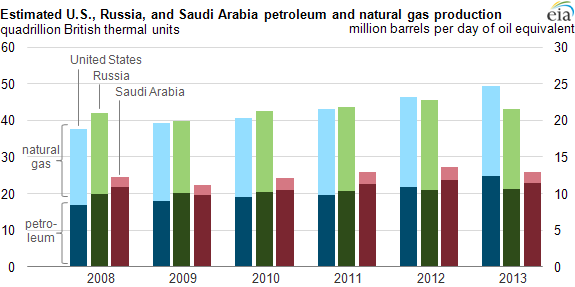
Graph of U.S., Russian, and Saudi Arabian petroleum and natural gas production, as explained in the article text

Source: U.S. Energy Information Administration
Note: Petroleum production includes crude oil, natural gas liquids, condensates, refinery processing gain, and other liquids, including biofuels. Barrels per day oil equivalent were calculated using a conversion factor of 1 barrel oil equivalent = 5.55 million British thermal units (Btu).

The U.S. Energy Information Administration estimates that the United States will be the world’s top producer of petroleum and natural gas hydrocarbons in 2013, surpassing Russia and Saudi Arabia. For the United States and Russia, total petroleum and natural gas hydrocarbon production, in energy content terms, is almost evenly split between petroleum and natural gas. Saudi Arabia’s production, on the other hand, heavily favors petroleum.

Since 2008, U.S. petroleum production has increased 7 quadrillion Btu, with dramatic growth in Texas and North Dakota. Natural gas production has increased by 3 quadrillion Btu over the same period, with much of this growth coming from the eastern United States. Russia and Saudi Arabia each increased their combined hydrocarbon output by about 1 quadrillion Btu over the past five years.

Comparisons of petroleum and natural gas production across countries are not always easy. Differences in energy content of crude oil, condensates, and natural gas produced throughout these countries make accurate conversions difficult. There are also questions regarding the inclusion of biofuels and refinery gain in the calculations. Total petroleum and natural gas hydrocarbon production estimates for the United States and Russia for 2011 and 2012 were roughly equivalent—within 1 quadrillion Btu of one another. In 2013, however, the production estimates widen out, with the United States expected to outproduce Russia by 5 quadrillion Btu.

Follow BOE Report
  • Facebook
  • X
  • LinkedIn

Sign up for the BOE Report Daily Digest E-mail

Successfully subscribed

Latest Headlines
  • Iran ready to reopen Strait of Hormuz if US eases military pressure and lifts blockade
  • Traders push for discounts for Venezuelan oil as shipping costs soar, sources say
  • Saudi Arabia restarts East-West oil pipeline, to resume exports from Yanbu, sources say
  • Feds approve FortisBC’s Tilbury LNG expansion under ‘one project, one review’
  • TC Energy announces sale of Guadalajara-Manzanillo Pipeline

Return to Home
Alberta GasMonthly Avg.
CAD/GJ
Market Data by TradingView

    Report Error


    Note: The page you are currently on will be sent with your report. If this report is about a different page, please specify.

    About
    • About BOEReport.com
    • In the News
    • Terms of Use
    • Privacy Policy
    • Editorial Policy
    Resources
    • Widgets
    • Notifications
    • Daily Digest E-mail
    Get In Touch
    • Advertise
    • Post a Job
    • Contact
    • Report Error
    StackDX
    • BOE Report Jobs
    • StackDX Intel
    © 2026 Stack Technologies Ltd.