 U.S. East Coast oil refiners are ramping up rail deliveries of crude from Western Canada, grabbing stranded barrels that full pipelines have driven to a record discount.
That trend is expected to accelerate, as prices will remain weak, with no new Canadian export pipelines expected until late 2019. Rail volumes from Canada to East Coast refineries averaged 35,000 barrels a day for the 12 months ending in July, up from 16,000 bpd for the prior 12-month period.
Canada is having difficulty building and expanding pipelines due to environmental and aboriginal opposition, prompting a swing back to its crude-by-rail delivery system.
Bottlenecks helped drive the discount of Western Canadian Select heavy crude, the primary grade of oil produced in the province of Alberta, to a record $43.50 below U.S. West Texas Intermediate oil futures late last week.
Canadian light synthetic crude trades around $18 below WTI, making both Canadian benchmarks more attractive to U.S. East Coast refiners than U.S. grades of oil or crude imported from Europe or Africa. Brent, the international benchmark, is currently trading at nearly a $10 premium above U.S. crude.
“Historically, East Coast refiners would be at the mercy of global waterborne Atlantic pricing, but given how North American crude differentials materially weakened, this has been a significant boon,” said Michael Tran, commodity strategist at RBC Capital Markets.
With five of the top 10 U.S. refiners of Canadian crude scheduled to go offline for maintenance in the next six months, Canadian prices may remain depressed, Tran said.
If the Canadian differential stays wide and rail capacity grows, traders expect volumes east to return to record levels around 100,000 bpd, last reached in 2014.
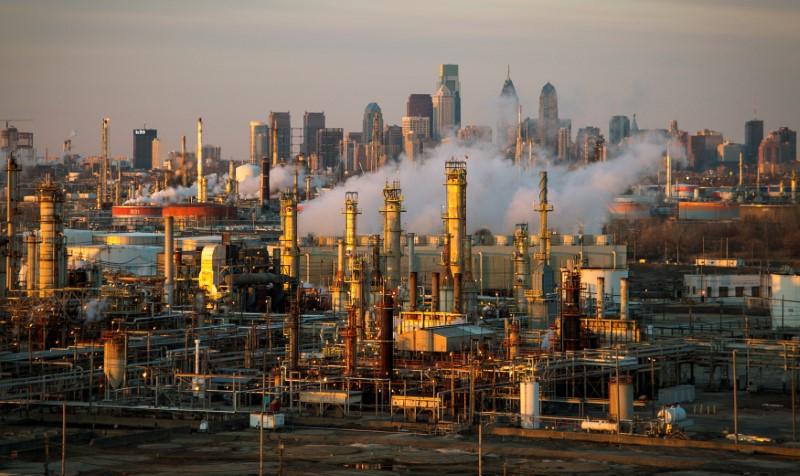
Just one East Coast refinery regularly processes the heavy oil that accounts for most Western Canadian production, traders said. Recent rail shipments of heavy crudes have gone to PBF Energy Inc’s 190,000-bpd Delaware City refinery, and light crude to Philadelphia Energy Solutions Inc’s 335,000-bpd complex, sources said.
Phillips 66 took in Canadian heavy crude to its 258,000-bpd New Jersey refinery in April for the first time in a year and a half, and also imported in May and June, the last months for which data is available. PBF, Phillips 66 and PES declined to comment on commercial operations.
Rail volumes from Canada to Gulf Coast refineries are larger than those to the East Coast, but their growth rate is slower. Those volumes averaged 81,000 bpd in the 12 months to July, up 26 percent from the previous 12-month period, EIA data showed. []
“There’s existing shippers who have increased their volumes to the east,” said Iqbal Gill, head of hydrocarbon supply for BarrelTex. “Gulf Coast shipments have increased as well but not to the degree Eastward movements have.”
Canada’s overall crude exports by rail hit a new record at 206,624 bpd in July. This is expected to keep rising, yet shipments may be hindered by competition from other commodities like grains and a shortage of rail cars.
Regulators are fast-tracking the phase-out of older, more puncture-prone cars, while top U.S. railroad BSNF is limiting the use of retrofitted cars on its lines, citing safety concerns.
Those changes together affect roughly 17 percent of the current fleet of crude rail cars in North America, said Matt Murphy, an energy analyst with Tudor, Pickering, Holt & Co.
This will limit volumes of Canadian crude to East Coast refineries, say traders.
“Every refinery out there that has access to rail is looking for more unit trains but they’re nowhere to be found,” said one East Coast refinery trader, who declined to be named, citing company policy.