A great many people have become upset because Elon Musk has become a trillionaire, so upset that they have started to, in significant numbers, show appreciation for communists. In this highly divided world that seems almost natural; an achievement on one side drives a reaction of similar amplitude in the other. .
We can’t do much about those two mindsets; dynamite or even a pick axe won’t dislodge such thinking because it is bound to people’s sense of self. Not everyone likes jazz, or success. But because much of the public debate seems to be centred on ‘whether it is good for someone to have so much money’, let’s view it from another direction: Where exactly did that money come from, and what are people getting from it?
A way to frame this event in a sensible way begins with an analysis of, as you would imagine, sardines.
Between 1997 and 2001, an experimentwas conducted throughout the Indian state of Kerala’s fishing industry to determine the impact of introducing modern communications technology.
The industry was, until that point, not exactly on the cutting edge of supply chain sophistication, to put it mildly. Subsistence fishermen in impoverished nations are neither gamers nor influencers. But nevertheless, fishing is important to the residents of Kerala; at the time of the study over 70 percent of adults ate fish at least once a day, and a million people were employed in the industry. The catch was largely done by a vast fleet of small fishing boats that had limited geographical flexibility; once the crew (of one) had the day’s catch, they had no way of knowing where the best market might be that day. So they simply returned to their home base or one nearby and sold the day’s catch there. With little refrigeration or ability to transport fish from community to community, that was how it went, and it was not very efficient. But no one really knew how inefficient. Some fishermen returned with a full catch and were forced to unload it for next to nothing if there was an abundance that day, while others might have hit the jackpot not too far away if demand was high and that day’s deliveries were small. The market wasn’t just price inefficient, it was highly wasteful, because in surplus markets without adequate storage the fish got even more gross (these are sardines we are talking about) within hours and had to be discarded.
The experiment was to equip the fishermen with cell phones, and the result were quite dramatic. Fishermen could then find out what the other participants did that day, which ports were in abundance and which were short, and adjust deliveries somewhat accordingly. They probably made TikToks about it as well, once they got proficient and hip, but the study did not cover that.
The results were impressive (not TikToks, fish-market efficiency). Prices stabilized across communities, an important signal that the right quantities of little smellies were being delivered in the right quantities for each location. Fishermen’s profits increased by an average of 8 percent while consumer prices declined by 4 percent. Waste went from 5-8 percent of daily catches to nothing.
The success of this relatively simple new communications strategy begs the question, with respect to beginning to understand Musk’s wealth: If cell phones can bring that much benefit to one industry in one Indian region, what impact does Starlink have when the whole world can benefit?
There’s a thing about new groundbreaking innovations – no one can even imagine all the benefits that will blossom forth. Here are a couple that are catalogued on the Starlink website.
Fighting wildfires is a chaotic exercise because the fires are, surprise, dangerous to be around, they can move erratically, and communications can be challenging or impossible in areas with no cell coverage. In the Santa Monica Mountains, a community brigade adopted the technology which resulted in a step-change ability to fight fires. The technology led to zero communications downtime in critical incidents, real-time situational awareness of new developments and greatly improved personal safety.
Or how about this one. Starlink provides internet connectivity to remote/rural areas around the world so that students and teachers can stream, upload and download all that the web has to offer, rather than entire classes huddled around a machine or two operating on expensive and unreliable bandwidth.
What is the value of that, to humanity? How many bright young rural minds are unlocked in ways they might not otherwise have been?
Musk has attained such stratospheric wealth in steps, with the biggest dollar value accruing from Tesla, then Starlink, and now SpaceX. SpaceX’s IPO drove Musk into the trillionaire club, bringing in that last few hundred billion in surprising short order.
SpaceX has many uses and investors expect those uses to make a lot of money. By being useful. That quality is kind of important. The market does not value that which is not useful. One of those uses is a potential linkage between SpaceX and Starlink – SpaceX may use the Starlink satellite network to connect mobile devices. To my techno-inferior brain, I can’t envision wild benefits coming out of this – but many others with better imaginations, certainly can. They envision that SpaceX and Starlink could upend the entire telecom industry with one new global architecture. And thus SpaceX is valued highly. And thus Musk happened to gain a lot of wealth from that valuation. And the weaker minds on the economic spectrum simply cannot process this.
On X is a fairly prominent communist economist named Gary Stevenson who is apparently about to be an economic advisor to Andy Burnham, the gent most likely to succeed Keir Starmer, and so England is as screwed as you can possibly imagine. But anyway, this chap runs a series of economic ‘explanatory’ videos, including one devoted to Musk’s wealth. (“Today we are going to explain everything you need to know about the world’s first trillionaire….” ). His thinking capacity is astonishingly weak; he calculates what 5 percent of a trillion dollars is, quite a lot, then breaks that down to how much he would make every second (“that’s about 1,600 dollars every second”) and then explains to his audience that this is passive income, that it will just flow to him every second.
That level of economic stupidity is just cruel to watch, like a dog trying to open a jar of pickles. Musk’s trillion dollar net worth is almost entirely tied up in stock that does not pay dividends. Musk reached that trillionaire level primarily because the value of stock he holds soared, which is not even real money, because in order for him to have a trillion real dollars he would have to sell all of his stocks to hold that money, which would be a precursor to him earning a level of passive income on it, and there is no guarantee at all that Musk would find a market for all his shares, regardless of what the closing price of the stock was. (Should Andy Burnham become the new British Prime Minister, and should he hire this broken shell of an intellect to advise him on things economic, Old Blighty will be a soldering rubble within a few years.)
Stevenson then goes on to ruminate that Musk’s trillionaire status is something that he has been predicting, because wealthy people are seeing their rate of wealth increasing at a faster rate than global GDP. Musk and the other wealthy of the world are on a path to own everything because of this higher growth rate, or, as Stevenson puts it, “That includes the gobbling up of your wealth.”
There are no words. But we must try, because there is a lot at stake. Every single person gets a vote, and the average voter can be swayed by inane statements like this because they sound convincing when coming from a pedigreed ‘expert’.
There is no fixed global pot of money that can be ‘gobbled up’ by anyone. Wealth is created. The cell phones that aided Indian fishermen created wealth – by cutting waste, by helping ensure that each community had an appropriate amount of supply. The success went much further than reducing waste; it eliminated a lot of human suffering by ensuring food was there when needed, at a lower price than before. Cell phone technology created a net human benefit, scattered amongst many, that simply didn’t exist beforehand.
Starlink does something similar, but on an incomprehensibly larger scale. The ability to have a contact and information link in remote places changes what is possible in every one of those places. A prospector working far, far out of cell phone range can analyze, upload, download information in real time that could revolutionize mineral exploration programs. As noted earlier, the Starlink program has many examples.
And then SpaceX is in one sense being built to springboard off of Starlink’s capabilities and help progress space exploration by making it easier, cheaper, faster. This is a critical point: We can’t even understand what Starlink’s benefits are to humanity, the use cases are still unfolding and new ones will appear as people come up with new ideas.
The same goes for SpaceX – what is the economic – or other – potential of making space travel and development more accessible? Who can even guess?
Investors are trying to guess, by putting a value on SpaceX’s shares, which puts a value on Musk’s ownership, which turns into a “He’s worth HOW much?” series of diatribes that represent incoherent thinking and nothing more.
Stevenson’s view of wealth isn’t a matter of philosophical difference, of a simple variety of viewpoints, all equally valid. His view is built on a refusal to see or comprehend the additive benefits of the actions of entrepreneurs and creators. His view encompasses some sort of dislike so intense that it blinds him to any of the positives. This isn’t an uncommon phenomenon. We see it every day, or maybe every hour, with Trump. In his second term, President Trump has done a lot of stuff. But for people that loathe him with their entire life force, nothing he does can be good, because of the source. It was the same here in Canada with Trudeau. Utter loathing of a person, or system, is unhealthy, because it becomes binary – anything associated with [insert name of enemy] is bad by connotation or association.
That is why haters of wealth accumulation can see it no other way, they cannot see the good, they cannot recognize the benefits even when mathematically irrefutable.
In Musk’s world, Stevenson refuses to even consider the existence of any global benefits from Musk’s enterprise. The introduction of cell phones added incredible value to India’s fishing industry – food went to where it was needed, pricing was better, food was no longer thrown out because deliveries were brought to an oversupplied market. It was a win win win win win, for everyone, for the citizens, for the government, for the fishermen, for the environment (less fish wasted)…just a glorious boost to efficiency.
We’ve seen this sort of weak thinking before in the energy wars: a complete and utter refusal to see the benefits that are created by either entrepreneurship or energy. In the energy world, the efforts of hydrocarbon workers keep everyone alive, provide us food, shelter, clothing, and everything else including the jet travel the biggest critics enjoy oh so much. But critics refused to talk about the benefits, only the drawbacks. It was epically irrational, and yet there it was, everywhere.
Now we are seeing the same phenomena with respect to wealth creation. This sentiment has always been present to some extent; a certain element of bitter humanity has always reacted negatively to wealth creation. They always will.
They also always fail when asked this very simple question: Suppose all the wealth was confiscated above some certain level, and redistributed to every citizen on earth so that everyone was worth exactly the same amount. A year out from such a redistribution, does anyone think everyone would have exactly the same level of wealth? There is zero chance of that. Some people would gamble it, some would travel, some would invest, some would start businesses, some would start smoking. Luxury car sales would skyrocket, and yet some people would choose basic transportation so as to have more to sink into their business or whatever. Wealth inequality is inevitable.
A trillion dollar wealth is the market’s valuation of enterprises that are expected to generate vast new wealth. The key word is ‘generate’. Not ‘take’. Not ‘tax’. Generate.
The question “How much is enough?” Usually makes an appearance about now. It is a flawed question reflecting the same flawed thinking. If you can build something, and you want to, and it has the potential be beneficial to someone (i.e.,, has value in a marketplace) then why on earth not do it?
If someone is good at making money, and thereby rich, is it somehow better if their fortune was distributed to say fifty people so that they could live comfortably than if they took that money and built a business that employed fifty people indefinitely? That business is creating something the market needs and will pay for; that business will pay taxes on income as long as it is around; that business will incur capital expenditures and acquire services that support who knows how many other businesses, and fifty people will be employed.
And that is somehow bad? If the business succeeds and the owners make more money?
The question “How much is enough?” Is simply irrelevant. No scratch that, it is worse than irrelevant, it is an abomination. Humanity would hardly have progressed if people did not create more than they need, and don’t forget that no business is guaranteed to succeed. Invested capital is risked capital.
Furthermore, no one knows what they will create, how much value it will create, or anything. It is a guess. It is an estimation that other people will find value.
It is frightening for some, when new technology or developments are unleashed. No one knows where it will go. In a world dominated by horse travel, autos provided opportunity but also upset the existing order. That rattles people, who sometimes lash out at creators.
And now in this hyper-polarized environment, it all comes together – politics and wealth, or politics vs. wealth. Musk was a totally acceptable rich green god when all he did was make EVs; once he supported Trump he became evil personified.
Leave politics out of it. You love or hate certain politicians based on what they add or subtract from your life. That is why politics are so tiresome to discuss. “I hate x. They cut y which I deeply care about.” If I had a nickel for every time I heard that I’d be trillionaire #2. Sorry, but in the big scheme of things, those nuances that enrage people are not consequential when trying to run nations or provinces. Millions of people have woes that won’t be met by governments. Take it out on them at the ballot box.
If you think trashing rich people and taxing them towards ‘equality’ are going to solve anything, good luck, and enjoy the consequences. Just remember to proudly declare, when capital flees and no one will invest, “I did that.”
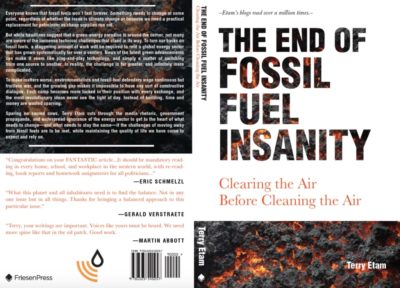
At the peak of the energy wars, The End of Fossil Fuel Insanity challenged the narrative of imminent fossil fuel demise, facing into the storm. And now everyone is coming around to this realization as well. Read the energy story for those that don’t live in the energy world, but want to find out. And laugh. Available at Amazon.ca, Indigo.ca, or Amazon.com.
Email Terry here. (His personal energy site, Public Energy Number One, is on hiatus until there are more hours in the day.)