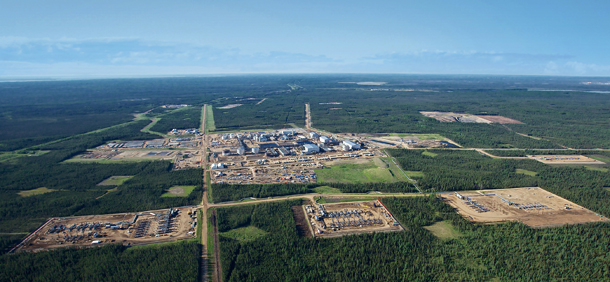
 After years of debating how quickly to reduce its dependence on fossil fuels, Canada is now looking for ways to produce and export more of them.
The shift is being driven by two geopolitical shocks, both courtesy of US President Donald Trump. First, there’s the tariff war kicked off at the beginning of Trump’s second term, which exposed the risks of overreliance on any one trading partner. Then there’s the US war with Iran, which reminded energy importers of the dangers of depending too heavily on any one region – particularly a volatile one.
Together, they are pushing Ottawa to embrace a new role as a major energy supplier, one it has long seemed reluctant to play despite its vast natural resources.
As Canada looks to expand its trading alliances, it is learning a lesson from an unlikely source: Saudi Arabia.
PIPELINE DREAM
Saudi Arabia discovered the value of planning ahead, some four decades ago.
Following the Iran-Iraq war in the 1980s, the Saudis built the 1,200-km (746-mile) East-West pipeline linking the country’s eastern oil fields to the Red Sea port of Yanbu. The project was designed to keep crude exports flowing even if shipping through the Strait of Hormuz – the Gulf’s most vulnerable chokepoint – were disrupted.
For years, the pipeline appeared to be an expensive insurance policy against a threat that would never materialize. But like all good insurance policies, it proved its value when disaster struck.
When Iran effectively closed Hormuz shortly after the US and Israel kicked off their offensive on February 28, many Gulf energy producers were hobbled. But Saudi Arabia was able to reroute a large share of its exports through the Red Sea, helping prevent a far more severe global energy shock.
Canada has clearly taken note.
Prime Minister Mark Carney announced earlier this month that Canada will fast-track approvals for its own alternative export route: the Pacific Link pipeline, a 1-million-barrel-per-day export line connecting Alberta’s oil hub to the west coast.
The pipeline would broadly follow the route of the existing 890,000-bpd Trans Mountain system, which already provides access to Asian markets and the US West Coast, doubling Canada’s west-coast export capacity.
Previous pipeline proposals ran into fierce opposition from environmental and Indigenous groups, leading to delays and cancellations. But Ottawa is determined to push ahead this time and expects construction to begin next September, Energy Minister Tim Hodgson told ROI.
The government estimates the project will cost between C$35.2 billion ($25.1 billion) and C$43.7 billion, with taxpayers expected to shoulder most of the bill.
“Security isn’t a productive use of resources, but unfortunately that’s what’s now required,” said Rory Johnston, founder of Toronto-based consultancy Commodity Context.
In other words, Canada needs its own insurance policy.
A SINGLE CUSTOMER
Unlike Saudi Arabia, Canada’s vulnerability is not a maritime chokepoint but its dependence on a single buyer.
Canada is the world’s fourth-largest oil producer, pumping more than 6 million bpd in 2025, largely from Alberta’s oil sands. Most of those barrels are processed by US Midwest refineries configured to run heavy Canadian crude.
As a result, the US has essentially become Canada’s sole customer, accounting for roughly 90% of its oil exports.
For decades, this arrangement worked well. Canadian producers gained access to an enormous market, while US refiners benefited from stable, discounted supplies.
But the deterioration in US-Canadian relations over the past two years has served as a wake-up call for Ottawa.
In August, Washington imposed 50% tariffs on $20 billion in Canadian imports after trade negotiations collapsed, sparking Canadian retaliation, though Trump said on Sunday that a deal between the countries was close.
Although energy has escaped the harshest tariff measures, Canada’s heavy reliance on its richer neighbour hangs over every trade negotiation.
So, just as Europe reassessed its reliance on Russian gas after Moscow’s 2022 invasion of Ukraine, Canada is now reevaluating the risks of sending nearly all of its oil exports to one country, even a close ally.
“We don’t intend to trade less with the United States, we just intend to trade a lot more with other people,” Hodgson said.
DIVERSIFICATION OF SUPPLIES
The Iran war has made that ambition easier to pursue.
The abrupt disruption of oil and gas flows through Hormuz this year has highlighted major importers’ energy-security vulnerabilities, particularly in Asia. This, in turn, has encouraged importers to seek a wider set of producers, diversifying away from the Middle East.
Canada fits the bill.
It has vast reserves, a stable regulatory system and – perhaps most importantly – direct access to the Pacific Ocean. Oil and liquefied natural gas (LNG) cargoes leaving Canada’s west coast can reach major Asian consumers, such as China and Japan, in roughly two weeks, considerably faster than shipments from the East Coast.
Canadian energy exporters are also better positioned to tap overseas markets after the Trans Mountain expansion opened in 2024 and the Shell-led LNG Canada facility on the Pacific coast began operating last year.
Ottawa is also seeking to spur growth through a range of tax and regulatory measures, as well as additional pipeline projects.
According to Hodgson, Canada’s oil production could rise by 2 million to 2.5 million bpd over the next five to seven years, while LNG exports could reach 50 million metric tons per annum by 2030, from around 14 million tons per annum today.
HEAVY CONCERNS
That may be ambitious. Commodity Context’s Johnston forecasts that oil production will grow by a more modest 100,000 to 150,000 bpd annually over the next decade, given oil companies’ reluctance to invest heavily in new capacity when the outlook for oil prices remains highly uncertain.
Canadian oil also faces cost challenges. Around three-quarters of Canada’s crude is bitumen-like heavy oil that must be diluted before being transported and processed in refineries. Such lower-quality grades typically command a lower price than lighter oil.
Yet these concerns only underscore the risk Canada is taking if it does not diversify its customer base now, when appetite for producers outside the Middle East is high.
As Saudi Arabia’s East-West pipeline demonstrated, in a geopolitically fractious world, export routes can become as strategically important as the oil fields they serve.
(The opinions expressed here are those of Ron Bousso, a columnist for Reuters.)
Enjoying this column? Check out Reuters Open Interest (ROI), your essential new source for global financial commentary. Follow ROI on LinkedIn, and X.
And listen to the Morning Bid daily podcast on Apple, Spotify, or the Reuters app. Subscribe to hear Reuters journalists discuss the biggest news in markets and finance seven days a week.
(Ron Bousso; Editing by Marguerita Choy)