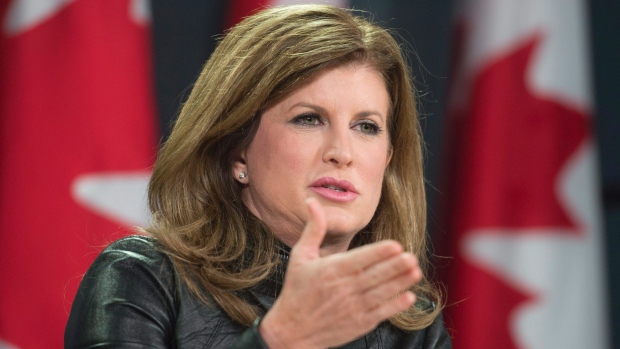
OTTAWA – The controversial Energy East pipeline has now been endorsed by a provincial premier from each of Canada’s three main political parties, interim Conservative leader Rona Ambrose said Wednesday in the House of Commons.
She was, of course, trying to score political points by depicting Justin Trudeau’s federal Liberal government as dragging its heels on TransCanada’s proposed $15.7-billion west-to-east energy project.
But the comment illustrates a much broader point, one echoed earlier this week at an energy conference in Ottawa: it’s time Canada’s environmental and energy proponents stopped talking past one another.
That theme was driven home by Michael Cleland, a former senior bureaucrat and energy industry leader who gave the keynote address Tuesday at an annual forum studying Canada’s energy landscape.
“Almost 30 years after the emergence of the climate debate, the public discussions on energy and climate continue as if they were being conducted on different planets,” Cleland told a room full of energy industry executives and diplomats.
His comments came as Trudeau was travelling west for two days of talks in Edmonton and Calgary with NDP Premier Rachel Notley and others to discuss Alberta’s foundering oilpatch.
And while much of the immediate political fracas is centred on pipelines, their approval process and market access for landlocked oil and gas in a sector devastated by $30-per-barrel oil, there are much bigger, longer-term forces at play.
Cleland, who parlayed senior positions with Finance and Natural Resources Canada into leading roles with the Canadian Electricity Association and the Canadian Gas Association, is now a senior fellow at the University of Ottawa. He says “real transformative change in energy is rather rare” and hasn’t happened in living memory — dating back to the widespread electrification of society and the development of the internal combustion engine.
Nonetheless, Cleland says the world appears to be on the cusp of another transformation.
While Canada’s carbon-intensive energy commodities are sure to be needed for the foreseeable future, he said, the long-term trend is in “one direction.”
As Cleland noted, the International Energy Agency’s base case forecast sees emissions of greenhouse gases climbing 16 per cent from 2013 to 2040. Yet in December in Paris, the same governments who are members of the IEA “cheerfully adopted” a goal to hold global warming to 1.5 degrees Celsius by 2050, requiring a drastic reduction in global emissions.
Cleland called it “refreshing” to see provincial, territorial and federal environment ministers “connect some of the dots” last week after meeting in Ottawa, when they frankly acknowledged that Canada is not on track to meet its 2020 or 2030 emissions targets.
“What the environment ministers did not say was that to meet any of the 2030 national targets being bruited about implies a change in trajectory which is probably impossible under any circumstances,” he said.
“Are we willing to tell consumers that their energy costs need to go up by 50 to 100 per cent or more — pretty much starting tomorrow — in order to meet our 2030 greenhouse gas commitments?”
Those are the hard realities that governments of all stripes, industry, environmentalists and citizens at large need to digest and discuss.
“Reconciling our energy and climate aspirations will involve the biggest change in our energy systems in over 100 years.”
But as Cleland put it, restoring public confidence in institutions, maintaining investor confidence in Canadian resources, reducing GHGs and moving on leading technologies are mutually compatible goals, “if we’re realistic about it.”
— Follow @BCheadle on Twitter