Each week, XI Technologies scans their unique combination of enhanced industry data to provide trends and insights that have value for professionals doing business in the WCSB. If you’d like to receive our Wednesday Word to the Wise in your inbox, subscribe here.
To manage drilling risk and reduce non‐productive time (NPT), you need to be aware of past problems. A major
circulation loss on a single well can negate the efficiency gains of an entire drill program, and cost your company
hundreds of thousands of dollars. But as in many situations, you don’t know what you don’t know until it’s too late. Researching historical incidents is the best way to avoid future risk, but how do you know you’ve got the right intel on which to base your decisions?
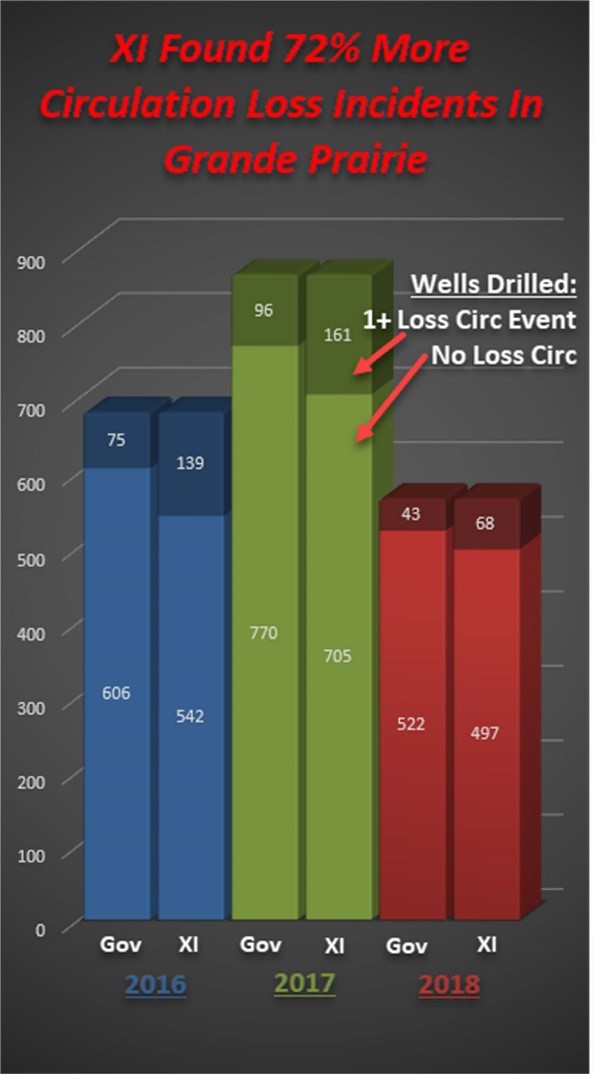 AER’s mandate to collect and disseminate well incident information is certainly an important source that is vital to problem avoidance when planning future drill programs. But, without specific standards defining what is a ‘reportable incident’, a level of subjectivity is applied in the data submission process after a well is drilled. This naturally results in a gap between the public record of circulation losses and the number of incidents that have actually happened.
Thankfully, there is another source to help supplement your knowledge. By employing XI’s Drill Database and specialized data mining techniques, you can close the information gap and raise awareness about areas/formations that are prone to losses. With this added knowledge, XI clients are able to:
- reduce their probability of encountering future incidents.
- better plan and prepare for potential problems.
- enhance the reliability/consistency of their drill program.
- approach innovation and optimization with less risk.
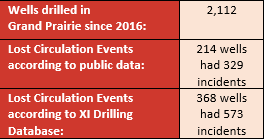
Example: How many Grand Prairie wells experienced circulation losses?
We ran a quick comparison on recent Grande Prairie drilling over the last three years.
Want to see ALL the known problems in your drilling area and a whole lot more? Contact XI, call 403-296-0964, or request a demo of OffsetAnalyst.