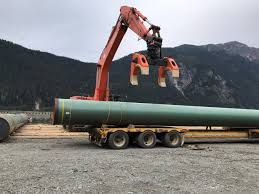
 An indigenous group that opposes construction of the Coastal GasLink pipeline in British Columbia will refuse workers access to their land, but in peaceful fashion, according to one of its chiefs.
The statement comes after Royal Canadian Mounted Police (RCMP) established a checkpoint on Monday for access to a remote, forested area along Coastal GasLink’s route, aiming to avoid a repeat of protests a year ago that resulted in arrests.
Police last week launched a criminal investigation after finding trees partly cut and ready to fall, and stacks of tires containing jugs of accelerant along with fuel-soaked rags.
The C$6.6 billion ($5.1 billion) pipeline, to be operated by TC Energy Corp , would transport gas from near Dawson Creek in northeast B.C. to Kitimat on Canada’s Pacific coast and supply the country’s largest liquefied natural gas export terminal, called LNG Canada, which is under construction.
Coastal has the support of all First Nations along the route, but hereditary chiefs of Wet’suwet’en Nation, through which 28% of the 670-kilometre (420-mile) route passes, oppose it.
The chiefs’ opposition highlights the difficulties of advancing resource projects in Canada, where by law governments must meaningfully consult and accommodate indigenous groups.
Chief Na’moks of Wet’suwet’en’s Beaver Clan said the chiefs will never support Coastal on their land, which was not ceded under treaty.
“We’ll maintain our stance of absolute opposition as well as remaining peaceful,” Na’moks said in an interview. “We’re not letting them have access.”
The route runs near rivers that provide salmon for Wet’suwet’en and through pristine forest, Na’moks said.
RCMP said it would allow chiefs, government officials, journalists and critical supplies to pass the checkpoint. Wet’suwet’en chiefs have said several of their people were denied passage, which RCMP said was the result of miscommunication.
Last month, private equity firm KKR & Co Inc and Alberta Investment Management Corp (AIMco) agreed to jointly buy a 65% stake in Coastal GasLink.
AIMco spokesman Denes Nemeth said the corporation has confidence in TC Energy’s ability to deal with opposition, and KKR declined to comment.
Construction continues on the pipeline, but not at a site where the chiefs say ancient stone tools were unearthed last year, Coastal said. The company has requested meetings with the chiefs, who have denied them.
Their opposition caused the United Nations Committee on the Elimination of Racial Discrimination last month to call for construction to stop on Coastal and two other western Canadian resource projects until they garner greater indigenous support.
Committee Chairperson Noureddine Amir said he was unaware that Coastal had broad indigenous backing.
“I did not know that most First Nations agree on that. This is something new that comes to my understanding,” Amir said in a phone interview from Algiers. Asked why the committee did not gather more information, Amir said its role does not include investigations.
A court injunction allows police to prevent disruptions to construction, but any arrests could backfire, said Dwight Newman, a law professor at University of Saskatchewan.
“Arresting some people doesn’t necessarily mean that other people go away. It may actually create more resistance,” he said.