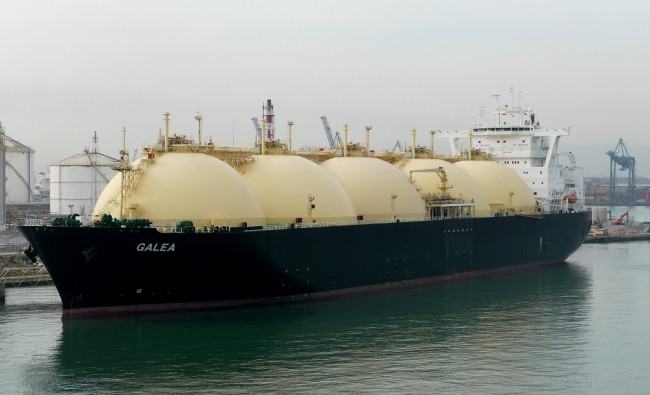
 The world’s imports of liquefied natural gas are set to jump to the highest in a year in January as Europe’s winter demand draws cargoes away from top-consuming region Asia.
A total of 38.12 million metric tons of the super-chilled fuel is on track to be imported in January, up from 37.69 million in December and the most since January 2024’s 38.73 million, according to data compiled by commodity analysts Kpler.
The January volume is also the third-highest on record, underscoring the strong growth in LNG imports as new supply comes online and as Europe seeks to replace pipeline natural gas from Russia.
Europe’s imports are expected by Kpler to rise to 11.82 million tons in January, up from 10.87 million in December and the highest since April 2023.
The January volume for Europe is also on track to be the fourth-highest monthly total, eclipsed only by three months in 2022 and 2023 when the continent was scrabbling for gas after the shutdown of pipeline supplies from Russia in the wake of Moscow’s invasion of Ukraine in February 2022.
It’s also worth noting that while Europe’s LNG imports are likely to rise 8.7% in January from the month before, arrivals from Russia are expected to drop to 1.60 million tons, down 11.6% from December’s 1.81 million.
The outlook for Europe’s LNG imports from Russia is increasingly uncertain, especially with the return of Donald Trump as U.S. president.
Trump is unabashedly in favour of boosting U.S. energy exports, and LNG shipments to Europe offer one of the best opportunities to do so.
If European countries agreed to phase out imports from Russia in favour of U.S. cargoes it would help meet several objectives.
These include putting further pressure on Russian President Vladimir Putin to end the war in Ukraine, as well as giving Trump a “win” that may help ease the threat of new tariffs on Europe’s exports to the United States.
The United States is already the world’s largest exporter of LNG, and the commissioning of new plants in 2025 will cement that position.
But the global LNG market may move into surplus by the end of this year, making it in the interests of both Trump and U.S. LNG exporters to try and limit markets for Russian exports.
Europe’s imports of U.S. LNG are expected to rise to a record high of 6.70 million tons in January, up from 5.20 million in December and 11.7% above the previous peak of 6.0 million in January last year.
SOFT ASIA
In contrast, Asia’s imports of U.S. LNG are expected to drop to 1.81 million tons in January, down from 2.2 million in December and the lowest since February 2024, according to Kpler.
Asia’s total LNG imports are also set for a decline in January, dropping to 24.48 million tons from a 10-month high of 25.50 million in December.
The decline is largely due to a milder-than-usual winter, which has trimmed demand in China, Japan and South Korea, the world’s top three importers.
Relatively high spot prices have also cut demand, especially in China, with January arrivals slated to come in at 6.29 million tons, down from December’s 7.58 million and almost 20% below the 7.83 million of January 2024.
The spot price for LNG for delivery to North Asia ended last week at $14.00 per million British thermal units (mmBtu), up slightly from the $13.90 in the prior week.
The price peaked last year at $15.10 in the week to Nov. 29, a period when January-arriving cargoes would have been secured.
European natural gas prices have also remained elevated, with the TTF benchmark ending at 47.90 euros per megawatt hour, which is equivalent to $14.73 mmBtu.
This is a high enough price to draw U.S. LNG to Europe and away from Asia, especially when the shorter shipping times and costs are factored in.
With Europe needing to replenish natural gas inventories and move away from Russian LNG, it’s likely that it will have prices higher than those in Asia.
This in turn may limit the usual seasonal decline in Asian spot prices in the shoulder season between the winter and summer demand peaks.
The views expressed here are those of the author, a columnist for Reuters.
(Editing by Kate Mayberry)