This summer, I did something I haven’t done in a while – drove across Canada. Or most of it anyway, from the NS Atlantic to Calgary. It is a formidable journey, of limited variability. I saw countless millions of trees. I saw at least 31 dead raccoons, possibly many more, but in the spirit of statistical integrity only identifiable carcasses were counted, and only if identifiable from behind the wheel. I saw scant benefit in putting in more effort.
In a similar vein, the trees of northern Ontario are not what I would call majestic forest, much is more like sullen swamp spruce. For vast stretches, the trees are generally spindly and malnourished-looking; they reluctantly grow because they have nothing else to do but don’t look happy about it. Long stretches of terrain have the similar swampy look, save for the occasional hair-raising gash where a semi-driver appears to have fallen asleep and plowed into the sodden landscape.
Based on these observations (and let me tell you there isn’t much else to look at), Canada’s national symbol should be one (or some combination) of: trees, Tim Hortons, dead raccoons. These are the common denominators, across this great big land.
It’s not that it is all disinteresting. Somewhere deep in Ontario, on a typically desolate stretch of road, in the midst of nothingness, appears a sign for a roadside eatery – Crazy Nic’s Kitchen. The design depicts a painting of a gray-haired man in a gold T-shirt holding a burger in one hand and some sort of beverage in the other. The ‘kitchen’ appears to be some sort of hut in the trees. There are two possibilities here: one is that the food would be magnificent, or the other is that Nic truly is crazy, and there’s a reason he chose to set up shop in the midst of bears and black flies and zero humanity. I decide not to investigate.
Don’t let my synopsis discourage you. It is a great experience to drive this path, particularly the quicker northerly route through Kapuskasing, in a uniquely challenging way. It is the best way to get a true sense of the size of the country, and the significance of regional disparities. Particularly Ontario. The province cleaves Canada in two, and it is a formidable division. While the raccoon corpse count dwindles to zero in this vast stretch – it is moose country primarily (those encounters are sizeable crimson patches on the highway (if you’re squeamish, it’s not the place for you)) – it is pure Canadiana and yet at the same time an apt metaphor for the divide between the west’s particular suite of assets, and the east’s.
The size of northern Ontario, about 2,000 km by road from Ottawa to Kenora, is a formidable barrier to anything. The physical and the metaphysical. It would be immensely challenging to build anything across it (TC Energy’s periodic compressor station signs are the only sign of life for long stretches, a welcome proof of possibility), and the endless space between Ontario’s borders sort of symbolizes the difference in world views between western and eastern Canada. TC’s gas pipeline shows it is possible to build something across the ‘gap’, but at the same time, given how different today’s socioeconomic climate is compared to when that was built, the challenge of building any “nation-building” cross-country infrastructure becomes readily apparent.
Prior to driving home, I got to spend time with experts from other industries and occupations, ones I know virtually nothing about. Mining, forestry, fisheries, general maritime thinking…it was a valuable summer to get reacquainted with the fact that it is good to step outside the bubble and get a different perspective of Canada, the other pockets. It is often different than what we think we know from news, current events, or prevailing attitudes. As one example, Canada is having challenging trade discussions with the US and one of the sticking points is dairy subsidies. We all know how material they are, how they are very grating to the US, and it is easy to say just get rid of them. But then I drove through eastern Quebec on the southern shores of the St. Lawrence Seaway. A significant stretch is nothing but dairy farms and related cheese signs, such as “Fromagerie Le Detour” and similar. Dozens and dozens of dairy farms are the backbone of this industry, and apparently the regional economy, and that is clearly evident. So is Quebec willing to let go of this part of their culture and their economy? Cheese is important to a lot of people, particularly of the European mindset. I’m not sure why but it just is. So this is not a simple trade off for Quebeckers, it is critically important to them, regardless of anyone else’s opinion. So now what do we do? A cross country pipeline, or energy corridor, that goes through Quebec will need their support. I don’t like the subsidized industry, but at least now I can kind of understand it. The province simply doesn’t want to risk the decimation of that significant component of their cultural identity, and they won’t abandon it. That’s just the way it is.
On the flip side, during the summer I spent time with people from eastern Canada who would ask about the energy industry. They were “the hope”, in a sense, because they were truly curious about it. Most aren’t. Generally, people are not familiar with the most elemental of energy topics. I drew graphs in the sand to demonstrate power supply and demand, and the challenge that renewables bring. I walked another person through the characteristics of oil pricing, as he had some innocent misunderstandings about how it all worked based on quotes he saw on BNN. I never did get it all clear in his head after 10 minutes of trying, which probably just means that I’m a bad teacher, but it also points out the fact that each industry’s complexity and nuances are really hard to get across to outsiders. This is probably true for any industry but it is particularly relevant for energy. As we have seen these past few years, that knowledge vacuum amongst voters was abused by evangelicals that persuaded many that hydrocarbons could and would be soon irrelevant. Sadly, that has been the national energy discussion and tragedy over the past decade. A further sobering thought is that those asking the questions are the interested people, of which there are not many, and the concepts were among the most basic in energy supply/demand/pricing, and the answers were still bamboozling. The rest of the population is not engaged; a mass body easily swayed by something that seems to make sense and resonate and offers simplicity what appears to be a better solution. It is fiendishly hard to intercept that messaging chain to point out realities.
Any of us that are involved in public energy discussions understand that it is important for the general public to understand the industry better, because the general public is the voting public, and governments are not shy about clumsy attempts to not just regulate but define the energy industry.
We come to know our industry well, or at least our parts of it. We understand concepts and things and definitions that are critical to energy. Of the following, most energy people could define enough to get a passing grad: WTI. HH. AECO. CNQ. CFFO. WCS. H2S. POOH. Pig. Mud. GCA. Class 41. SDFN. EBITDA. Spud date. Condensate. COGPE.
The thing is, every industry or occupation has the same nested world of expertise. Truck drivers do. Medical personnel, certainly. Fishermen. Lawyers. Miners. Farmers. Bay/Wall Street capital markets people. Accountants. Academics. You name it; each has a bank of expertise that is critical to their function.
Many of these occupations, rightly so, feels that their industry is critical to human well being. They’re not wrong. They’re also not respected or recognized as widely as they probably should. You think you can live without truck drivers or parts managers or farmers or educational institutions or lawyers? You cannot. Not in the way we’re used to.
As a viewer from within the energy industry, just as with every other occupation, our chosen one feels special. Different. More critical. And while other occupations are indispensable to modern life, some have different, how to say it, wavelengths in our life.
We can live without a doctor for a day or a week or a month. We can live without a miner or an academic or a lawyer for a day or a week or a month. That doesn’t make them less critical to our functioning society; it just means their function is slightly or somewhat isolated from a day’s activities. Remove any one of these though, and at some point things grind to a halt. All things.
Some functions really are different though, in the cycle of modern life. Food, energy, shelter – each are required each and every day. Other things are critical every day as well, remember the toilet paper shortage scare and always keep that handy for supply-chain respect.
Supply chains are the arteries that deliver the food and energy and shelter we need on a daily basis. We can function for a day or two without any particular leg of the supply chain, but not much longer.
Energy is different because energy is everything. We can’t go a day without it because no one moves without it. This fact is sometimes overlooked, or downplayed, which is frustrating to those within, particularly when attacked by others from other fields that do not understand this.
So often in the energy industry we become frustrated by the lack of energy knowledge, particularly amongst voters from distant regions that have a say in how the industry is to be run though they clearly have zero knowledge of how it actually does. Sometimes we sit around in circles and tell ourselves “Education is the key,” that we just need to explain the industry better.
But they just don’t care, the general public. They can’t. They don’t have mental energy to invest to learn about all the industries that are critical to their existence, and to respect them properly.
The premier of Quebec said something fascinating a few weeks ago. He was asked what he thought about the topic of Alberta separation, and he said something along the lines that Quebec’s desire for independence was cultural, and you can’t build a culture on oil.
His comments were illuminating on several levels. The first level is that for one claiming high culture he is evidently a bit of a boor, and the second, more important point is that you may not be able to build a culture on oil, he’s right about that, but you can build one on ignorance.
At the same time, I suffer from the same fate – ignorance. That’s one reason I was pleased to have spent 5 long days driving across the country. Sometimes you only understand perspectives by seeing them.
It has been a weary decade of energy wars and few want to fight them anymore. Well, not on this side of the fence – most of of us just want to get on with the business of providing critical fuels. There are so many out there that are still committed to 2019’s rage against the energy machine. They will have to find a way to live with that angst, because the world is steaming ahead.
We have come through the past decade leaner and stronger probably and yes, have even have made significant strides in reducing emissions such as methane for example. These are good things. Power institutions are starting to find ways to balance the insane anti-hydrocarbon demands of a few years ago and seem less scared of stating the obvious out loud, in public. LNG is now a household word, which is quite the oddity considering that the phrase natural gas itself receives less attention but anyway it is all for the good to see the LNG industry develop globally, and for Canada to become a part of it.
We are an astoundingly huge nation filled with stuff that we cannot use With a small population and that the world desperately wants and needs. That is the good part, we can help them with that. We can grow all the other industries that people want of course, such as tech, AI, manufacturing, whatever, but fundamentally resources will power our economy. A drive across this vast country will show you that.
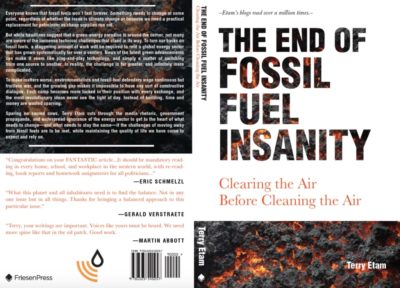
Explore the lighter side of energy, and think of it as you never have before in The End of Fossil Fuel Insanity – the energy story for those that don’t live in the energy world, but want to find out. And laugh. Available at Amazon.ca, Indigo.ca, or Amazon.com.
Email Terry here. (His personal energy site, Public Energy Number One, is on hiatus until there are more hours in the day.)