“The public, on the other hand…The public was like one of those huge Pacific jellyfish, one enormous, pulsating mass of indifference, drifting wherever the current carried it; an organism without a motive, ambition, or original sin to call its own, but which somehow believed, in whatever passed for its brain, that it chose its own leaders and had a say in its own destiny.” – Mick Herron, Real Tigers (third book of the Slough House series, best spy series ever)
Cynical? Maybe a bit. Accurate? Without a doubt. And no where more so than when it comes to energy.
While that description of the general public as a singular entity seems pretty accurate, I’d modify one of the takes – that the ‘organism’ doesn’t have a motive. It does, in a feeble kind of way – the public will do what it can to avoid discomfort, or maybe better to say a pain avoidance mechanism, that acts as a motive.
The ‘enormous, pulsating mass’ can be shocked in any number of ways without any meaningful systemic reaction – sure, pockets of rage flare up at various stimuli – but as a whole, things are stable. That is so until something either creates great universal discomfort, or it hits the pocketbook in a more or less universal way.
And that is what is happening with energy. Almost none of the great blob pay any attention to energy as long as it shows up reliably, and is affordable (I’m talking about the wealthy west here, where an indoor temperature variance of more than 5 degrees F is unacceptable and you don’t even want to translate that to degrees C as it sounds even more crazy. Most of the world’s population prizes the same qualities of reliability and affordability but have a much wider definition of what comfort means. As in, can we please stop burning dung now…etc.).
Five or seven years ago, there was a global ‘energy transition’ narrative arc, that was interesting at one point, before it took on the darker vibe of extremists and political activists. Then the gloves came off, because these people were messing with people’s energy supplies, and they wanted that existing supply system dead and gone. “Fossil fuels killing us all, and there are plentiful clean alternatives, etc.” – this became acceptable discourse in the media, and in politics, and the great public blob watched and ate popcorn. (A dwindling number still propagate this view, which is the only reason for bringing it up at all.)
And while it might seem like it from inside the energy business, the throttling extended across the land, because heavy-handed federal programs stifled any desire to invest in Canada, period. The numbers were artificially distorted by news of mega-battery plant investments, for example, investment decisions that were made because they were accompanied by large government handouts, and by governmental promises that, for example, Canadians will all be driving EVs within a dozen years, because we’re going to make them. The great public blob watched, and ate popcorn.
The resource industry, and agriculture and forestry, pointed out that things were not well, but were largely dismissed as either simple vested interests talking their book, or as populations with such small vote counts that who cares.
Then a few globally noteworthy events happened that began to dismantle the state-sponsored narratives. Russia invaded Ukraine, triggering a renewed global focus on what we’ve so long taken for granted – energy security. In 2019, that phrase – ‘energy security’ – was used about as much as the words hornswoggle or sluberdegullion (respectively, to be swindled or a sloven rascally type (if you must know, I’m actually 140 years old)).
Today, the phrase energy security underlines all the major energy-related tectonic events happening globally.
Anecdotally, I recently took a small poll of thoughtful people I know, asking them for their view of the vibe of energy, currently. I didn’t ask oil producers, because well I know what they’d say, so I asked people peripheral to the industry but linked in some way. The underlying theme was: this energy transition thing is way more difficult than anyone imagined. The kooks who said this years ago are now vindicated. (A subtheme is caution, particularly with respect to Canada; there is a lot of hesitation to do anything for fear of more wacko government policy, or possibly more likely the lack of evidence of removal of existing wacko government policy under which nothing happens.)
The chickens are coming home to roost now. A few examples: In the US, the Department of Energy, of whose upper ranks had been purged of anyone related to the hydrocarbon industry, has been attempting to reverse some of the policies that were guiding towards a rapid phase out of hydrocarbon base load power. They had to reverse them. In a recent Resource Adequacy Report, the DoE summed up the problems in a few succinct bullet points: The status quo is unsustainable. Retirements plus load growth increase risk of power outages 100 times by 2030. Planned supply falls short, reliability at risk.
Power outages can be annoyance, or they can be catastrophic, depending on where in the world of weather they appear. In the depths of a winter cold spell, a prolonged outage would be an unmitigated disaster. Same for one in an Arizona summer. These are not areas in which policy makers should be gambling, and yet they were.
That’s on the supply side, where reliable – if CO2 emitting – baseload power was forced into retirement by government mandate, and replaced with intermittent power. The media had no trouble at all equating 100 MW of wind power with 100 MW of natural gas fired power, just a simple swap! And hearing that, the great public blob voted along.
Now we know better, or at least that’s seeping into the public consciousness. And the same goes on the demand side.
Here in Canada, the maritime provinces provide a few eloquent examples. While small in population, the four provinces represent valuable seats come election time. As the first few years of Canada’s carbon tax came into effect, the effect on utility bills was negligible, and no one cared. But as the tax rate ratcheted up, all of sudden utility bills took a notable leap upward, and the outcry came one fine spring day, a month or so after the last carbon tax hike came into effect and the bills arrived. The outrage was so intense that the federal government quickly issued a carve out for fuel oil usage, which then had the rest of the country screaming. The great wall had begun to crumble.
The biggest push to knock it over is now coming to pass in Canada as we find ourselves both insanely blessed in energy resources and yet facing power shortages, in part because the government coerced/cajoled/subsidized everyone to start going ‘all electric’. In the Maritimes, one manifestation of this was…free heat pumps! For almost everyone! (The hurdle to qualify for a free heat pump is not large, in Prince Edward Island; households with a combined income of up to $129,000 qualify. Since about 70 percent of households make less than $100,000 on the island, that $129k number means well over three-quarters of households qualified.) Recall that heat pumps are wonderful little heating/cooling devices that operate basically on heat exchange, and so when it gets super hot they have to work very hard, and the same when it gets very cold.
So, use your imagination to guess what happened next. The grids were already weakened in terms of meeting peak load by the introduction of a lot of intermittent power. Then, all those heat pumps added demand at the very worst time – at peak energy consumption times. An electrical system must be able to reliably supply the peak load when it is needed most, or there is a catastrophe. With all these power-sucking heat pumps, consumers turned them up to 11 just when the system demand was highest anyway. A population relying largely on heat pumps in a cold climate creates a death spiral of demand, at exactly the worst time. Imagine going all in on electric heat…and having the power go out on the coldest night of the year.
In Prince Edward Island, the stats make this clear. Even a CBC article had to say this out loud. In a filing made with the Island Regulatory and Appeals Commission, energy utility company Maritime Electric noted that, prior to 2025, the utility had a customer load exceeding 326 MW only once, in 2023 during a tough cold snap when the temperature dropped to -23.8 C. In April of 2025, Maritime Electric said that that 326 MW peak had been exceeded six times so far in the first 3 months of 2025, at temperatures nowhere near the 2023 peak. The utility also said that, should -23.8 C temperatures return, they would not be able to supply enough power to meet demand.
Only systemic energy ignorance could create a situation like this. Few understood what was coming when the rapid-transitionists were cooing “Don’t worry, we’ve got it figured out.” Did you really. Well, now we can all see the energy world a little more clearly.
That’s why the vibe is changing. That happens when your utility tells you, “Your rates are going way up, and btw we may not have enough power when it gets really cold.” The ‘pulsating mass of indifference’ is no longer indifferent.
Then along came US President’s public musing that he’d like to annex Canada, and the vibe shift went into overdrive. Long time hydrocarbon haters who 5 years ago would likely have contributed to any cause that blocked pipelines now found themselves cheering for more to be built, as insane as that sounds. It’s true.
A friend keeps in touch with a McGill sociology professor that made his way onto national TV some 5 years ago to deliver (social) scientific proof that fossil fuel companies were derailing climate action through disinformation campaigns. (In the eyes of these individuals, the question “Would you like fuel or not?” is ‘disinformation’.) My friend has chosen to debate this prof over the years in some sort of masochistic hobby, and whatever, suit yourself. In a recent email exchange though, the prof communicated some astounding comments: “The game is over. The industry won.” Even more shocking is what he now says he teaches his students: “The extraction and processing of the materials currently used to make the batteries in electric cars is terribly toxic. Importantly, their extraction and processing is disproportionately taking place in some of the poorest countries in the world with some of the worst protections for the safety of workers. We must understand that, as wealthy countries move towards electrification of the auto fleet, we are increasingly destroying clean water sources, polluting the air, and imposing enormous health risks on some of the poorest and most powerless people in the world in order to mine the materials needed to make the batteries for our cars.”
And then it gets even wilder. While still accusing the industry of destroying the environment through disinformation campaigns, he goes on: “By the way, for the first time I am very glad we have a oil refinery on the island [Montreal, home of McGill]. Also, I think this is a fantastic time for the feds to fast track major pipelines from Alberta to the coasts. I’m talking massive investment and cut all red tape.”
I wouldn’t have believed it if I hadn’t seen it with my own eyes.
It is likely that President Trump’s musings to annex Canada have elevated the relevance of new cross-country pipelines in virtually everyone’s eyes, which kind of calls into question what drove those hard anti-hydrocarbon viewpoints in the first place. But regardless, it is great to see this change in the wind, where people are actually grateful for things like refineries.
It is a bit sad to see that the prof’s attitude is that “The industry won.” The industry didn’t win anything. “Thanks for not trying to kill us anymore” is a pretty feeble victory cry, but that’s the victory speech in a nutshell. For energy producers, for the longest time there wasn’t even an inkling that there was a war. Twenty years ago, it would have been a battle or war that no one imagined the industry would have to take – there’s no way the public would vote to dismantle the energy system that provides life as we know it, not in this lifetime. While some may choose to go back half a century to attack Exxon’s actions at the time, committing the fatal error of transporting today’s knowledge and beliefs back in time to judge actions, modern energy producers are of the correct opinion that, every day, they get up and provide the fuel the world requires for survival. The industry won? What? What the hell are you talking about? Life won. Lifestyles won. Consumers won. There’s no “victory”. Thank you for no longer trying to kill your fuel providers. Does that sound like a win?
And maybe now we can get on with pursuit of new energy technologies if and when they make sense, if and when they are scalable, if and when they provide reliability and affordability. The way it should always have been.
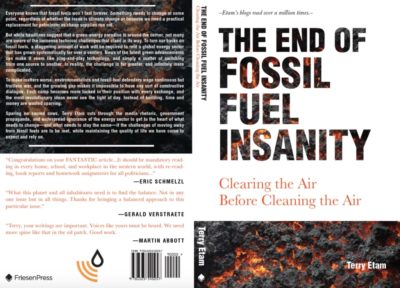
At the peak of the energy wars, The End of Fossil Fuel Insanity challenged the narrative, facing into the storm. Read the energy story for those that don’t live in the energy world, but want to find out. And laugh. Available at Amazon.ca, Indigo.ca, or Amazon.com.
Email Terry here. (His personal energy site, Public Energy Number One, is on hiatus until there are more hours in the day.)