Designing reliable on-site power generation has become a defining factor in the success of industrial projects across North America. As facilities projects outpace utility capabilities, more industrial operators are considering their own power generation solution to accelerate their project. Incorporating effective power planning is no longer a technical exercise; it is a strategic investment that directly influences uptime, revenue continuity, and long-term operational efficiency.
With natural gas supply allowing for consistent, reliable power generation, many industrial operators are turning to on-site generation solutions to improve reliability while maintaining cost control. Yet selecting the right system requires more than sizing a generator. It demands a deep understanding of CapEx versus OpEx trade-offs, future scalability needs, and the reliability standards required to keep modern facilities online.
To help facility planners make informed decisions, CANUSA EPC’s experts break down the key factors that matter most, offering clear, practical guidance to navigate the complex process of selecting the right onsite power generation strategy.
Balancing CapEx and OpEx: The First Critical Decision
Every power system selection begins with understanding the trade-off between upfront investment and long-term operating costs. There are various options for generators; reciprocating engines, turbines, fuel cells, and renewable microgrids. The first evaluation hurdle typically involves building a CapEx and OpEx model around a system capacity. CANUSA EPC has compiled various project data points to the following initial metrics that can start a financial analysis of the correct power solution for your industrial asset.
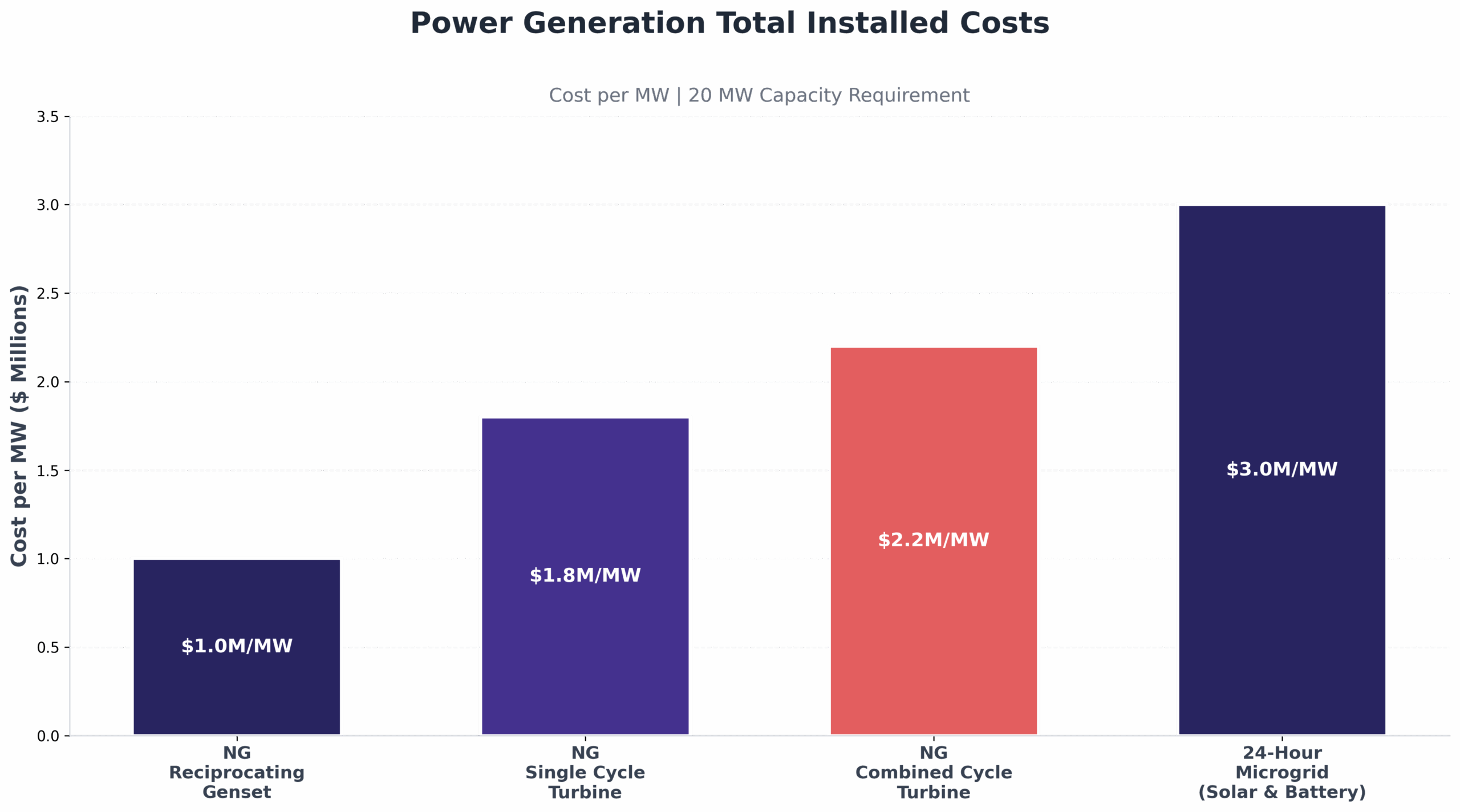
Along with these capital metrics operating costs of the generator should be considered, as they will contribute 50% of the total cost of generation. Natural gas pricing will account for 80% of the OpEx of the power asset and CANUSA EPC has generated cost comparisons of reciprocating engines compared to turbines at various gas prices to highlight the importance of gas pricing and thermal efficiency. Readers can explore full-cost modelling, including 20-MW OPEX comparisons and maintenance projections, in the downloadable whitepaper.
Reliability as An Asset
With the current interest in power generation for datacenters, reliability tiering requirements have become an important differentiator in the developer space and understanding approaches to meeting these designations is more important than ever. Not only will it allow an operator to command a higher rate base for their power, it also greatly impacts the CapEx for the development of those systems.
Industry reliability standards Tier III and Tier IV provide a framework for designing systems that minimize downtime.
| Metric | Tier III | Tier IV |
| Uptime | 99.982% | 99.995% |
| Annual Downtime | 1.6 hours | 0.4 hours |
| Concurrent Maintenance | Yes | Yes |
| Fault Tolerance | No | Yes |
Achieving these standards requires attention not only to generator selection but to system architecture. Effective design strategies include:
- N+1 redundancy to maintain operations during maintenance or equipment failure
- Microgrid configurations capable of island mode operation
- Predictive maintenance and remote monitoring to reduce unplanned outages
- Fuel supply security, including on-site natural gas or diesel storage
- Environmental hardening to withstand extreme temperatures, snow, and wind
Planning for Scalability: Designing Power Systems That Evolve with Production
Industrial sites can experience a dynamic power demand over the course of the lifecycle of the asset.
- Early development: Low demand; temporary or modular systems often suffice.
- Peak production: Highest energy intensity; reliability and redundancy become essential.
- Decline phase: Lower demand; oversized systems lead to inefficient fuel use and unnecessary maintenance.
Aligning the demand profile with the generation solution can allow for efficient CapEX deployment and optimized OpEx. A strategy staggered power generation capacity relies on:
- Modular generation that can expand or contract with production
- Hybrid systems with battery storage to handle peaks without oversizing
- Microgrid architectures for flexible multi-source integration
- Load forecasting tools that align capital planning with asset economics
Read through some case studies of these various approaches at https://canusaepc.com/onsite-power-generation/.
Planning Beyond Capacity: The Long-Term Value of a Power Strategy
Power generation assets often operate for longer than the processing assets they support. Decisions made early in the project lifecycle influence future operating costs, emissions, expansion opportunities, and bargaining power with utilities. Effective early-stage planning reduces project risks, prevents costly redesigns, and ensures that power infrastructure becomes an asset rather than a bottleneck.
To access CapEx/OpEx models, technology comparisons, and reliability design examples, download the full whitepaper at CANUSA EPC’s website.
About CANUSA EPC
CANUSA EPC delivers engineering, procurement, construction management, and consulting services for industrial and energy facilities across North America. With offices in Calgary and Denver and more than 2,100 completed projects, the company is known for minimizing construction risks, supporting safe operations, and providing reliable, on-time project execution. CANUSA EPC serves a wide range of markets, including natural gas processing, power generation, oil processing and storage, pipelines, CCUS, helium, and emissions reduction, and is committed to transparent communication and collaborative partnerships. Their mission is to make industrial infrastructure and facility design simple, efficient, and tailored to client needs.
Learn more at https://canusaepc.com/
References
AUC. Rule 007; AER. Directive 038; Government of Alberta. TIER Regulation; AESO. Grid Connection Process; Reuters, “Canada Pushes Out Target for Net-Zero Electricity Grid by 15 Years,” December 17, 2024; EIA, NREL, IEA datasets.