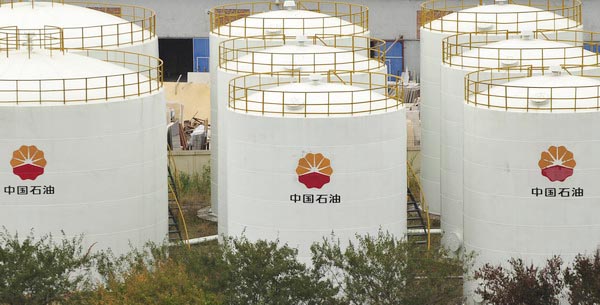
 China continued to boost its crude oil inventories in the first two months of the year as strong imports and domestic output exceeded an increase in refinery production.
China’s surplus of crude oil was 1.24 million barrels per day (bpd) in the January-February period, according to calculations based on official data.
The extra crude was down from a record high of 2.67 million bpd in December, but was still higher than the average of 1.13 million bpd for the whole of 2025.
China does not disclose the volumes of crude flowing into or out of its strategic and commercial stockpiles, but an estimate can be made by deducting the amount of oil processed from the total crude available from imports and domestic output.
It is worth noting that not all the surplus crude was likely to have been added to storage, with some being processed in plants not captured by the official data.
But even allowing for those gaps, it is clear that from March 2025 onwards, China was importing crude at a far higher rate than necessary to meet domestic fuel demand.
China combines January and February trade data into a single release in order to smooth out volatility caused by the shifting timing of the Lunar New Year holidays.
For the first two months of the year, China imported 11.99 million bpd of crude, while domestic output was 4.42 million bpd, giving a combined total of 16.41 million bpd available to refineries.
A total of 15.17 million bpd was processed by refineries in the January-February period, leaving a surplus of 1.24 million bpd.
It’s no surprise that China continued to import more crude than it needs to satisfy domestic consumption in the first two months of the year.
Cargoes that arrived in January and February would have been arranged in November and December, a time when global benchmark Brent futures were trading in a narrow range just above $60 a barrel.
China would also have been buying heavily discounted crude from producers under Western sanctions, namely Russia, Iran and Venezuela.
HORMUZ DISRUPTION
However, the crude market dynamic has shifted dramatically since the U.S. and Israel launched an aerial bombing and missile campaign against Iran on February 28, prompting Tehran to respond with drone and missile attacks on targets across the Gulf countries that host U.S. military bases.
It is the effective closure of the Strait of Hormuz that has had the biggest impact on crude and refined product markets, with the narrow waterway carrying as much as 20 million bpd of oil and fuels, or about one-fifth of global consumption.
Brent futures surged to the highest since June 2022, reaching a high of $119.50 a barrel on March 9, before easing to end at $100.21 on Monday.
While Brent has gained 38% since the start of the conflict, prices for Middle East crudes and refined products have risen by much higher percentages, and in the case of jet fuel in Asia they have doubled as the market starts to worry about a supply crunch.
In past episodes of higher prices, China has typically reacted by cutting imports and even dipping into stockpiles in order to maintain refinery runs.
It’s likely that the same playbook will apply this time, meaning that by May and June China’s crude imports will decline.
It’s also likely that China may have little choice but to lower imports, especially if the Strait of Hormuz remains closed to most of its usual tanker traffic for an extended period of time.
China has already signalled that it is likely to hunker down from a crude and refining perspective during the current crisis, with reports of some refineries cutting runs and Beijing banning the export of refined products.
China ordered an immediate halt to refined fuel exports on March 11, according to four sources with knowledge of the matter.
Sinopec, the world’s biggest refiner by capacity, aims to lower processing by 10% this month from its original plan in response to the loss of crude supply from the Middle East, two sources familiar with its operations said.
It could be argued that China’s authorities are taking sensible precautions amid an uncertain situation not of their making.
But it is also valid to question why Beijing seems reluctant to access some of its massive stockpile of crude, which analysts estimate to be around at least 1.2 billion barrels, split between commercial and strategic inventories.
Not only would that be highly profitable to export refined fuels into an increasingly desperate Asian market, it would also win Beijing political goodwill and help the region weather a crisis created by U.S. President Donald Trump.
Enjoying this column? Check out Reuters Open Interest (ROI), your essential new source for global financial commentary. ROI delivers thought-provoking, data-driven analysis of everything from swap rates to soybeans. Markets are moving faster than ever. ROI can help you keep up. Follow ROI on LinkedIn and X.
The views expressed here are those of the author, a columnist for Reuters.
; (Editing by Sam Holmes)