Many people I chat with these days that are outside the energy sector, if they know that I am in the energy sector, extend complex salutations, superficially and congenially voicing a kind of high-five vibe along the lines of Hey, congrats on these oil prices, you must be so happy…and yet as those words come out, it is obvious they paper over a simmering cauldron of rage and/or confusion and/or fear about the Middle East brouhaha unfolding live before our eyes in real time, and what it is doing to oil prices and supply chains. The angst is totally understandable; depending on how you look at the situation, there are multiple simultaneous reasons for hope or hatred, sometimes at exactly the same time. No one knows exactly what to cheer for. If one wishes for a quick/permanent ceasefire, does that mean they are indifferent to the gruesome fate awaiting Iranian citizens? If one is happy to see the IRGC’s cage getting seriously rattled, does that mean they love Trump? If one takes it as a positive that Israel and other Muslim Middle East countries are collaborating, does that mean excusing every wrong that any of these countries ever did? Because that’s how it plays out as soon as the topic comes up. Everything is in perfect tension; any move or support in any direction creates negativity in another. It takes a world-class pot head to be indifferent to it all.
So yeah, higher oil prices are nice, but few beneficiaries are overjoyed; it’s like being in a tornado and a suitcase full of cash lands at your feet. Cool, but you’re still in a tornado. Such is the odd life of oil and gas producers these days; strong prices arise seemingly only from very bad things – extreme weather, massive global instability. Yay.
The prices aren’t high enough for long enough to warrant a lot of new drilling either; the whole thing could go away as soon as it started (insofar as commodity markets go; the chaos from supply chain shortfalls could last a long time, but be sure that if peace were to break out, oil prices would crater in minutes). So all in all, it’s just a time of great unease. Downtown Calgary is an ocean of nervous tics. Stampede might be wilder than usual.
But yes of course, a period of higher prices certainly adds strength to the industry, and the geopolitical turmoil has a peripheral benefit: leaders who have spent a decade kicking at the industry, blaming it for everything from floods to an influx of right-handed sharks (not kidding), all of a sudden have been forced to face the fact that dismantling the world’s energy supplies has not been a good strategy. Some die-hards won’t admit it (see: UK, UN, various Canadian/Australian/other cemented-in-place leaders) but it is very hard to avoid that reality. Even Canada’s Captain GFANZ, whose website still stands, all wobbly and disoriented but still there, “mobilizing capital and driving transition finance” towards a “managed phaseout” of hydrocarbons, even Mark Carney is now at least voicing support for hydrocarbon development (he’s still hiding a giant boat anchor under his grey suit to be deployed when ‘conditions warrant’, I’m sure of it, but optimists are focusing on the change of narrative anyway).
This awkward embrace of hydrocarbons is welcome, but politicians don’t really know how to do it after a decade of acrimony. Gee, this body has 200 stab wounds, what should we do to nurse it back to health. It’s all kind of endearing, and I wish them well, but they have a lot of work to do before understanding the actual lay of the land and restoring trust.
Take, for example, news last week that Enbridge’s $4 billion expansion of the Westcoast Pipeline system has been approved by the federal government. Sounds great! And it is. But look at it a little closer, and you’ll see Canada’s predicament.
The expansion consists of 139 km of new pipeline that will loop various segments – “looping” being twinning segments of pipe, in the same right-of-ways, meaning no new lease requirements, nothing outside the existing footprint – and adding new compressors at 4 existing compressor stations.
In other words, this is about as simple as it gets for a significant multi-billion dollar expansion. All the new infrastructure is within existing footprints. And yet even then, the project first kicked off in 2022 when Enbridge held the initial open season. Enbridge filed the official regulatory application in Q2 of 2024. It took two full years for the federal government to approve the expansion, subject to 47 binding conditions related to environmental protection, safety, and Indigenous engagement. The pipeline is expected to enter service in 2028.
Looking beyond the positive headline, the structural problems that aren’t discussed therein become readily evident. First of all, why is the federal government involved at all, or at minimum why involved such that two years go by waiting for their ‘approval’? While the Westcoast Pipeline system falls under the purview of the CER (federal energy regulator), this expansion is wholly within a single province. The open season guaranteed that there was indeed a ‘business case’; the money came from willing private sector investors, and the entire project is within existing right-of-ways and facilities. The length of time for the feds to give their pointless blessing is a reflection of why so little gets built in this country. And don’t even think about greenfield projects. Kick one off today and your toddling children might finish it off in their twenties.
Equally as vexing is the fact that the federal government set in motion some wheels that run counter to the very benefits the feds tout about this project. The federal government says on its website: “The $4 billion natural gas expansion of Enbridge’s Westcoast pipeline system will help meet growing energy needs in the province…This gas will heat homes, business, schools and hospitals…” Sounds great, except for the fact that the BC government, in lockstep with federal ‘progress’, enacted the Zero Carbon Step Code for new residential and commercial developments, requiring a phased exit from natural gas usage. The goal is to align with a 2030 goal to ensure all new buildings in BC are zero-carbon. Per the BC government’s website, many municipalities have adopted this zero carbon code including 44 percent of all new residential units in large multi-family buildings and 30 percent of all new units in small residential buildings.
So the feds are touting how a new $4 billion project will bring gas to new homes and buildings while the provincial government is forcing new homes and buildings to quit using natural gas within a few years of when the expansion will be completed. Awkward.
On top of all of this mayhem, the federal government is still driving towards its ultimate goal of a $170/tonne carbon tax on industrial users, a thundercloud that by itself is enough to drive away investment, never mind the pile of other anti-development policies of the past decade that have not been removed from the books at all. Yes, we do have to talk about it, because it is not dead at all, and in fact the tax increased just this very month, yet again.
Here is some math behind the carbon tax that shows what a disincentive it is for everything except the European model of “de-industrializing”. But let’s assume for a second we don’t want that, and look at what the carbon tax means on the ground by analyzing the impact on natural gas prices from the viewpoint of those who consume it, and those who produce it.
Going out to about 2030, Henry Hub prices as of a week ago averaged about $3.63 US/mmbtu or $4.67 CAD/GJ at a 74 cent dollar, out to 2030. The forward AECO price for the same period is about $2.58, or was last week, might be half of that now. but anyway, Carney and Premier Smith are talking about a potential $130/MT carbon tax. That works out to about $6.25/GJ, or more than twice the forward price of natural gas. For a consumer in 2029, at these forward prices, their gas cost would be $2.58 + 6.25 = $$8.83/GJ CAD. Compare that to the US forward price of $4.67 CAD/GJ. In other words based on forward markets, if Canada accepts $130/tonne CO2 for end users, our gas cost – for users – will be nearly double that of the US, but Canadian producers will pocket just over half of what US producers do. It is cold comfort to hear that this tax can be avoided by spending hundreds of millions on carbon capture schemes. It’s like paying ransom, and the effect is the same either way: get clobbered by higher natural gas consumption prices, or by capital costs of carbon sequestration. This is not how capital is attracted.
And now, out of the clear blue sky, Canada is proposing as some sort of partial solution a sovereign wealth fund. Oh lord help us all. A sovereign wealth fund is, as the name implies, a WEALTH FUND, whereby surplus funds are invested. We as a country have no surplus funds. We have debt up to our ears. The government will initially “provide $25 billion over three years” and allocate more to it over time. Read through that statement: The government overtaxes citizens and businesses, borrows more than is in any way sensible, and then tells us it is investing on our behalf with borrowed money. Let’s see, how does that usually work out? Does the word “slush fund” come to mind? It should, like a freight train. Skeletons are still being uncovered from last decade’s various debacles, vast sums disappearing into governmental pet projects.
The country does not need the government creating new businesses through investment; the world can clearly see the opportunities in Canada. What we need is the government to get out of the way. To clean up the regulatory morass. To stop taxing so much. To show fiscal restraint to rein in debt levels.
This isn’t oil patch whining. The hydrocarbon industry can see clearer than ever just how much the world needs its products. It is crystal clear that the world desperately needs the hydrocarbons that Canada can produce, and so the future could be bright indeed. But it is a wake up call for any sort of national economic recovery. Even the staid Bank of Canada has declared that the country is in a ‘break the glass’ investment emergency, that we desperately need to attract investment dollars to buttress our economy, to provide the tax dollars for all those hungry mouths, to service that staggering federal (and provincial) debt loads that only go up, never down.
Below the federal level, there is more indebted paralysis. Provincial governments like BC are in a muddled state, having launched a thousand anti-hydrocarbon missiles at the behest of the feds, who launched even more. All these policies and programs took root, and any warnings of the inevitable disasters were shouted down from the moral high ground. And now we want investment.
That might sound like beating a dead horse, that the federal government will keep on with the green agenda that is so economically damaging. But it isn’t dead at all. Carney made ominous noises in announcing the fund, saying, as Heather Exner-Pirot noted: “..where the federal government is catalyzing, helping to make the project happen through a tax or other incentive – regulatory support – and at the core there is a commercial business making a profit, it is fair, right, just, smart for Canadians to have a share directly in those profits.” Get that? If the feds provide regulatory support for a project, Canadians should get a (presumably bigger) slice of the profits. What does “regulatory support mean? Allowing something to be built? That’s exactly what it sounds like. Which is a special kind of insane blackmail.
To be clear, on the green front, which Carney has up his sleeve no matter what the emergency posturing says lately, there is a way forward; the only way forward, or the only graceful one. First, accept that oil and natural gas are the bedrock of the global economy. Oil is civilization, as Peter Zeihan says. Then beyond that, get off the soapbox and start thinking. Alternative energy sources work very well in the right environment. The long-running auto show Motorweek recently profiled US grocery chain Wegmans, which dramatically cut its reliance on diesel power. They did it in a logical way that should be didactic. First, with most of their operations in the American Northeast and Mid-Atlantic, the company converted a majority of their diesel fleet to run on natural gas, thereby substantially cutting emissions. Next, they electrified the parts of their transportation chain that made the most sense and had the most benefit. The company “switched to battery-electric power for box trucks and 17-yard tractors that move trailers around the loading docks day and night.” A transportation manager explains: “I’m proud to say that we didn’t shoehorn EV in where it didn’t belong. Right? We looked at the application, we looked at trucks like this one here, you know; can an EV box truck do the same thing as a diesel box truck would do? And the answer was yes for this particular application. Same thing for our yard spotter trucks. Those are the trucks that just move trailers on and off the docks for us every day. They’re really just big material handling equipment tractors, that’s what they are, and so for those to be electric was just kind of a no-brainer.”
The lesson for every politician: Choose the optimal fuel for the job at hand. It really is that simple. Arizona’s demand for air-conditioning goes hand in hand with solar power, because solar power peaks when air-conditioning demand does. Another example is the Middle East’s groundbreaking desalination facilities. It really doesn’t matter in the big scheme of things if the process slows when the sun goes down (operational challenges notwithstanding).
New technologies will arrive, new uses will be found, new breakthroughs will happen. Integrate them as they make sense; don’t try to ‘shoehorn’ what does not. It just won’t work.
For Canada to dig itself out of the economic hole it is in, and maybe start feeling good about itself, these mindsets must be accepted, together with a real determination to root out dysfunctional bureaucracy and regulatory overhang. Leaders must at least try to understand the system, and put ideology aside.
That’s not quite the total solution though. As always, it is up to voters. Or, to put it another way, LOL. We know where our uniparty country elects its leaders. But on the other hand maybe not so much LOL, because those voters have to maybe look beyond infrastructure and ask themselves if they want a Canada at all. Regional discontent is now flowing into Ottawa not just from the east. Let’s see how loud the signal is.
We need Canada to be a beacon for investment. Federal infrastructure groundwork can be of immeasurable value, just as the original cross country railway was. The problem is, current leaders think a high speed rail system is cut from the same cloth. It’s not, but it is a shiny trinket that buys votes.
Until that thinking is corrected, until productive capability is clearly understood in the halls of power, don’t expect much to change.
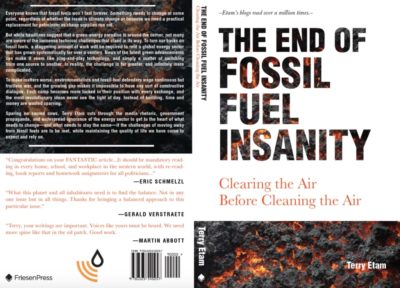
At the peak of the energy wars, The End of Fossil Fuel Insanity challenged the narrative of imminent fossil fuel demise, facing into the storm. And now everyone is coming around to this realization as well. Read the energy story for those that don’t live in the energy world, but want to find out. And laugh. Available at Amazon.ca, Indigo.ca, or Amazon.com.
Email Terry here. (His personal energy site, Public Energy Number One, is on hiatus until there are more hours in the day.)