If you find the idea of stuffing your head full of useless trivia to be appealing, you’re going to like this one: In the 1830s in the United States, some two hundred years ago, almost 30 percent of American GDP was expended on firewood. Think about that. Almost one in every three dollars went towards material to burn for heat and cooking and the basic industries of the day. A further 40 to 50 percent of US GDP went to food, another staggering statistic considering that restaurants were not common to absorb wealth, neither were supermarkets and absolutely no one would bring hot pizza to your door within 30 minutes.
Of course, there are some error bars on these numbers; a plate of squirrels is not easily integrated into hard economic statistics – what was the value of labour to catch the little buggers? What is the market value for the edible parts when there is no market for the edible parts? Etc. – nor is an armful of twigs. In fact the term GDP did not even exist at the time; historians have to interpret the barest of statistics in quite a fanciful way to reverse engineer estimates for things like firewood’s share of the economy, but because they are grad students or professors they have nothing better to do and so it is done. Whatever, the point remains that firewood was a critical component of life, and a big one.
Life today versus 200 years ago is, obviously, very different. Everything today is easier (with the possible exception that we now burden ourselves with self-inflicted mental anguish over an infinite set of annoyances and/or grievances and/or discomforts that no one had time for back then). Few people in the 1800s lost a lot of time pondering “Who am I?” You are a person without a fridge or air conditioning or a natural gas furnace. You, in 1830, do not know what any of those things even are. Dentistry consisted of whisky and pliers. Life was brutal and short.
Today life is comfortable and long, for the most part. And yet the two very same driving forces remain as strong as ever: We want energy security, and we want food security. Nothing at all has changed in that regard, except that life was much closer to the edge on both those fronts, so people understood that universally. Now, we don’t.
Two hundred years ago, before the arrival of coal, wood was the energy system. It was key to industry and to keeping people alive and thus held a special value to the average person. A lack of firewood was more than just a bit problematic, and as populations grew, competition for wood resources grew with it. Deforestation was a critical issue, a key economic indicator, far more relevant than GDP. The fuel source had to be local, and plentiful, or everything ground to a halt.
Today, despite all the technological advancements, despite infinitely better health/medical care, despite social safety nets, the fundamental requirement of civilization has not changed: access to reliable and affordable energy is the key to everything. When firewood was 30 percent of GDP, everyone was acutely aware of it (well, they weren’t aware of the statistic but definitely were of wood’s relevance). Today, when people are distanced from sources of production, the public is in general removed from energy security, and therefore both understands it less and pays less attention. Fuel and power are just there, always: natural gas just magically appears in stoves and furnaces, just as electricity does from a wall socket. In the days of wood heat, everyone knew where the wood came from. No one thinks that natural gas comes out of the ground sometimes thousands of miles away and is transported right into homes at precise quantities at all times.
Consumers do however pay immense attention if there is any sign of shortfall though, which brings us to the current respect that hydrocarbons are now enjoying. Digging up an old typical headline from 6 or 7 years ago, the raging anti-oil ones, provides a fascinating glimpse into the mindset that was prevalent at the time. That view was the epitome of the distance between fuel source and consumption that people had gotten used to.
Energy will evolve over time, when something comes along that people race towards, that improves everyone’s lot without question. We are on an energy continuum, of sorts; there is no reason to think that the trajectory will change, but it is important to understand that the change vector is energy density, and not anything else. There is a reason the world moved rapidly from wood to coal, and coal to oil. We are a bit plateaued there for the time being. Nuclear power tops hydrocarbons for energy density but is not a suitable replacement for all the hobbies and habits and supply chains we have built around hydrocarbons. Some day fusion energy might take us to the next level of energy density. On a smaller scale, maybe it will be solid state batteries, which show great promise. Or solar power derived from space installations, Elon Musk’s vision. But that isn’t today,
The very first squirrel-gatherers presumably understood the power of the sun. I say presumably because not there to corroborate, but it seems logical that neanderthals would have understood the benefit of standing in the sun versus the shade. Lizards know this. Solar power is a known entity. Capturing solar power is one of the smarter things to do in life, few energy sources are as free (not just solar panels; think of passive solar structures where the sun can heat rocks or stone fireplaces or other clever structures and release the heat at night).. But on the energy density scale, it can’t keep up with human life. The scale and reliability required is just too vast.
Imagine turning back the clock, with today’s population and expectations. Most people live in cities. Imagine your city with no fuel, and everyone out scavenging firewood. First, you have to imagine they all have wood stoves or fireplaces, which even if they did would create unimaginable amounts of smoke. And how long would it take for every tree to be hacked down and burned?
And then what, once the trees were gone? Where would next week’s firewood come from?
It helps to think of energy that way, how we have built out systems from the initial requirements of “live near a wooded area with few other people” to distribution systems that reach almost everywhere. Building those channels took a very long time. Hydrocarbon development began where firewood (and coal) development left off – oil was produced and consumed locally, then markets expanded as the utility of the fuel expanded. Natural gas was even more of a linear development; new pipe could only be connected to existing pipe or new sources.
Proximity to fuel has been replaced by a global web of interconnectedness that makes it all work. The system is remarkably resilient so that, in general, a catastrophic outage in one part of the system is problematic but not fatal. Consider right now the previously unthinkable – closure of the Strait of Hormuz. A decade or two ago, the idea was enough to send oil markets into vertical spasms. Now, the situation is definitely not great, but a global web of storage facilities has bought time for the fiasco to be sorted out.
But of course, that doesn’t mean we are out of the woods. Global crude oil inventories are being drawn down in an orchestrated governmental chorus of “Nothing to see here, move along, lots of oil for everyone” because they know what will happen once we actually start hitting physical shortages on a global basis. It will not be pretty. It will be like an 1830s household running out of firewood on a cold night.
Sometimes, often times, it takes a crisis to jolt people out of comfort zones. People that endure near-death experiences often report a heightened appreciation for life and everything in it. We may be on the cusp of that with respect to oil, and the other products that come through that strategic Strait. The closer we get to a crisis, the more acute will be the desire for, among other things, for Canada to become an Energy Superpower.
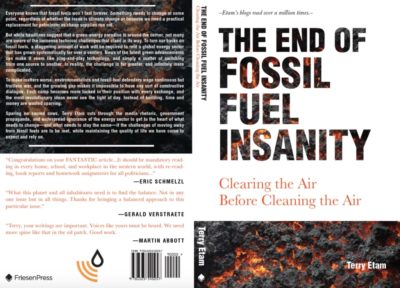
At the peak of the energy wars, The End of Fossil Fuel Insanity challenged the narrative of imminent fossil fuel demise, facing into the storm. And now everyone is coming around to this realization as well. Read the energy story for those that don’t live in the energy world, but want to find out. And laugh. Available at Amazon.ca, Indigo.ca, or Amazon.com.
Email Terry here. (His personal energy site, Public Energy Number One, is on hiatus until there are more hours in the day.)