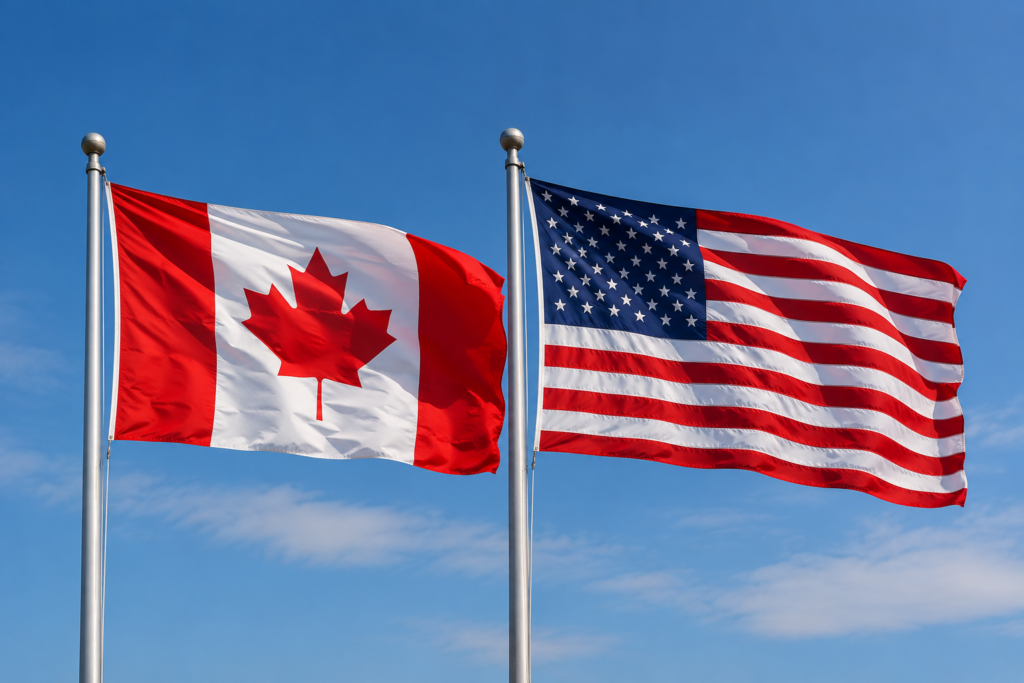
 The resurgent trade spat between U.S. President Donald Trump and Canadian Prime Minister Mark Carney comes at a delicate juncture for both North American countries – and the global economy. Missteps between the neighboring G7 nations could have wide-ranging economic impacts. The Trump administration imposed 50% tariffs on an array of Canadian goods on Saturday after bilateral talks collapsed on Friday. These levies might appear modest on the surface, applying to only 5.5% of Canada’s exports to America, goods worth around $20 billion. All else being equal, this will raise the U.S. effective tariff rate on Canadian exports to 6.9% from 5.1%, according to Oxford Economics. Ultimately, this is small stuff. But the potential for escalation and damaging spillover is large. Canada is America’s second-largest single trading partner – coming in ahead of China – with total trade between the two hitting $715 billion last year, according to the U.S. Census Bureau.Canada also hoovered up more U.S. goods and services than any other country last year. Both sides already appear to be digging in. Carney has vowed dollar-for-dollar retaliation, and Trump said on Monday that 50% tariffs on Canadian cars, trucks and automotive parts will come into effect on January 1, if no deal is reached. A protracted spat could inflict heavy damage on Canada’s economy, potentially even triggering a recession. U.S. consumers and companies, meanwhile, could also suffer – whether in the form of tariff costs themselves, lost exports, or higher inflation.
But the bigger risk for the world economy is the possible regional impact.
USMCA UNDER THREAT
Trump’s fight with Canada could signal the demise of America’s biggest trade agreement: the U.S.-Mexico-Canada Agreement (USMCA). As a reminder, Mexico is America’s largest trading partner, with total goods trade between the two reaching $872 billion last year. USMCA, the revised version of 1994’s North American Free Trade Agreement (NAFTA) has been in place for six years but is under serious threat. Trump opted on July 1 not to renew it, subjecting it to annual reviews, although talks are continuing. Unless the three countries agree on fresh revisions, the pact will gradually be wound down and is most likely to be replaced by bilateral agreements, adding yet more uncertainty and complexity to the future of transshipment, investment, and product sourcing in this critical supply chain. Trump’s statements surrounding the USMCA renewal don’t exactly inspire confidence. “I don’t care. I mean, I don’t really want to. I’d rather be independent. Here’s the thing: Mexico and Canada need us. We don’t need them. The deal is important for them. It’s not important for us,” Trump told Fox News on July 28. True, the last 17 months have shown that Trump often climbs down from his initial threats, and the unraveling of USMCA would threaten U.S. producers, making him unlikely to junk it altogether. But the resurgence in U.S.-Canada tensions raises the likelihood of that eventuality. This could ultimately lead to job losses, more expensive goods, higher inflation, more cumbersome supply chains, and greater investment uncertainty.
SPILLOVER POTENTIAL
The U.S.-Canada spat could also send a message to other U.S. trade partners.
While Carney has come out fighting and is seemingly prepared to defend Canada’s strategic autonomy at the expense of increased trade friction, Mexican President Claudia Sheinbaum has taken the opposite path, choosing less friction with Trump in return for what she hopes will be greater access to the U.S. for Mexican companies.
It’s not clear yet which approach – if any – will pay off, but other countries will be watching. If Carney is successful in pushing back on Trump’s aggressive tactics, this might further blunt the president’s already reduced tariff power. The Supreme Court in February struck down Trump’s sweeping tariffs, forcing the administration to apply import duties under alternative legal justifications. On the other hand, with Trump’s approval ratings at record-low levels ahead of the U.S. midterm elections in November – and no signs of any breakthrough in the Iran war quagmire – the U.S. president may seek to make a splash on the international stage to highlight America’s global might. This could lead him to stick to his guns and call Carney’s bluff, because Canada is the more vulnerable party here.
While that might make Sheinbaum’s approach look smarter, if the ultimate result is a heavily weakened USMCA, then everyone could end up losing. This latest flare-up comes at a difficult time globally. Yields on long-dated bonds are near multi-decade highs across the developed world, the U.S.-Iran war is reaching its six-month mark, energy supply routes remain choked, and inflation is still uncomfortably high in many countries. That’s not a good environment for one of the world’s largest and most critical supply chains to come under threat.
(The opinions expressed here are those of the author, a columnist for Reuters)
Enjoying this column? Check out Reuters Open Interest (ROI), your essential new source for global financial commentary. Follow ROI on LinkedIn, and X.
And listen to the Morning Bid daily podcast on Apple, Spotify, or the Reuters app. Subscribe to hear Reuters journalists discuss the biggest news in markets and finance seven days a week.
(By Jamie McGeever Editing by Marguerita Choy)