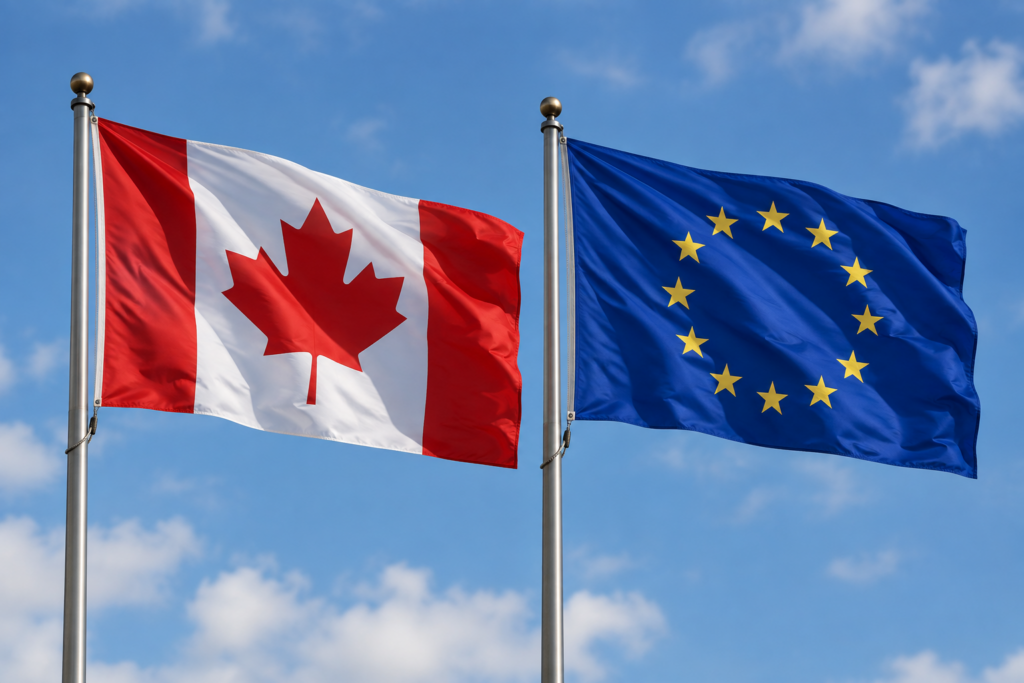
 European Commission President Ursula von der Leyen said on Wednesday she wanted to open the door for Canada to become the European Union’s first “associate member”.
Earlier this week, Canada’s Prime Minister Mark Carney — who was in Strasbourg to listen to von der Leyen’s annual State of the Union address — said Canada was seeking a “unique alliance” with the EU but not membership.
WHAT MIGHT THE NEW RELATIONSHIP INVOLVE?
There is currently no such status as “associate member” set out in the European Union’s treaties — though various versions of an associate-type of membership have been floated in the bloc over the years.
Most recently, Germany suggested Ukraine be an associate member as an interim stage to full accession, though the proposal failed to gain traction as some EU capitals pushed back.
WHAT IS CANADA SEEKING?
Carney is seeking new alliances amid repeated threats by U.S. President Donald Trump against Canada’s sovereignty.
Both sides want to forge deeper cooperation to counter U.S. and Chinese economic dominance as well as preserve democracy and the rules-based international order, which they see as under threat.
In her speech, von der Leyen said the two sides would create a “common prosperity and economic space”. This would include joint work on manufacturing, a tech alliance, integration of defence industrial bases, the Arctic, AI, energy and critical minerals.
WHY MIGHT THE IDEA OF ‘ASSOCIATE MEMBER’ BE COMPLICATED?
Implementing such an ‘associate’ status would be unprecedented and may be legally complex.
Von der Leyen was speaking in her capacity as President of the European Commission, the bloc’s executive arm. It would fall on the EU member states to decide whether the idea flies.
There is no suggestion von der Leyen is proposing enshrining the status of ‘associate member’ in EU treaties. That would require unanimity among all 27 capitals and ratification by all domestically.
Canada and the EU already have a trade agreement, called CETA. More than a decade after the deal was struck and nine years since it provisionally entered into force, several EU countries still have not ratified it.
If Canada wishes to become locked into the EU’s Single Market, Ottawa would need to reconcile Canada’s norms and regulations to match EU law.
Canada would become a rule-taker with no say on policy if it entered the Single Market without full membership like Iceland, Norway, Switzerland and Liechtenstein who are members of the European Economic Area.
Canada’s rules have historically been geared towards its biggest trade partner, the United States.
WHAT DOES THIS MEAN FOR EU CANDIDATE COUNTRIES?
The quest for a deeper alliance between Canada and the EU will not impact the path to accession for European candidate states — but it may serve as an irritant if Canada is perceived to be getting special treatment.
Accession negotiations and aligning with EU norms is a long process that often requires candidate nations to push through politically sensitive reform.
Full membership can only be granted to European states and provides access to the bloc’s €18 trillion ($20.77 trillion) Single Market, voting and representation, EU funding and legal recourse to the European Court of Justice.
Ukraine saw Germany’s proposal for “associate membership” as “unfair” as Kyiv would participate but with no voting rights.
The EU has said it could admit new members as soon as 2030. Montenegro, Albania, Ukraine and Moldova are the most advanced among candidate countries.
(Reporting by Julia Payne; editing by Richard Lough and Andrew Heavens)