Sour reservoirs are becoming the rule, not the exception, and the gas specifications operators must hit to move that gas to market keep getting tighter. Pipeline specifications across North America and global LNG markets are enforcing lower allowable sulfur limits for both H2S and mercaptans, a trend that is especially pronounced anywhere downstream catalysts are prone to sulfur poisoning, such as hydrogen production and petrochemical processing. At the same time, regulators are pushing operators toward more integrated sulfur recovery and tail gas treatment systems rather than treating gas sweetening as an isolated step.
For an operator sitting on a newly sour well, that combination of pressures turns a technology selection decision into a high-stakes one. A new whitepaper, based on a recent gas sweetening evaluation, breaks down how wide that decision can swing and what a Front End Engineering and Design (FEED) study can do to close the gap before capital is committed.
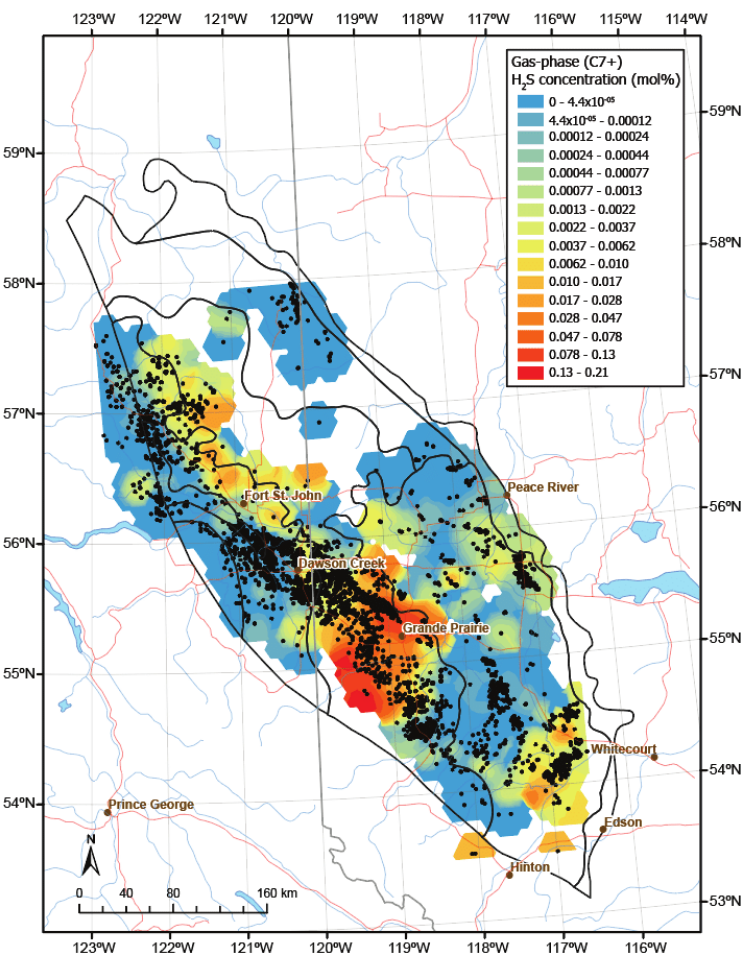
Figure 1: Hydrogen sulfide (H2S) distribution in the Montney Formation
(Source: Natural Resources CANADA)
A Mature Field Meets a New, Sour Well
The case at the center of the study involves a mature, low decline gas field producing 200 mscf/d of lean sweet gas. After acquiring the asset, the operator drilled and completed a new well expected to ramp total field production to 1,000 mscf/d, but the new production was sour and would commingle with the existing sweet gas stream.
To meet delivery point specifications, the operator needed a gas sweetening solution capable of taking an inlet stream of 700 ppm H2S and 150 ppm mercaptans down to an outlet of less than 1 ppm H2S and less than 10 ppm mercaptans. Complicating the picture further, the production forecast called for flat commingled output of 30,000 sm3/d for roughly 3.5 years before declining into the mid 2030s, a relatively low flow rate paired with high turndown requirements that ruled out a one-size-fits-all answer.
Four Solutions, a Six-Figure to Seven-Figure Spread
The evaluation team ran a technology market assessment across providers in Canada, the United States, and China, comparing capital cost, consumables cost, changeout frequency, and operability side by side:
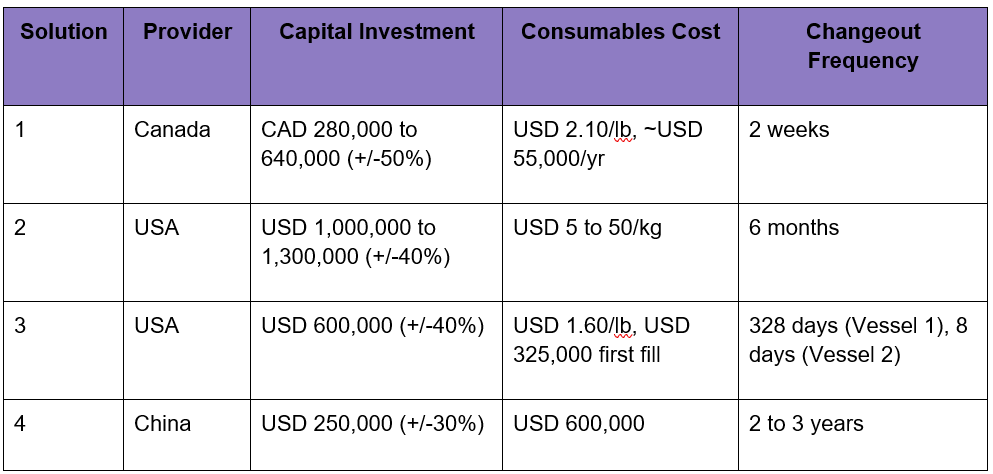
The spread is not small. Capital costs alone ranged from a quarter million dollars to well over a million, and changeout frequency, a direct driver of long-term operating cost and downtime risk, varied from every two weeks to once every two to three years. A regenerative amine system was also evaluated for completeness and confirmed to be the least economic option given the field’s relatively low produced gas volumes and high maturity, useful validation that more sophisticated technology is not automatically the right answer.
Why the Cheapest Option on Paper Was Not the Obvious Choice
Cost was only one input. The evaluation also weighed geographic sourcing risk, safety, plot space, constructability, salvage value, and how each option would perform against a declining, low-volume production profile. Solution 4, the lowest capital cost option, required upstream dehydration as part of a combined system, adding scope the headline number did not capture. Solution 2 required hydrogen that was not provisioned for in the base case. Solution 3 split H2S and mercaptan removal across two vessels with very different service lives, a detail that significantly changes maintenance planning beyond what the capital cost comparison alone would suggest.
After reviewing the full findings, the operator opted to evaluate non-regenerative options further, prioritizing lower upfront capital and stronger lifetime economics given the field’s production trajectory, and asked that operating cost be assessed at the individual wellhead level based on production decline rather than at a central facility. That is precisely the kind of decision a FEED study is built to surface before it becomes an expensive field discovery.
The Bigger Picture: A Moving Regulatory and Technical Target
Feedstock variability adds another layer of difficulty. Mercaptan, H2S, and CO2 concentrations can fluctuate significantly across unconventional reservoirs, not just between fields but over the life of a single asset, and being unprepared for that variability risks underperformance, higher operating costs, and premature shut-in. Some operators are also weighing energy efficiency and carbon intensity more heavily in technology selection, since regenerative solvent-based systems can represent a meaningful share of a facility’s total energy demand. In select cases, CO2 removed during gas sweetening can also align with broader CCUS strategies where a concentrated stream can be sequestered or put to beneficial use.
What Comes After Technology Selection
Choosing a sweetening technology is not the end of the planning process. Compression systems, vent capture strategy, and material selection all need to be worked through next, along with metering that can reliably identify, record, and report on contaminants for custody transfer. Analyzer sensitivity requirements shift depending on which contaminants are present, so this is not a detail to leave until later in the project.
Getting the data needed to make a technology decision with confidence, rather than a best guess, is the point of a gas sweetening FEED study. For operators facing a similar mix of a sour new well, a mature field, and a tight delivery specification, the full whitepaper walks through the technology landscape, the complete case study findings, and the questions worth asking before assembling a project team.
Read the full whitepaper here.
About CANUSA EPC
CANUSA EPC delivers engineering, procurement, construction management, and consulting services for industrial and energy facilities across North America. With offices in Calgary, Denver, and Houston and more than 2,100 completed projects, the company is known for minimizing construction risks, supporting safe operations, and providing reliable, on-time project execution. CANUSA EPC serves a wide range of markets, including natural gas processing, power generation, carbon capture and utilization, helium, and emissions reduction, and is committed to transparent communication and collaborative partnerships.
Learn more at canusaepc.com.