Perspective is everything, particularly with respect to the blizzard of energy infrastructure announcements. Industry readers here will fall into two groups: those with more than a decade in Canada’s upstream energy sector, who will be identifiable by a countenance of total disorientation. The other group less hardened group will be observing the absolute torrent of new energy development news, and be thinking, “What’s up with those old guys? Shouldn’t they be over the moon?”
Both viewpoints are rational. Newcomers to the energy scene may have arrived, or started paying attention, only since trade friction developed with the US, the point at which Canada realized vividly that it had been lax in developing alternative markets. As such, they are the ones looking on nonchalantly, supporting new pipeline and energy infrastructure investments as some sort of well-executed national development strategy.
But the oldtimers…it is hard to describe the context and the tension of a decade ago if you weren’t there. Since social media’s speed brings in a new news cycle every 15 minutes, let us battle-scarred veterans remind you of why we may appear stunned (and possibly dubious) at the onslaught of pipeline support.
In a 2017 town hall meeting in Ontario, sitting Prime Minister Justin Trudeau said this about the largest sector of oil patch: “We can’t shut down the oilsands tomorrow. We need to phase them out. We need to manage the transition off of fossil fuels.”
Trudeau was recently replaced by global banker Mark Carney, who had this to say in 2020: The financial sector is “not moving fast enough” to divest from fossil fuels, and had not woken up to the looming crisis that half the world’s oil and gas assets could become “stranded and worthless”. Canada’s oil sands were at the top of that asset list, being flagged as expensive ‘dirty’ oil by the people most hoping for hydrocarbons’ demise.
Six years later, Mr. Trudeau is but a Covid-like memory, and Mr. Carney’s head has gone owl-like and is now pointed in exactly the opposite direction. From a BOE Report article last week, Mr. Carney popped up in Fort McMurray to announce the first major proposal to be deemed in the national interest, a new oil sands pipeline, saying of the oil sands: “I wouldn’t use the term boom, I would use ‘sustained growth’.” Wait, this is the same dude, right? Mr. Starve Them Of Capital? Yep. Times they are a changin’.
Flagging this about-face isn’t as rewarding as one might think, for oil patch people. The decade of animosity has been utterly exhausting, and it is with a sense of relief and astonishment that the patch looks on as announcement after announcement is rolled out, most with respect to hydrocarbon development.
Ontario’s premier Doug Ford recently jointly announced with AB Premier Danielle Smith the Northern Shield oil pipeline to bring western crude to central/eastern Canada through a solely Canadian route. Carney and Smith announce the Pacific Link oil pipeline to the west coast. LNG Canada announces sanctioning of the second phase that will double throughput. BC’s conservative party, with a fairly good chance of winning their snap election, has pledged to double LNG levels within 5 years, and then keep on growing. Coastal GasLink announces a gas transportation expansion to accommodate. South Bow announces the Prairie Connector pipeline project, kind of a stunted rebirth of Keystone XL, using some of the pipe already in the ground from that project that was derailed by the ‘stranded asset’ people. Data centers are being announced frequently.
All in all, the list of projects and the sheer enthusiasm is staggering, well past $100 billion in aggregate.
Why is that all happening? For a couple of reasons. First of course is trade mayhem with the United States. All of a sudden people want to see infrastructure development, and they want it now, if it will help Canadian products find new markets. No longer is there hand wringing over what the product is; there is a flat out sprint to access almost any new global market for any of Canada’s products.
A second reason for the disorienting national pipeline enthusiasm is a bit awkward, in that Alberta’s separatist element may have done wonders to shift the country’s mindset. Early but distinct rumblings of national worry appeared earlier this year, when Ontario premier Doug Ford said in a news conference that Canada’s previous federal government had treated Alberta (and Saskatchewan) “like garbage” and that “I’ve never seen anything as bad as that.”
Nova Scotia has spoken out in favour of development of the west’s resources, particularly Alberta, recognizing the benefit to all Canadians. Other provinces have done same. The message is logical and true, but also united in a messaging theme: Alberta, you’ve been heard, we want you as part of the country, and you weren’t crazy to be frustrated by Ottawa.
Whether it is on account of Trump or fear of Albexit, support for pipeline development – a soundbite/proxy for hydrocarbon development – is soaring across the country. In 2026, only 21 percent of Canadians oppose pipeline projects like the BC Pacific Link project, and half of Canadians think the federal government is not doing enough to support pipeline development. Support is greater than 50 percent across the entire country, including in Quebec.
It is awesome for every Canadian, or actually any human, to see a return to reason in the common discourse. It had to happen. The inertia of a global energy system built out over a century was and is simply too great to be rerouted in the timeframe that 2017 Trudeau and 2020 Carney envisioned. Anyone involved in infrastructure development could see that, and now thankfully so can most. Better still is that people are no longer afraid to say such things.
But there is still weirdness afoot. New governmental enthusiasm is welcome for sure, but such enthusiasm can be…not good, if channeled for the wrong reasons.
Consider the following projects, and more importantly their drivers. Over the past six months, three major initiatives have been put forward, or at least three, with quite different characteristics. One is the Pacific Link, which will be built at great cost across very challenging mountain ranges to the west coast. Another is Northern Shield, which will be built across the vast Canadian Shield, another logistical challenge of the first order. A third is the Prairie Connector, which would go south into terrain that is an order of magnitude easier to build pipe through, that will not require expensive and challenging port construction, that will not bring into play the challenges of tanker traffic, etc.
All three are relevant to the oil patch in terms of increasing egress and access to markets. But only two are relevant to the current Canadian consciousness; the purely Canadian options that seek to avoid the US as a customer. Fair enough, that is what diversification away from the US means.
But as with every big problem, there is much nuance at stake. Ignoring nuance led to disastrous energy transition narrative dominance, and it could lead to bad outcomes in this desired direction as well.
Expanding market access is the core principle that ordinarily underlies economic decisions like these: are enough shippers willing to sign on for an acceptable pipeline toll to justify the capital cost of the line and to warrant the pipeline developer to proceed with construction? That is how it works, as a purely economic decision.
But these are not purely economic decisions; these are national policy instruments being driven by two not-necessarily economically pure motives: first, to avoid the US as much as possible (to suit the mood of voters), and second, to encourage Alberta to remain in Canada (to suit the mood of another subset of voters).
So, we have politicians tilting the table to encourage more investment, by publicly supporting energy mega-projects, and also by tangible actions that actually benefit businesses like Canada’s super-productivity tax deduction scheme. In an ideal world, governments would step out of the way, capital would flood in, and boom we’re off to the races.
But we don’t live in an ideal world, and those private investors that could bankroll megaprojects are justifiably nervous in doing so. Recall from one your reading of one minute ago, the paragraphs above, where you read how our federal leaders have completely reversed course in a way that was unimaginable 5 years ago. Could that happen again? Why on earth not? Many politicians are weathervanes.
And then there is the cost and complexity of developing these very long-horizon projects. Adequate returns must be expected, based on expected capital costs and in-service dates. What if the wackos come back, chaining themselves to bulldozers again? What if projects get delayed or derailed by the insane level of bureaucratic regulations that can stop virtually any economic development dead in its tracks, from many angles, from many layers of government?
So we are stuck in this zone where governments are involved in ways that are certainly not optimal, but that are hard to avoid in today’s regulatory quicksand.
Fortunately, government involvement need not necessarily be evil or ruinous, in certain circumstances. Nation-scale infrastructure development can be very much the right direction, objective and outcome, even if said projects may not make the cut as a purely economic endeavour. The US interstate system is a good example. It was a massive infrastructure build out with the knowledge that it would enhance interstate commerce, but the magnitude of the benefit was unknown – there was no simple ‘backstop’ arrangement with shippers that would provide a guaranteed return. And yet the spectacular success is undeniable. Same with Canada’s cross-country railroad. The developer did not have firm service take-or-pay shipper support to ensure economic success, yet the project proceeded, and built out a country, and it is hard to say it was a bad idea. In hindsight.
The point is that a country does need to put on its very best thinking hat before shotgun-blasting in all directions. The ‘energy transition’ had, included, at its core, a desired outcome of creating economically competitive new energy sources. Not such a bad idea, development has to start somewhere. And in some senses, it worked exactly that way: for example, solar power developed remarkably while costs dropped, and there are areas of the energy system where it works very well, such as in very hot climates like Arizona where solar power directly can offset air conditioning usage, and if air conditioning usage drives daily or seasonal energy demand peaks, then solar power is a net added benefit to the system. Where we got in trouble was an extrapolation of that potential to encompass all areas in ways that did not make sense. And so we ran completely off the rails.
The current infrastructure build out is not the same thing; no one is pledging what is physically impossible, but at the same time, let’s put our best foot forward on all this and think it all through.
Governments are involved, like it or not, and so we need to work with that fact. Sometimes, as with the Canadian cross country railway, it is a spur that makes it happen when too many variables are uncertain. Whether that is good or not can be debated endlessly; what is interesting is to look at some optionality that could leverage the potential.
Here are a few examples of what success in that dimension looks like. Consider first a project that had no government involvement but was a direct response to market demand – the construction of the Alliance pipeline system. A handful of entities, including producers, banded together to construct a new greenfield pipeline from BC/Alberta to Chicago. One of the key characteristics was a recognition that wetter gas, gas that includes more propane, butane and pentanes-plus, was becoming more dominant in the mix relative to straight dry gas that supported initial development of the NGTL system. So the Alliance partners took the wise step of constructing a massive liquids extraction plant in Chicago (Aux Sable), creating two businesses rather than just a transport conduit. Clever.
Here is another interesting example from a government-driven initiative. As the trans-Canada railway was built, luxury hotels were constructed along the route to attract travelers, particularly wealthy ones, and open up new economies. That strategy a hundred and some years ago means we now enjoy such spectacular sites as the Banff Springs hotel, and many other similarly grand stop-offs across the country.
Building all pipelines everywhere may be the best idea everywhere, but it is going to take a lot of time and money, and the conquering of some very tough regulatory terrain. True will only be in office for two more years, and Alberta’s referendum question will be settled by then. Will political will remain? Yes, if the multiplier effect is great enough, and maintains Canadian support.
The references above to Carney and Trudeau’s thoughts and comments of 6-8 years ago are not thrown into the discussion for purely derogatory purposes. Just partially. But they are mainly brought up to illustrate something clearly: political motivations are often unstable and flighty, and yet are sometimes required to cut through the fog that private industry cannot (such as accelerating regulatory approval processes).
We are at a very crucial stage now, seemingly open to unleashing the full power of our national economic assets. Political whims cannot be the sole driver. There are many other great reasons to do these things. We need to think them all through.
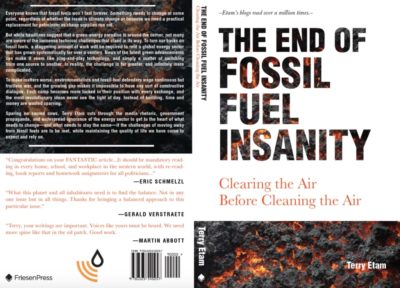
At the peak of the energy wars, The End of Fossil Fuel Insanity challenged the narrative of imminent fossil fuel demise, facing into the storm. Read the energy story for those that don’t live in the energy world, but want to find out. And laugh. Available at Amazon.ca, Indigo.ca, or Amazon.com.
Email Terry here. (His personal energy site, Public Energy Number One, is on hiatus until there are more hours in the day.)