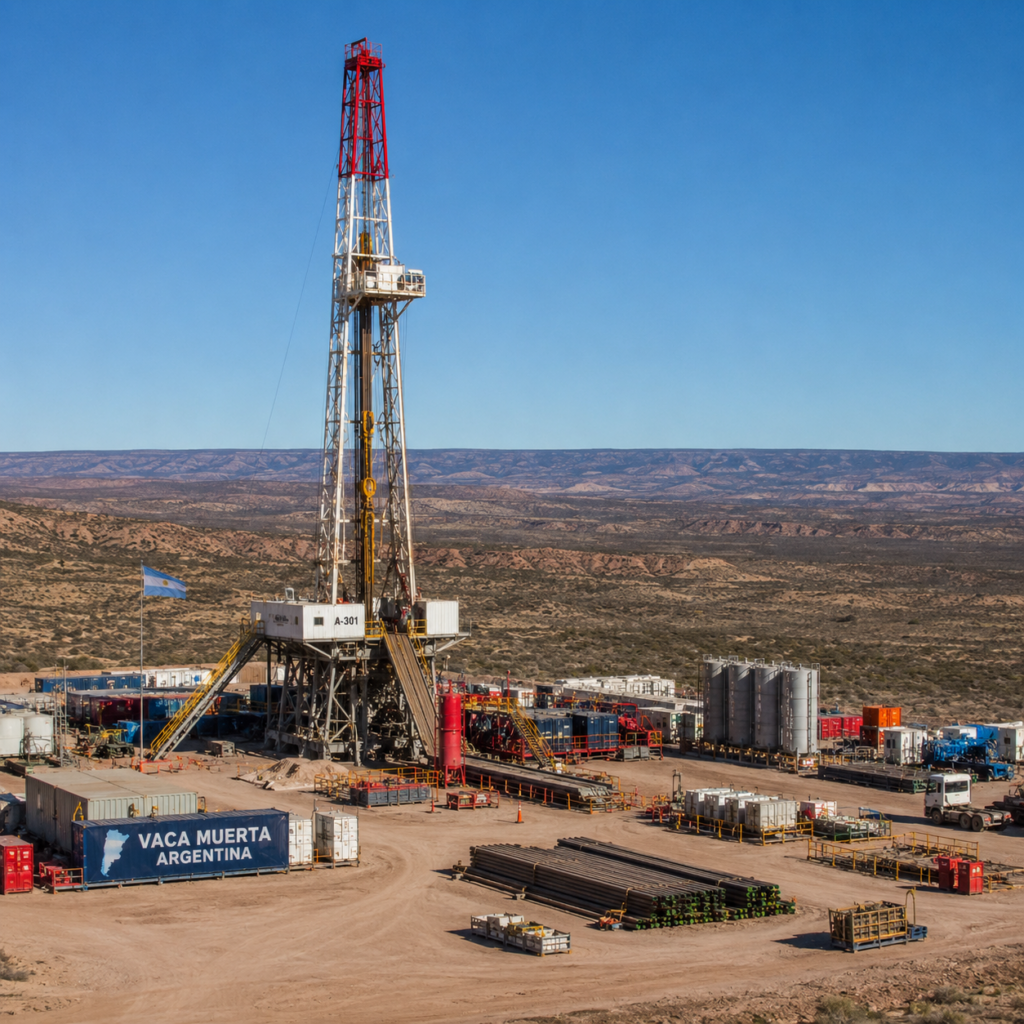
 In a windy, remote oilfield in Argentina, Chevron is bringing in US workers, equipment and expertise, betting it can recreate the Permian Basin shale boom that transformed the US oil industry two decades ago, this time in the Vaca Muerta formation, where success has long been elusive.
The US oil producer hopes to accelerate its goal of tripling production from Argentina, with plans to go from one to three drilling rigs at its El Trapial block by early 2029, a company executive told Reuters. Longer term, the company is working to secure government approval for its plan to spend $13.8 billion over 30 years so it can increase production at the block, one of Chevron’s three projects in the formation, company officials said.
Vaca Muerta, Spanish for dead cow, is one of the world’s largest shale basins. Output there has never reached its full potential due to Argentina’s volatile economy, which has been marked by bouts of protectionism, sovereign debt defaults, hyperinflation and capital controls that made it difficult for companies to access US dollars to pay for imports.
“There’s always been an expectation that Vaca Muerta would deliver more than it has,” said Adrian Lara, a principal analyst at energy consultancy Wood Mackenzie.
That is changing under President Javier Milei, whose sweeping reforms have accelerated an oil boom that has put Argentina on track to overtake Guyana to become the third-largest liquids producer in South America by 2028, Wood Mackenzie estimates.
The country is expected to average 910,000 barrels of oil equivalent per day this year, a 42% increase from 2023 when Milei took office, according to Wood Mackenzie data.
Even with favorable government policy, producers still must contend with higher costs and a less-developed supply chain than in the Permian, where Chevron alone produces about 1 million barrels of oil equivalent per day (boepd).
Chevron’s 25-year-plus history in Argentina and its stake in the upcoming Vaca Muerta Oil Sur export pipeline demonstrate confidence that Argentina’s oil sector can sustain its upward trajectory, country manager Ana Simonato said in an interview in Buenos Aires.
“The difference is in the way that we’re partnering and working together. That’s something very important to enable Vaca Muerta’s development,” she said.
The importance of oil and gas to Argentina’s economy means that even if Milei is not reelected in 2027, a new administration may avoid policies that could slow the energy sector, Lara said. Operators are still confronting the question of how stable Milei’s reforms will be as they consider long-term investments, he added.
NEW RIGS, UPGRADED FACILITIES
Chevron disclosed in June that it submitted a $13.8 billion investment plan for El Trapial, but the timeline and its plan to deliver additional rigs and accelerate production growth across the country have not been previously reported.
The oil producer said last year it would triple its output across Argentina by 2035 to 195,000 boepd. That timeline could accelerate if it is able to add a second drilling rig in June next year and a third around early 2029 at El Trapial, Chevron’s president of shale and tight, Gerbert Schoonman, said.
“I’m hoping we can shave a year or two off,” he said.
Chevron fully owns and operates El Trapial, which currently produces 40,000 boepd. It also holds a 50% interest in both Loma Campana, which produces about 110,000 boepd, and Narambuena, which has not yet started production. Energy firm YPF operates both, which are also located in Vaca Muerta.
El Trapial is central to Chevron’s long-term Vaca Muerta strategy. Chevron envisions extending its contract for the block’s western section beyond its 2032 expiration and building additional facilities such as tanks to separate oil and water to handle increased production, Simonato said.
The remote location requires a 45-minute chartered flight from the city of Neuquen. Chevron is replacing older housing units on the campgrounds where crews stay with redesigned buildings with eight bedrooms each. The dining hall’s menu features steak — not surprising for a country known for beef — while a new soccer field and courts for padel, a racket sport booming in popularity worldwide, are a short walk away.
HIGH COSTS REMAIN A PROBLEM
The hurdles to develop the field remain vast. Bringing a well online costs about 30% more than in the Permian, though better oil productivity in Vaca Muerta helps to close the gap, Chevron Argentina operations manager Juan Pablo Romano said during a September press tour of El Trapial.
Sand used for hydraulic fracturing, or fracking, is delivered on trucks that travel nearly 2,000 kilometers (1,240 miles) from north of Buenos Aires, as local sources of sand have not yet produced satisfactory results for the high-pressure process, Schoonman said.
Schoonman said that when the second rig is delivered in June, Chevron will be able to build enough inventory of drilled wells so a fracking crew can work continuously on-site, rather than their current intermittent schedule.
The ability to continuously drill and frack wells was a game changer for the Permian and other US shale basins, Schoonman added.
“The same will happen in Vaca Muerta. I’m 100% convinced of that,” he said.
(Reporting by Sheila Dang in Neuquen, Argentina; Editing by Nathan Crooks and David Gaffen)