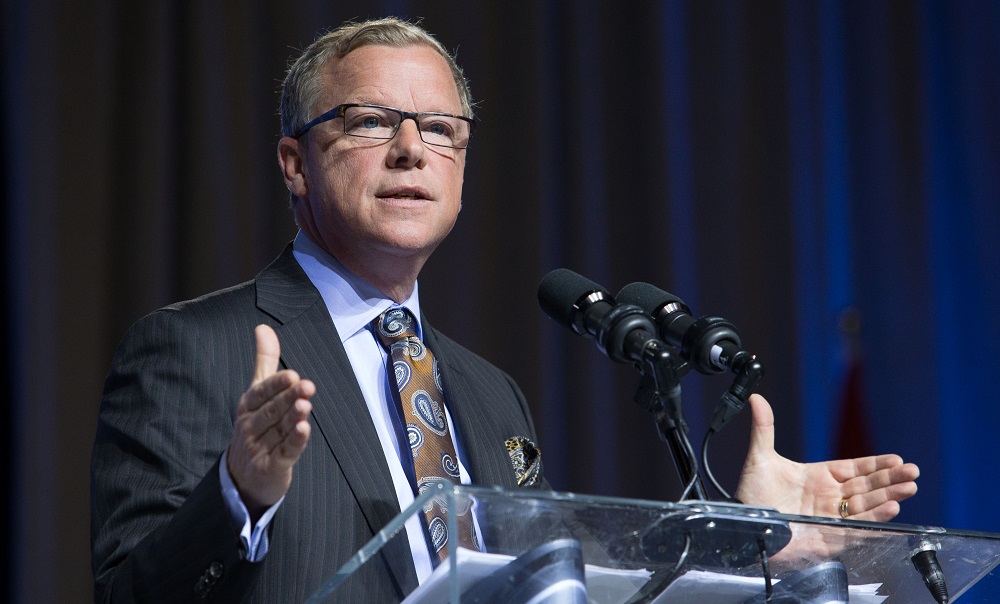
REGINA – Saskatchewan Premier Brad Wall says bringing in a carbon tax would “kneecap” an already struggling Canadian economy.
Wall was reacting to a report in the Globe and Mail that the federal government is eyeing a national carbon tax of $15 a tonne.
The premier says the energy sector across Canada has already been hit hard by the falling price of oil and tens of thousands of jobs have been lost.
“And the last thing we need right now is a tax increase or a new federal carbon tax or frankly a provincial carbon levy. Now’s not the right time for any of those things,” Wall said Friday at the legislature in Regina.
The Saskatchewan government has talked in the past about a possible carbon levy for heavy emitters with the money going back into a technology fund to help find ways to reduce emissions.
The premier says he thinks it would be a better idea to invest in technology to reduce emissions. He points to a carbon capture and sequestration project at a coal-fired power plant in southern Saskatchewan.
“Let’s focus on technology that’ll actually clean up things like coal-fired generation that’s still happening around the world.”
Wall said he hopes the issue can be discussed when the premiers meet with Prime Minister Justin Trudeau next month in Vancouver.
He said he’ll also push for an economic impact analysis of any proposed national carbon tax, which he suggested would increase gas and power prices for consumers.
Ontario Environment Minister Glen Murray said the main concern from his perspective is the federal government duplicating carbon-pricing efforts already taken by jurisdictions, including Ontario, Quebec and B.C.
Quebec is already in a cap-and-trade market with California, Ontario and Manitoba are set to join and discussions are ongoing with Mexico, said Murray.
He argues the global move to carbon pricing will become a growing problem for jurisdictions outside the market, and he’s made that case directly to his Saskatchewan counterpart Herb Cox.
“Carbon pricing is the reality of this century and people who don’t realize that aren’t dealing with the reality of it. On the other hand, we need the federal government to be supported, and not to be duplicating provincial efforts and allowing provinces the room who aren’t there yet the time to get there.”
Murray also said delay is not a winning tactic.
“The sooner you do it, the less expensive it is for businesses. And the bigger the carbon market you’re part of, the more stable and less expensive it is,” said Murray.
“Manitoba’s figured that out. Newfoundland’s figured that out. B.C. has figured that out. Quebec’s figured that out. Eighty five or 90 per cent of the Canadian economy represented by those provincial governments has figured it out. Waiting five or 10 years to start to deal with the inevitable price that’s going to be put on carbon is going to make it much more expensive.”
Wall said “it’s really none of their business in the province of Ontario” as to what Saskatchewan does with its policies.
“And No. 2, with respect to his suggestion that we introduce a carbon levy right now with the economy the way that it is, the answer’s ‘No,'” said Wall.
The carbon debate also reared itself in the House of Commons where Conservative MPs, mostly from Saskatchewan, pressed Environment Minister Catherine McKenna not to move forward with what they called a “job-killing tax scheme.”
McKenna said the federal government will work with the provinces.
“We are well aware of the challenges faced by Saskatchewan and other provinces. That is why we are going to invest in green infrastructure, and how we are going to create clean jobs.”
— With files from Bruce Cheadle and John Ward in Ottawa