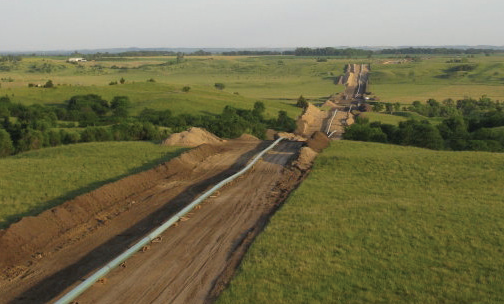
CALGARY – The latest volley of U.S. tariffs targeting Canada are temporarily on hold, and social media postings from U.S. President Donald Trump suggest a revival of the defunct Keystone XL pipeline is factoring into ongoing negotiations.
Trump posted Tuesday night on his Truth Social platform that Canada and the U.S. “have a DEAL!”
“The great Keystone XL Pipeline, long ago killed by Sleepy Joe Biden, may be awoken from the grave!” he wrote.
A subsequent post showed a rendering of the president yanking a pipeline out of the ground beside a tombstone labelled “buried by Biden” and alongside another sign reading “Keystone Pipeline. Completely Free. Energy. Jobs. America First.”
Here is a recap of the nearly two-decade Keystone XL soap opera and recent reboot efforts:
TransCanada Corp. — since rebranded as TC Energy Corp. — first proposed the Keystone XL extension in 2008. It would have expanded an existing pipeline delivering crude from Hardisty, Alta., to refineries in the U.S. Midwest and provided a direct route to the world’s biggest refining complex on the Texas coast.
Canada’s energy regulator approved the plan in 2010. South of the border was another matter as activists made the project a proxy for the broader battle against climate change.
The saga was marked by pipeline reroutes, lawsuits, political showdowns and high-profile protests that saw the likes of actors Margot Kidder and Daryl Hannah arrested outside the White House.
Former president Barack Obama nixed the pipeline — twice — only to have President Donald Trump reinstate its permit during his first term. Former president Joe Biden pulled the plug on the pipeline again on his first day in the White House in 2021.
In his second term, Trump has said repeatedly he wants to revive Keystone XL, and it has been — in a way.
The existing system is now owned by South Bow Corp., which was spun off in late 2024 from TC Energy.
South Bow had earlier said it “moved on” from the contentious Keystone XL proposal, but that it would “continue to explore opportunities that leverage our existing corridor.”
South Bow this spring held an “open season” — a formal process to solicit bids from potential customers — for its Prairie Connector proposal. It received 20-year binding commitments amounting to 465,000 barrels a day for firm transportation service from Hardisty, Alta., to the Canada-U.S. border, where it would connect to another pipeline proposed by Bridger Pipeline LLC to Wyoming. Trump has granted a cross-border permit to Bridger.
Prairie Connector would use about 150 kilometres of pipe in the ground on the Canadian side that had been intended for Keystone XL, South Bow has said. The company plans to make a final investment decision next year.
“Over the coming months, we will focus on stakeholder engagement, execution planning, cost refinement, financing, and securing the permit durability needed to support that decision,” Bevin Wirzba, South Bow’s chief executive, told analysts on a quarterly earnings conference call earlier this month.
This report by The Canadian Press was first published Aug. 19, 2026.