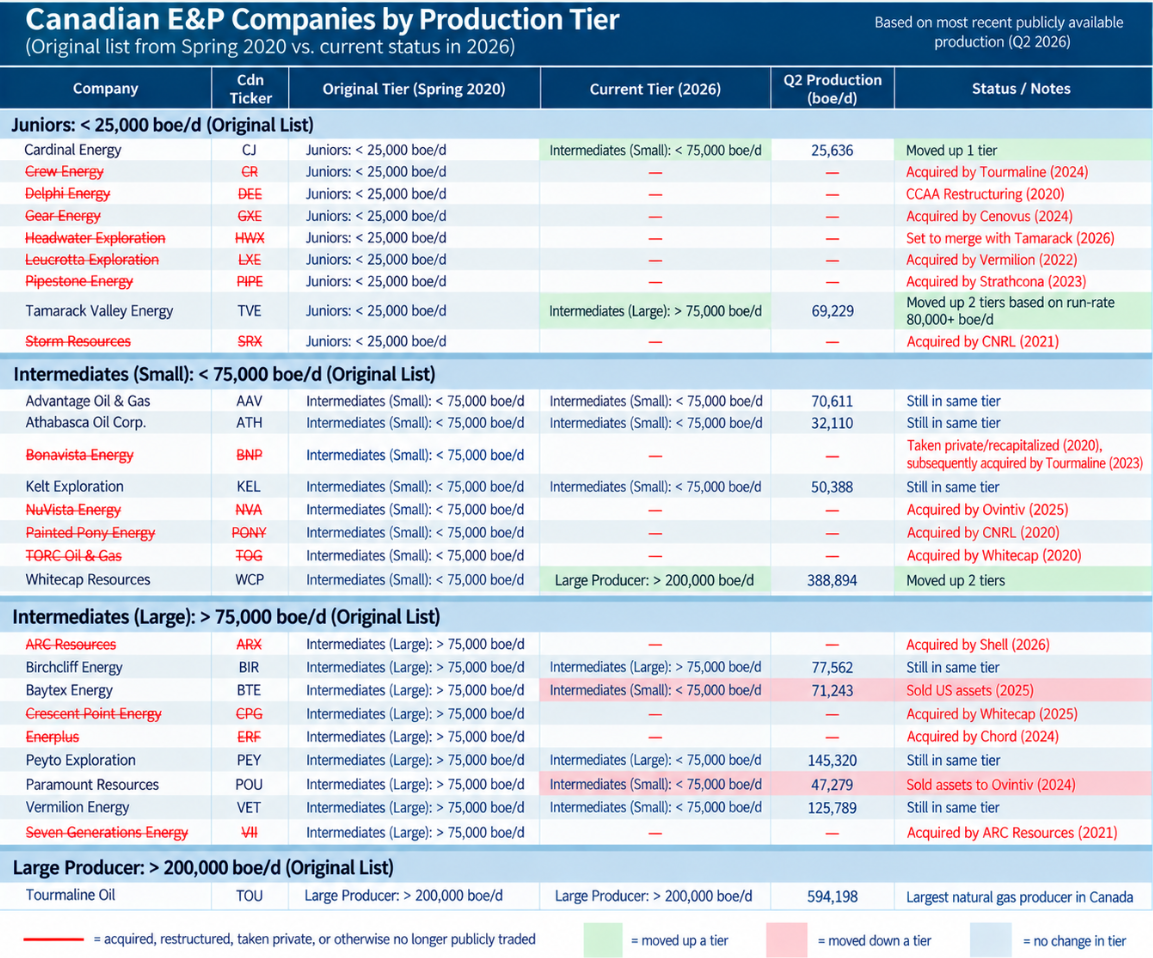
We came across an old overview table the other day from the spring of 2020. It listed publicly traded Canadian oil and gas producers covered by a research firm at the time.
You’d hardly recognize the list today.
Only two of the nine junior producers remain as independent public companies. Half of the small intermediates are gone, and half of the large intermediates have also been consolidated.
The list is by no means exhaustive (apologies to those companies not on here!). Many small and mid-sized producers weren’t covered by the research firm at the time, while Canada’s largest producers and integrated companies were probably on a different table.
Still, it’s a remarkable snapshot of just how dramatically Canada’s E&P landscape has changed in a little more than six years.
Consolidation has created a smaller group of much larger producers. Whitecap Resources, for example, has gone from the small-intermediate category in 2020 to nearly 400,000 boe/d today. Tamarack Valley Energy has grown from a small company to a producer with a post-transaction run-rate above 80,000 boe/d. Tourmaline, already the largest producer on the original list, has nearly doubled production to around 600,000 boe/d.
Of course, moving up or down a production tier doesn’t necessarily mean value was created or destroyed. The cutoffs are arbitrary: a company going from 74,000 boe/d to 76,000 boe/d suddenly lands in a new category even though little has changed operationally. Likewise, a producer can grow substantially without changing tiers at all. Peyto has nearly doubled production since 2020 but still sits in the same broad category. Meanwhile Baytex and Paramount fell down a tier but that was the result of strategic asset sales.
Production growth is only one measure of progress. Per-share growth, free cash flow, returns on capital, balance sheet strength and acquisition economics matter just as much, while a company that shrinks after selling assets may actually have improved its portfolio or financial position.
And it isn’t simply a story of companies disappearing. A new generation of junior and intermediate producers has emerged since 2020, including several companies that didn’t even exist when the original list was published. In fact, we have already noticed that a new generation of junior producers continues to emerge in Western Canada. There is also the list of companies that didn’t even exist yet or weren’t public that are now intermediate sized public companies already: Spartan Delta, Saturn, Strathcona Resources to name but a few.
What does it all mean? Well, nothing really, it was more of a fun exercise to visualize that list and how it looks today. But it also means everything. The Canadian E&P universe is constantly evolving. Consolidation is a major theme in the industry today, but so too is the emergence of new companies in their place. See Monday’s announcement by Avenrock as an example.
Moving on to the graphic itself. The table below shows the original companies on that spring 2020 list, where they stood then, and what has happened to them since.
Click here for more details on the StackDX suite of software solutions for oil & gas data, including client testimonials and case studies.