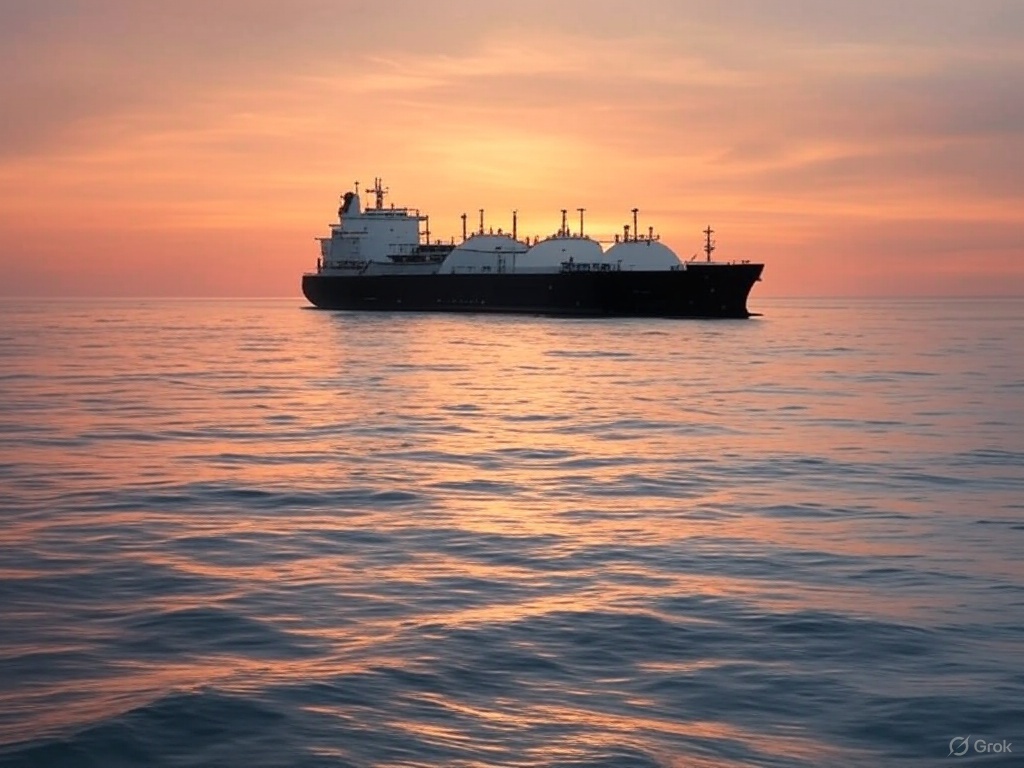
 QatarEnergy is buying long-term supplies of liquefied natural gas from the US and other producers as part of a trading strategy designed to generate revenue if exports through the Strait of Hormuz are disrupted in the future, CEO Saad Sherida Al-Kaabi told Reuters on Thursday.
“In a scenario where you have a closure of the strait, which is the true contingency that we’re looking to have, you’d immediately see a spike in gas price and you’ll be able to generate revenue for QatarEnergy that otherwise wouldn’t be generated,” Kaabi, who is also the minister of state for energy affairs, said of the plan.
Kaabi’s remarks reveal for the first time how Qatar, one of the world’s largest LNG producers, plans to offset lost income from the Iran war and protect revenue against future disruptions in the Strait of Hormuz.
The company signed a 20-year agreement on Thursday to buy 3 million metric tons per year (mtpa) from Woodside’s US facilities. Last week it signed two agreements with Cheniere Energy for up to 4 mtpa through 2054 from its Sabine Pass and Corpus Christi plants. Together, the deals amount to 7 mtpa in the past two weeks.
“There’s more to come,” Kaabi said. Cheniere deliveries are not expected to begin until 2031.
TRADING EDGE
Kaabi, appointed CEO of the state energy giant in 2014, said the strategy was his idea and took shape about three months ago after QatarEnergy studied and ruled out pipeline options.
“As we have seen, pipelines and pump stations or compression stations can be also targets.”
The strategy builds on QatarEnergy’s LNG expertise, trading operation and shipping fleet. It requires no capital spending and is far cheaper than building pipelines or extra LNG trains, he said.
“In normal circumstances you’d make a reasonable return and in critical circumstances — however that comes out and how long it is — you have actual proof today of what you could make.”
QatarEnergy halted LNG production in early March after several days of Iranian missile attacks on Qatar. It declared force majeure to affected buyers on March 4.
Qatar accounts for around a fifth of global LNG exports, all of which pass through Hormuz. The company has extended force majeure until the end of 2026.
Kaabi said being unable to ship volumes had taken a heavy toll on revenue.
QatarEnergy believes it can leverage its fleet of about 200 LNG tankers, the world’s largest, as well as QatarEnergy Trading, which Kaabi said will soon become the world’s largest gas trading platform.
“When you have the arbitrage capability that we have, the volume, number of ships, all the capabilities that we have, that’s why you can do it,” Kaabi said.
The hedge targets a market transformed after Iran responded to a war launched by the US and Israel on February 28 by effectively closing the Strait of Hormuz, a vital chokepoint through which a fifth of the world’s oil and LNG shipments pass.
QatarEnergy can profit from the gap between lower US gas prices and higher European prices, Kaabi said.
“You can imagine the arbitrage you can make, and that would make up some of the loss.”
MORE DEALS TO COME
Kaabi said he expects QatarEnergy to sign more 20- to 25-year supply agreements with US and other producers this year.
The company’s target is “much higher” than 7 mtpa, though Kaabi declined to give a figure. He said QatarEnergy was in talks with “everybody”, including Venture Global, and would buy from whichever supplier offered the best commercial terms. Reuters reported last week that Venture Global is in advanced talks to supply 3 mtpa.
Kaabi said QatarEnergy cannot offer US volumes to long-term customers as a backup to Hormuz disruptions because long-term customer contracts are point-to-point — requiring deliveries from specific export terminals to specific destinations. He added that customers had been understanding of the disruption.
Iranian missile strikes on QatarEnergy’s main Ras Laffan gas processing facility in March damaged two of its 14 LNG trains, affecting combined capacity of 12.8 mtpa and knocking out about 17% of Qatar’s export capacity. QatarEnergy said in March the damage would cost about $20 billion a year in lost revenue.
Kaabi said on Thursday that repairs to the two trains would take about three years. The Pearl gas-to-liquids plant, a joint venture between QatarEnergy and Shell that was also damaged in the attack, should return to service by the first quarter of 2027, he said.
He said Qatar could restart full LNG production within a week of a peace deal, provided ships were available. Output would be limited to about 83% of pre-war levels until the damaged trains return.
Kaabi said no announced project had been cancelled. Ras Laffan has capacity of 77 mtpa, and Qatar’s plan to expand LNG output to 142 mtpa remains unchanged, with all contracts awarded, he said. North Field East, South and West are all proceeding. The first North Field train is expected to start up in the first quarter of next year, although production would require a US-Iran peace deal to be in place.
Kaabi said he had met Iran’s acting petroleum minister twice in recent weeks to explore oil and gas cooperation once the war ends.
(Reporting by Andrew Mills in Doha and Maha El Dahan in Dubai. Editing by Mark Potter)