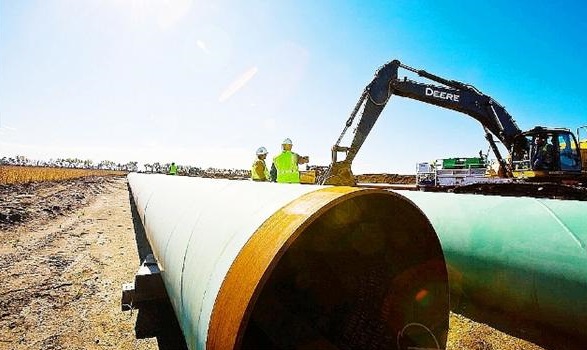
CALGARY – Immediately after U.S. President Barack Obama denied a permit for the Keystone XL pipeline, TransCanada Corp. (TSX:TRP) vowed to review all of its options.
Unfortunately for the Calgary-based company, none of those options are quick, simple or sure to succeed, according to a Washington, D.C., lawyer who at one time dealt with energy issues at the U.S. Department of Justice.
“There’s not much anyone can do to reverse the decision practically or legally in the short term,” said Jim Rubin, now a partner at Dorsey & Whitney.
The one possibility TransCanada raised in its statement Friday was filing for a new permit to ship oilsands crude across the border.
That’s a non-starter as long as Obama is in the White House, said Rubin. Same story if the Democrats win the 2016 election, given the front-runners for the nomination have come out against the project.
The best hope, said Rubin, is for TransCanada to bide its time and see if the Republicans take power in 2017.
The rejection came when it did because a “perfect storm” of factors happened to coincide, said Rubin.
Oil prices are low, so Americans weren’t grumbling about pump prices. A new Canadian prime minister came to power who, while supportive of Keystone XL, has not been as aggressive as his predecessor. And then there are the UN climate talks coming up a few weeks from now in Paris.
Rubin said there could be a congressional push to change the permit process, which gives the president ultimate say over cross-border infrastructure and the State Department oversight of the review.
But again, said Rubin, that’s unlikely to fly until after the next election — if at all.
“We would have to have a Congress capable of passing legislation and a president willing to sign it. Right now have neither,” he said.
Going through the courts is the most complicated route, said Rubin, adding that the optics of TransCanada itself launching a lawsuit aren’t great. Other parties could argue they’ve suffered economic harm as a result of the project not going ahead, but that’s tough to prove.
A challenge under the North American Free Trade Agreement would be a protracted process and a win would be far from a sure bet. The best-case scenario for TransCanada would be recouping funds it sunk into the project, said Rubin.
“I wouldn’t be putting a lot of effort in that because it won’t make Keystone come back.”
Afolabi Ogunnaike, a Houston-based analyst at consulting firm Wood Mackenzie, had already been expecting Keystone XL’s startup to be pushed past 2020. Now the pressure is on the other three big pipelines out of Alberta to proceed — Energy East to the Atlantic and Northern Gateway and the Trans Mountain Expansion to the Pacific. The latter seems the most likely to succeed, he said.
TransCanada may look at building pipe along the same route of its existing Keystone network, which has been delivering crude to the Midwest since 2010, Oklahoma since 2011 and the Gulf Coast since early 2014. The XL segment would have offered a more direct path from the border via Montana, South Dakota and Nebraska.
“It may be something that they will be looking to do now as they’re going back to the drawing board, to really figure out, ‘OK — do we really focus more of our energy on Energy East or do we still try and push on KXL,” said Ogunnaike.
“Maybe they will pursue all of the above. Because one thing is clear: Alberta needs more takeaway capacity.”
Follow @LaurenKrugel on Twitter.