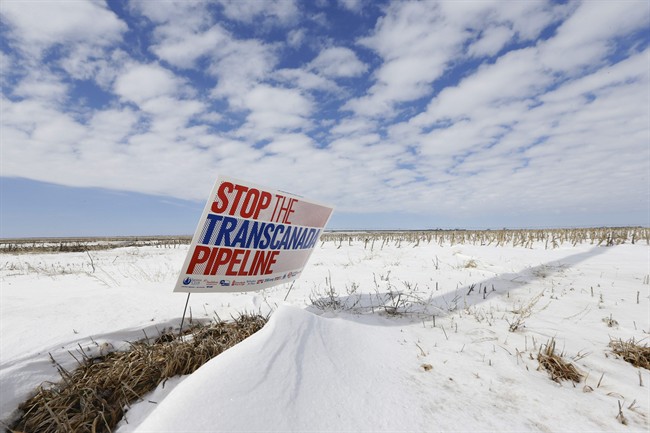
WASHINGTON – The American environmental organizations fighting the Keystone XL pipeline say there’s no climate-change plan Canada could possibly adopt that would make them back down.
Multiple groups contacted this week dismissed an idea often heard in Canada — that a more ambitious climate policy by the federal government might have influenced the Keystone outcome.
They said there’s no carbon tax too high, cap-and-trade ceiling too low, or climate plan too punishing on greenhouse-gas emissions that would have changed their opposition to that pipeline.
“Inconceivable. Would never happen,” said Jason Kowalski, the U.S. policy director for 350.org, one of the groups that helped turn a Nebraska land dispute into a national debate over climate change.
They’re now awaiting the final outcome of the six-year Keystone saga — and these green groups are extremely optimistic they’re on the verge of victory.
President Barack Obama has issued several signals that point to a rejection of the project, like announcing he’d veto a Keystone bill without even waiting to see what the final version looked like.
That veto announcement had a political ripple effect across the northern border, with some opposition politicians in Canada blaming the Harper government’s inaction on climate change for the turn of events.
The Liberals in particular, including leader Justin Trudeau, have repeatedly suggested Keystone might have succeeded if not for government inertia on climate change — which they say turned the Canadian oilsands into an environmentalist target.
Kowalski is unsparing when asked about those Canadian politicians’ claims: “They’re fake, and they’re phoney, and they don’t understand climate science.”
He said any worthwhile climate policy would make Keystone XL unnecessary — because it would halt the growth of Canadian oil production. His group points to a paper in the journal Nature that concluded virtually all the oilsands would have to be left in the ground to keep global temperatures from rising by 2 degrees C.
“Pundits don’t understand this,” Kowalski said this week during a protest outside the White House. “The point of climate policy is to leave carbon in the ground.”
Deirdre Shelly was also at the White House protest on Tuesday, where groups dropped off boxes with hundreds of thousands of signatures from people asking Obama to reject the pipeline.
The university student said it would be great if Canada had a more aggressive climate policy, like a carbon tax.
“But it wouldn’t give them an out to just go on developing one of the dirtiest forms of oil on the planet,” said the American University student in international studies and environmental politics.
“The climate movement is done with letting people slide by on weak policy and weak commitments, and then saying, ‘Yeah, OK, you can go develop that awful, awful product.'”
When asked about her end goal, Shelly laid it out: “We need to stop Keystone, we need to stop Energy East, we need to stop Kinder Morgan, we need to stop all of the pipelines, all of the infrastructure projects, exports, exploration, and (our addiction) to fossil fuels.”
It was a similar response from a clean-energy advocate who has worked as a spokesman for billionaire anti-Keystone Democratic donor Tom Steyer. “The idea that Keystone would have gotten approved if (Prime Minister Stephen) Harper had done more on carbon pollution is silly. You can’t build Keystone and do anything meaningful to offset its 55-coal-plant footprint,” Mike Casey said.
The Canadian government has consistently pointed to a study from Obama’s own State Department that the pipeline would actually reduce emissions, because it would be cleaner than rail.
It also points out that Keystone opponents are a minority within U.S. public opinion.
Be that as it may, the anti-Keystone position has now become a mainstream position within one of America’s two major political parties — the party that controls the White House, and enough Senate seats to uphold a presidential veto.
It’s a far cry from the issue’s origins as a Nebraska land dispute. The activist who organized farmers there against the project, Jane Kleeb, said when contacted this week that a Canadian climate plan wouldn’t have made a difference to their property rights and drinking water.
But one Canada-watcher in the U.S. said the course of events might indeed have been influenced early on. Had Canada stayed in the Kyoto accord, and had carbon capture been working earlier, David Biette said: “I think it would be a different story.”
That possibility disappeared after about 2011, he said, when Keystone mushroomed from a Nebraska land dispute into a proxy national referendum on the carbon economy.
Now Canadians need to know that the debate is not about them. In fact, it’s not even about the pipeline itself anymore, said Biette, the director of the Canada Institute at the Wilson Center.
“It’s a symbol,” Biette said.
“It’s way more about U.S. politics than it is about Canada … Having Canadian politicians come into the United States right now to talk about the positive aspects of the Keystone pipeline — it’s not going to be helpful.”
A former U.S. ambassador to Canada agreed that it’s hard to see how federal announcements on climate change might have swayed climate activists, or even the White House.
“I don’t know how the government of Canada could have addressed ‘concerns’ in the U.S. government,” Gordon Giffin wrote in an email. “Because our government has not been forthcoming with any suggestions (for possible actions)…
“For Canada to try to guess what might work would be to negotiate with oneself, which is generally a bad practice.”
But one government insider who’s worked on the file, and asked not to be named, said more robust federal action early on might have marginalized opponents — and made them less capable of pressuring Obama.