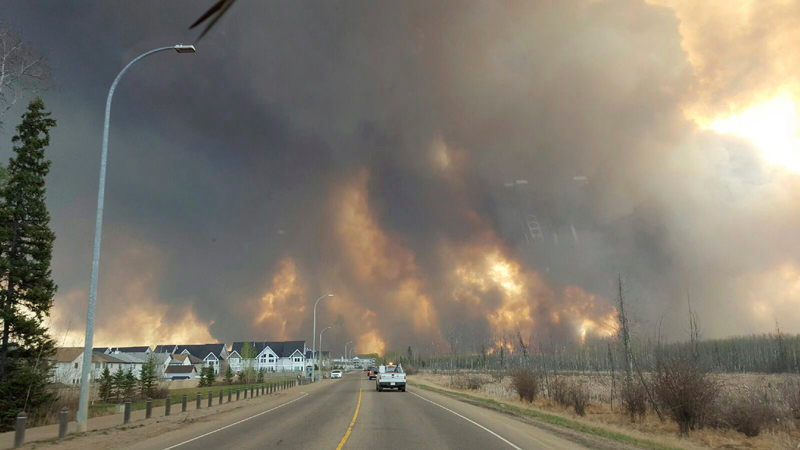
CALGARY – The wildfire raging through the heart of Canada’s oilsands capital dealt a blow Wednesday to crude operations, with companies curtailing production or stopping it altogether.
Shell Canada shut down output at its Albian Sands oilsands mining operations, which have the capacity to produce 255,000 barrels of oil per day. The site is located about 70 kilometres north of Fort McMurray.
The company said it made the decision to focus on getting employees and their families out of the region while also freeing up room at its 2,000-person work camp for some of the 80,000 people who were ordered evacuated Tuesday from Fort McMurray.
“Right now, our priority is providing support for our people, their loved ones and others in the area,” Shell spokesman Cameron Yost said in an email.
Shell also employed its landing strip to fly employees and their families to Calgary or Edmonton and has provided two teams to support firefighting efforts in the area.
Operations were also scaled back at the two largest and oldest oilsands mining operations in the Fort McMurray area.
Suncor Energy said the Millennium and North Steepbank mines, its main oilsands project just north of the city, were not in danger from the fire but it is operating with fewer staff and producing less. About 2,000 evacuees have been accepted at its three work camps, the company said.
“We have evacuated all non-essential employees,” said spokesman Paul Newmarch.
Syncrude Canada also reduced the number of people and machines working at its Mildred Lake oilsands mine 35 kilometres north of Fort McMurray. The company was also sheltering 2,000 employees and family members at its work camp.
Husky Energy said it was cutting production at its recently commissioned Sunrise thermal oilsands project from 30,000 barrels per day to 10,000 bpd because the fire had forced the closure of a diluent supply pipeline. Sunrise, situated about 60 kilometres northeast of Fort McMurray, uses steam injected into a well to produce bitumen and the diluent, a light oil product, is used to thin it enough to allow it to flow in a pipeline to market.
Inter Pipeline, whose systems move about 30 per cent of northern Alberta’s bitumen to market, said it shut off its Corridor pipeline system and partially closed its Polaris diluent pipeline system in the Fort McMurray area as a precaution. No assets have been damaged by the fire, the company said.
Michael Dunn, an oilsands analyst for Calgary investment firm FirstEnergy Capital, said the fire could lead to gasoline price hikes throughout the country, depending on how much damage has been done and how long it takes the industry to recover.
“If this fire does cause an extended period of misplacement of the workforce or movement of them, this may impact the output of a lot of these oilsands mines and upgraders,” he said.
“This could trickle down to crude price differentials, making light sweet crude more expensive, and might trickle down to gasoline prices if refiners need to recoup some of those margins at the pump.”
Canada’s oilsands are considered the third-largest reserves of crude oil in the world, with 166 billion barrels of recoverable oil covering 142,000 square kilometres.
About 80 per cent of Canada’s oilsands are buried too deep for mining and must be recovered through wells. Bitumen ore mined at the surface is considered to be much less flammable than other types of petroleum because it is full of impurities such as sand.
All large oilsands sites have emergency crews and plans for fires, including procedures to shut in facilities to minimize damage.
Most flights in and out of the Fort McMurray International Airport southeast of the city centre were cancelled just before noon.
Follow @HealingSlowly on Twitter.