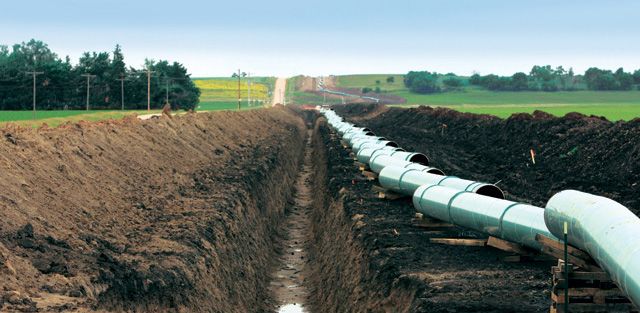
CALGARY – The National Energy Board is set to begin public hearings Monday into the Energy East Pipeline in New Brunswick, a province where the prospect of oil and gas development has led to fierce, and sometimes violent, protest in the past.
A three-member panel tasked with deciding the fate of the controversial $15.7 billion development will start the hearings in Saint John, where the oil that would be shipped through the proposed 4,500-kilometre project would be refined.
In all, 337 intervenors are scheduled to give their take on a pipeline that has already widened a chasm between some who believe the project is vital for the country’s economic growth and others who oppose it on environmental grounds.
Stephen Thomas, energy campaign co-ordinator at the Ecology Action Centre, will be travelling from Halifax to make a 20-minute presentation on the first day of the hearings.
He said he plans to raise concerns about the impact an oil spill would have in the turbulent waters of the Bay of Fundy. So far, he isn’t persuaded by TransCanada’s mitigation plans.
“They would have to work a lot harder than they are now to convince us that they could respond in an effective way, that’s for sure,” said Thomas.
He said he wants to highlight that the pipeline, which would carry 1.1 million barrels of crude per day from the Alberta oilsands to the East Coast, would increase greenhouse gas emissions. But that issue will be assessed in a separate review process run by the federal government.
Roger Hunka, director of intergovernmental affairs at the Maritime Aboriginal Peoples Council, has submitted 16 detailed questions ahead of his presentation scheduled for Tuesday.
He said the council is not opposed to development if it’s well-planned and well-communicated. But TransCanada hasn’t done a good job doing that, he said.
“TransCanada … from my experience, has had a very disdained approach to citizens,” said Hunka. “When it comes to the public, they don’t really care.”
He said his main concern is the impact a spill would have on the environment and how that would affect hunting and fishing grounds.
TransCanada spokesman Mark Cooper said the company is committed to informing the public about all aspects of the project.
“Communication, transparency, accountability, and openness with local communities is fundamental to building confidence and acceptance of our projects,” said Cooper. “Open, two-way communications and information sharing with indigenous communities is essential in order to build a better Energy East.”
He said TransCanada has had more than 3,200 meetings with 166 aboriginal communities across Canada since 2013, including direct meetings with 16 of them in New Brunswick.
Still, oil and gas projects remain contentious in a province scarred from past clashes over natural resources development.
In October 2013, a protest in Rexton by the Elsipogtog First Nation and others against shale gas exploration turned violent when some started throwing Molotov cocktails. At least five police vehicles were destroyed and dozens were arrested.
Not all intervenors are opposed to Energy East, with many companies and business groups strongly in favour.
Joel Richardson of Canadian Manufacturers and Exporters is planning to voice his support and encourage the hiring of local companies to build the project.
“We felt there was a tremendous opportunity for New Brunswick companies to support all the needs that TransCanada’s going to have, and also just to really support a tremendous job creation opportunity at a time when New Brunswick unemployment is still hovering over 10 per cent,” said Richardson.
The hearings, which will take place in nine other cities, are scheduled to wrap up in Kingston, Ont., in December.
The board must make a recommendation on the project by March 16, 2018, to the federal government.
Follow @ibickis on Twitter.