Headlines within the oil gas industry often revolve around the two most fundamental questions in economics: How much is in demand, and how much is in supply. Millions of dollars worth of taxpayer and industry funds are dedicated to measuring, estimating and projecting these numbers, which show up in articles produced by the EIA, the IEA and OIES. As such, the demand curve for crude oil is so steep that small changes in excess demand or supply have a disproportionately large effect on prices. As we ride on the back of a recent plunge in prices, this article attempts to lend an economic foundation to intuition on the economics of supply, demand and how precautionary demand shocks affect the price of crude oils. This article is part of a upcoming series on explaining the price movements, or volatility, within the larger market.
With oil prices declining 20% in July, it is hard to fathom why the price changes so drastically. It is not like a barrel of crude oil magically produces 20% less than what it usually does. The physical characteristic that contributes most to oil price volatility is that crude oil lacks viable substitutes. After a century of production, crude oil has become the largest traded commodity and accounts for a third of our society’s energy requirements.
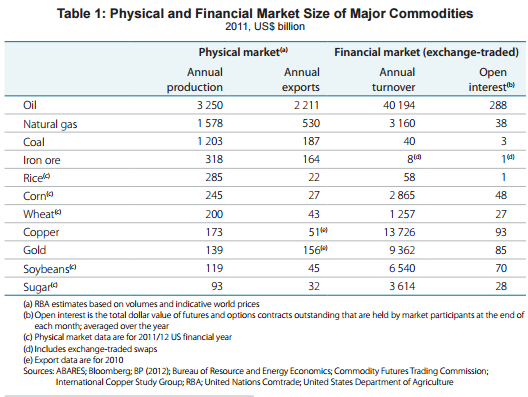
Consumers face little choice but to continue buying in the event of a price increase; crude oil, in economic terms, is an extremely inelastic commodity. Large price changes are required to change consumption, or inversely, small changes in production generate large price changes. It is for this reason that minuscule supply or demand disruptions exert so much influence on spot prices.
Studied in depth by economist Lutz Kilian of the University of Michigan, three types of disruptions, or shocks, hold considerable impact on the oil market. The first being shock to supply. Unexpected changes in the volume of crude entering the market, whether through a strategic market flood, sabotage , inconvenient wildfire locations or military intervention, there are a variety of economic and geopolitical events that can augment supply into the hundreds of thousands of barrels per day.
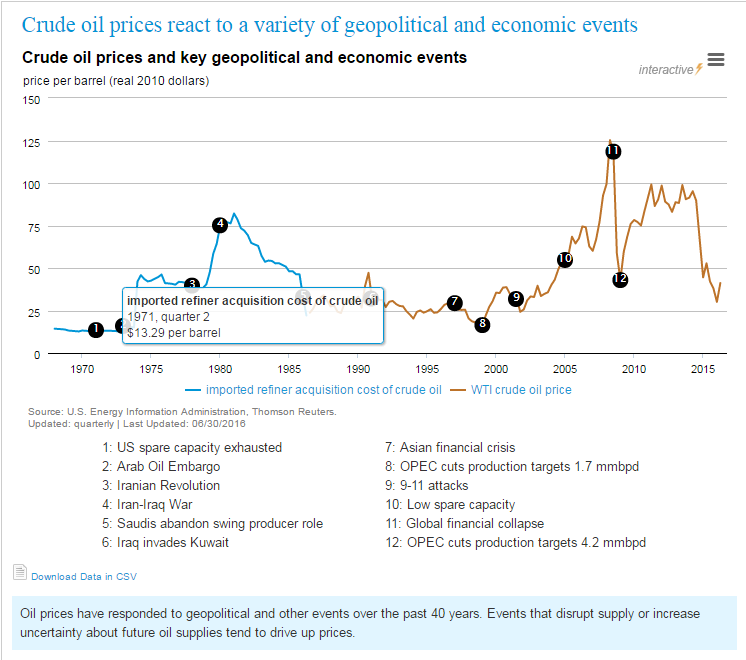
Given a moment in time, these shocks have the effect of shifting the supply curve to the left or right relative to demand, generating short term changes in spot prices. Second, aggregate demand shocks happen through unexpected changes in regional demand. This occurs as nations and economic units alike ebb and flow through their business cycles, reaching periods of growth and decline their oil consumption changes. 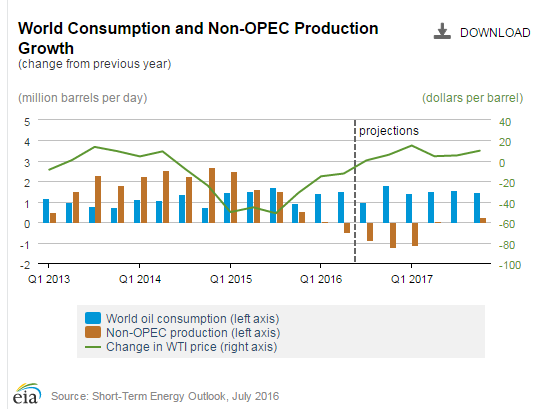
Third, are precautionary demand shocks. With the ability to store crude oil, knowledge of the future price will dictate how much a buyer purchases in any given day. Avi Rapaport, publishing through the University of Chicago divides precautionary demand shocks into two types. A ‘news shock’ reports a future disruption with certainty, such as a war resolution passed through congress upon an oil producing nation. Companies carrying inventory then wield this information to their advantage and buy excess crude to prepare for the future shortfall, causing a immediate dip in price. A ‘variance shock’ occurs when the future becomes less predictable. In the conditions where the balance between supply and demand become less clear, market participants will ensure the smooth operation of their production lines by stockpiling crude. Unlike pure demand or supply shocks which can have a rather lagged effect, precautionary demand spikes cause an immediate, persistent and large increase in crude prices.
The price of crude oil is not unlike an elephant balancing atop a skyscraper; where a simple breeze is enough to jeopardize the balance of the beast. Crude oil lacks substitutes, so that consumers won’t change their buying decisions based on small price changes. The inverse analogue is than true, small changes in supply and demand grossly change the price. This is the foundation for why small changes in these numbers generate such large swings. Supply shocks raise prices by increasing the scarcity of crude. Demand shocks raise the price through increased consumption of our scare resources. Precautionary demand shocks change the price level by changing expectations on future supplies. In an era where rampant price volatility is a primary critique of our current pricing system, knowledge of its roots may help ease future volatility.