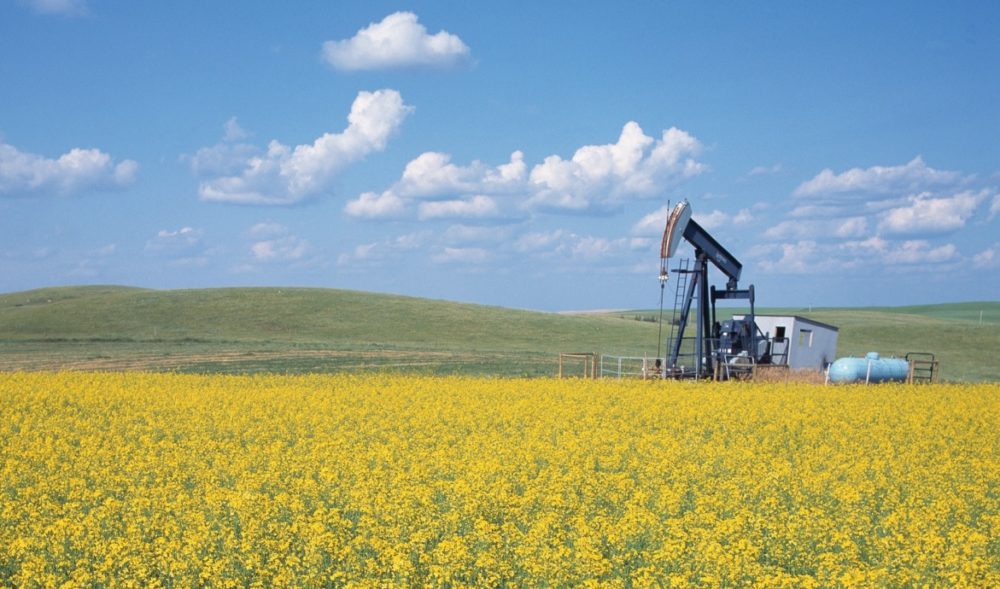
CALGARY – The National Energy Board has revised down its long-term outlook for oil prices and Canadian production in the face of lower global industry costs and stricter environmental regulations.
In an update released Wednesday, the regulator projects inflation-adjusted oil prices rising to US$68 a barrel by 2020 and US$90 by 2040, $12 and $17 a barrel lower, respectively, than in its January report.
“A lot of it is the ability of oil production to be sustained at lower prices,” said Shelley Milutinovic, chief economist at the NEB.
“There’s an expectation that somewhere between 40 and 60 dollars a barrel, you can get a lot of oil production around the world,” she said.
The lower prices are expected to translate to lower long-term production for Canada, where costs are comparatively high.
The NEB projects oil production to increase from 4 million barrels a day in 2015 to 5.7 million barrels a day by 2050, which is 391,000 barrels a day less than what it estimated in its January report.
The lower oil prices would only have a modest effect on increased oilsands production in the near-term, as projects are already under construction, but recently cancelled and deferred projects start to hit production numbers by 2019.
Increasing prices in the longer-term would bring a return to steam-extraction oilsands growth, while mining-based oilsands production remains flat from 2020 onward as the high cost of the large-scale projects make them less economic.
Rapidly changing climate policy is also creating increased uncertainty for oil and gas, but so far it’s playing out more in changing projections in the electricity sector.
The NEB sees non-hydro renewable energy making up 12 per cent of electricity generation by 2040, up from eight per cent in the January report, while coal drops from seven to one per cent of generation, as Alberta’s and Ontario’s climate plans take full force.
Prime Minister Justin Trudeau has also committed to imposing an national carbon price on provinces that don’t initiate their own programs, but Milutinovic said the policy was announced too late to be incorporated into the report.
“Things are changing very very quickly, particularly with respect to climate policy,” said Milutinovic. “It’s a very fast-moving target.”
Technology improvements and stricter regulations continue to push down energy demands, she said, with energy consumption growth rising only 0.5 per cent a year compared with 0.7 in the last report and 1.3 per cent over the past 25 years.
“We’re in a time of so much considerable change when it comes to climate policy, which is very influential when it comes to energy markets,” said Milutinovic.
Climate change is also leading to greater scrutiny and uncertainty on pipeline proposals in Canada, but the NEB assumes infrastructure will be built as needed in its projections.
Similarly, the NEB assumes liquefied natural gas exports begin in 2021, even though no export projects have been sanctioned.
The report estimates that the opening of exports would boost natural gas production from 14.8 billion cubic feet per day in 2020 to 17.3 billion cubic feet per day by 2025.
Follow @ibickis on Twitter.