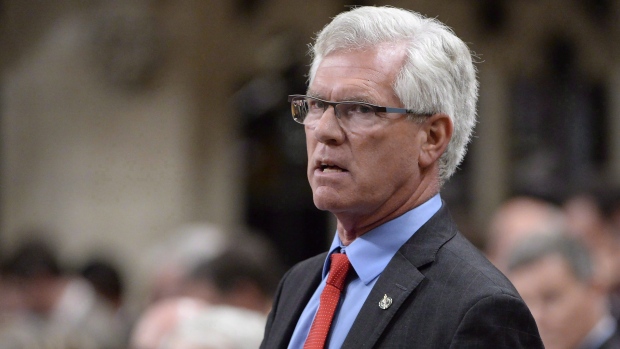
OTTAWA – Natural Resources Minister Jim Carr says the federal cabinet was never going to include downstream emissions as a factor when it reviewed the application for the now defunct Energy East pipeline.
In a bid to stem political fallout from Energy East’s demise, Carr is on a mission to convince Canadians his government’s policies are not to blame for it.
But a new research report suggests the project is just part of a trend of energy investment going elsewhere because of the high cost of additional government regulation in Canada.
TransCanada cancelled the Energy East project last week citing “changed circumstances.”
In response to a barrage of questions lobbed at him in the Senate on Tuesday, Carr repeatedly asserted those circumstances were not government policies.
“The situation had changed dramatically,” he said, pointing to oil prices less than half what they were when the project was first proposed, and the recent U.S. decision to go forward with another TransCanada project, the Keystone XL pipeline.
Opponents blame Carr’s government for changing the review process and including things like upstream and downstream emissions — that is, greenhouse gas emissions created by extracting the oil before it flows through the pipeline and those create by refining and burning it after it leaves the pipeline — as part of the evaluations of proposed projects.
While the National Energy Board panel decided to look at both upstream and downstream emissions, Carr said the government had only asked that upstream ones be looked at. He said that was done in 2016 when the government approved both the Enbridge Line 3 and the Kinder Morgan Trans Mountain pipeline projects and it would have been the same for Energy East had it ever made it to cabinet for consideration.
If upstream emissions didn’t stop approval of the other pipelines, Carr said TransCanada had no reason to believe it would stop approval of Energy East.
But a new research report by the Montreal Economic Institute suggests Energy East’s demise is a growing and worrisome pattern.
“People are giving up on Canada as a safe place to invest in natural resources,” said economist Germain Belzile, a senior researcher at the institute.
“It’s seen as a very hostile environment now. You have a lot less certainty if you invest here (than) if you invest in many other countries where the regulatory environment isn’t changing as you’re doing things.”
Four major projects have now been cancelled in the last two years, including Energy East, the Northern Gateway pipeline, and two liquid natural gas plant proposals, he noted. Together they amounted to $84 billion in investment.
Belzile said new regulations in Canada, including things like the carbon price, coupled with a reduction in regulation under President Trump in the U.S. has seen investments leaving Canada and flowing to the U.S. instead.
His report shows capital investments in resource projects in Canada and the U.S. rebounded this year but are expected to grow 38 per cent in the U.S. and just 19 per cent in Canada.
The Liberals could face political fallout if Canadians think their policies are hurting the investments and job creation that come with them.
Pollster David Coletto said Energy East alone is not likely to be the only reason the Liberals lose seats in 2019 but it could be a contributing factor, particularly in New Brunswick, which stood to gain refinery jobs had the pipeline gone ahead.
“This fits with a broader narrative that is starting to develop about the government’s position on business development and business friendly policies,” the Abacus Data CEO said.
However, he added Energy East could have been a political liability for the Liberals in Quebec, where opposition to it was strong.
-follow @mrabson on Twitter.