Carbon capture and storage (CCS) is a hot topic in the 2023 Western Canada energy landscape…and with good reason! Western Canada has both the geology and the geological and engineering know-how to sequester CO2 in a big way. This article focuses on results from the recently published Northeast BC Geological Carbon Capture and Storage Atlas. The atlas provides a high-level analysis of CO2 geological storage potential in saline aquifers and depleted gas pools in NEBC; it found that there are multiple opportunities for geological carbon storage within both saline aquifers and depleted gas pools on all scales from small to large.
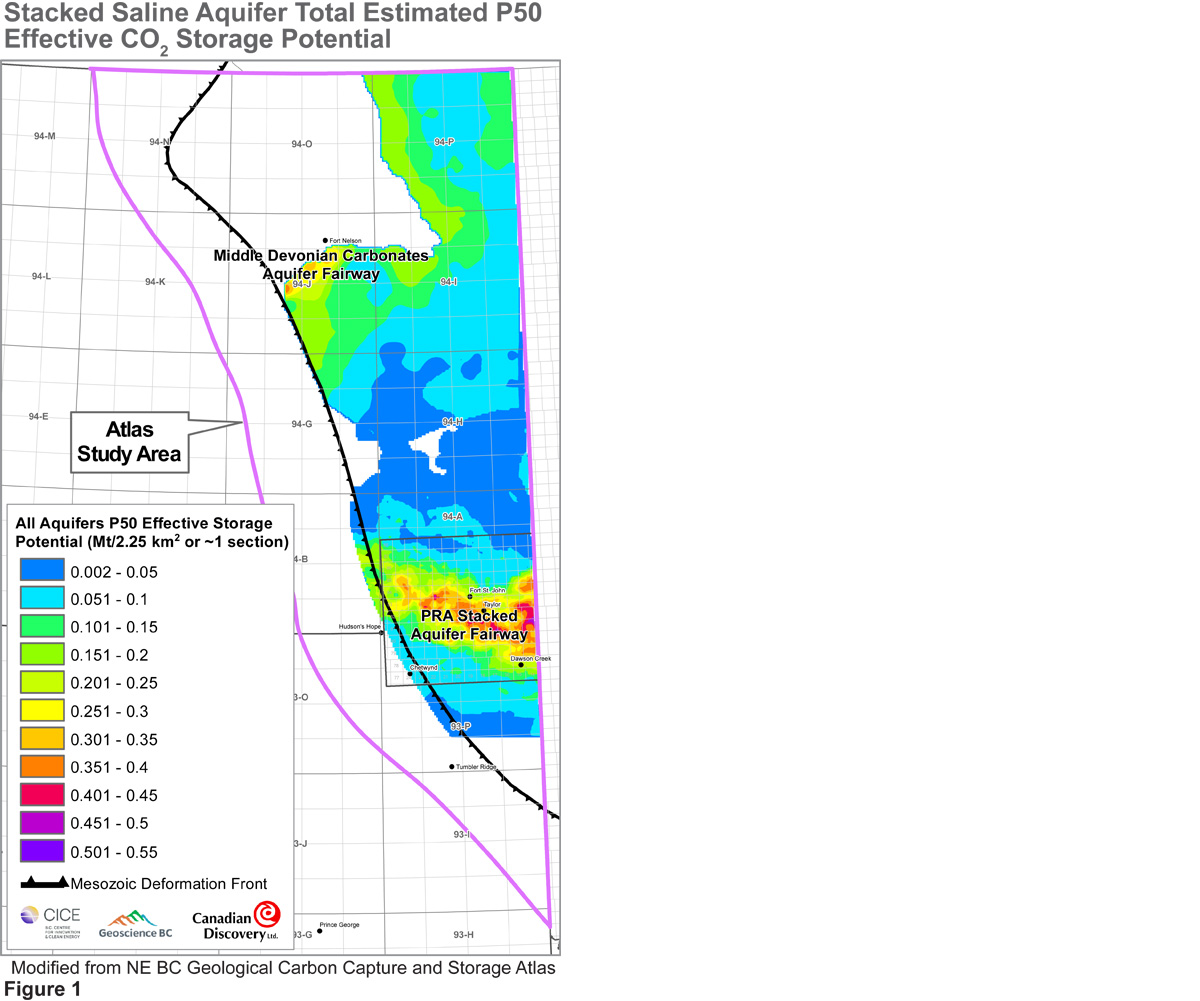
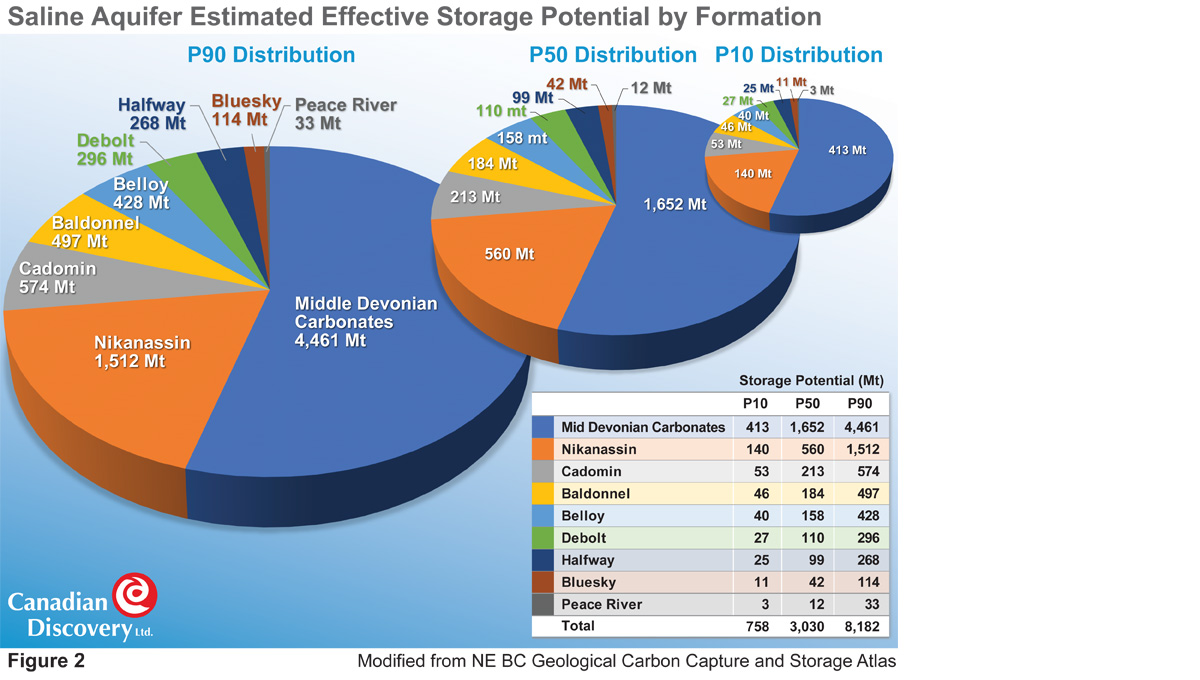
The CO2 storage potential in saline aquifers is substantial. Figure 1 is a map of the NEBC atlas study area highlighting areas of total estimated P50 effective CO2 storage potential that has been combined (or stacked) for all aquifers. A clearly defined fairway of stacked aquifers with significant storage potential has been identified in the Peace River block near Fort St. John; it is coincident with some of the larger CO2 emitters between Fort St. John and Dawson Creek. A second substantial aquifer fairway exists further north near Fort Nelson. Figure 2 shows the distribution of the estimated effective storage potential of saline aquifers by formation on a P10 (small), P50 (median) and P90 (large) basis. Total estimated effective P50 storage potential available in saline aquifers is 3.0 gigatonnes (Gt) (3,030 megatonnes (Mt)), with a P10–P90 range of 0.758 Gt (758 Mt) to 8.2 Gt (8,182 Mt), respectively. To put this in perspective, British Columbia’s CO2 emissions for 2020 were calculated by the provincial government to be 65.4 Mt (BC Government, 2023).
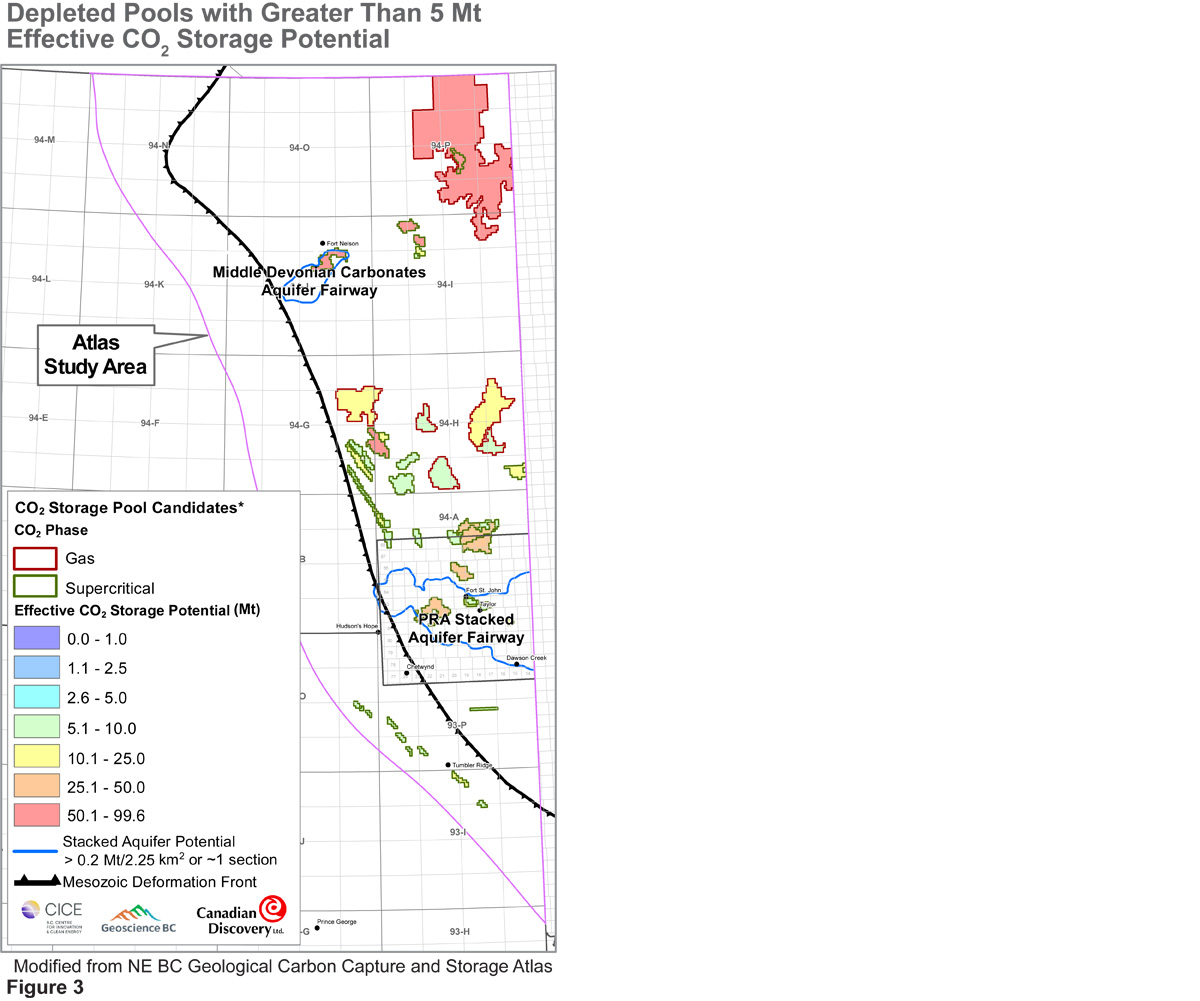
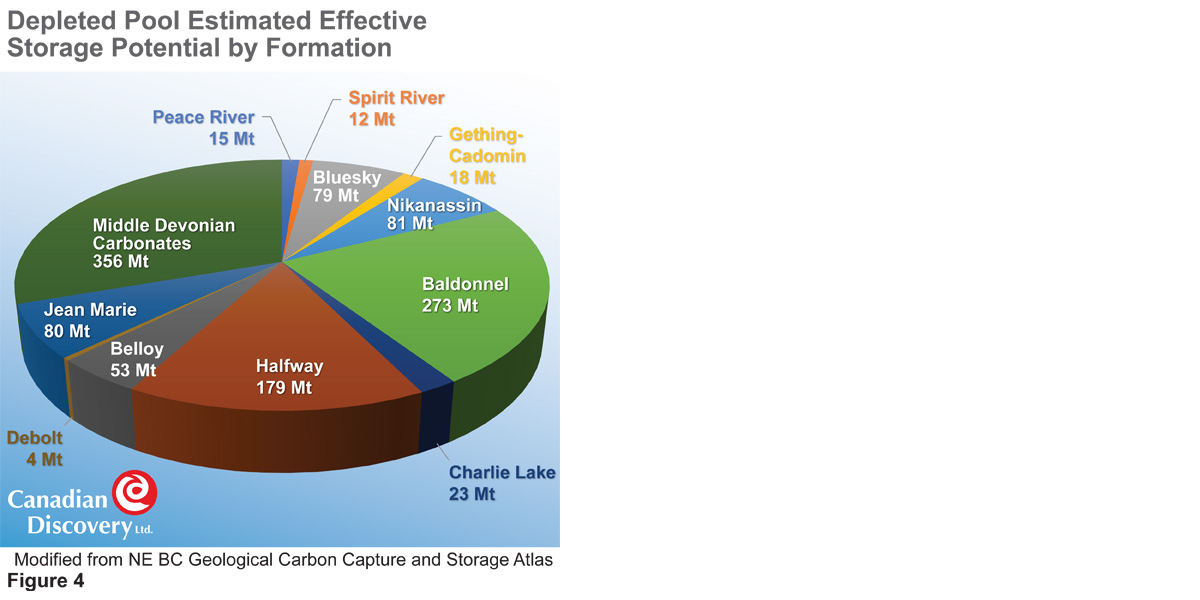
Depleted gas pools could also figure prominently in meeting NEBC’s CO2 sequestration needs. Figure 3 shows depleted gas pools with greater than 5 Mt of CO2 calculated storage potential, whereas figure 4 shows the distribution of effective storage potential in depleted pools by formation. Several depleted pools with greater than 25 Mt of storage potential exist in the Fort St. John area. For perspective, a depleted pool with 25 Mt of storage has the potential to sequester 1.2 Mt annually for 20 years. Total estimated effective storage available in depleted pools in NEBC is approximately 1.2 Gt (1,173 Mt).
The atlas was sponsored by Geoscience BC, the BC Centre for Innovation & Clean Energy (CICE), and the BC Hydrogen Office, while the research (collating available public data/studies, filling in gaps in mapping and the CO2 storage calculations) was undertaken by Canadian Discovery Ltd. (CDL). The atlas can be downloaded from the Geoscience BC website; the link is in the references.
To learn more about the Northeast BC Geological Carbon Capture and Storage Atlas and how CDL can provide similar cost-effective and sustainable solutions to fit your needs, visit https://canadiandiscovery.com or contact us at info@canadiandiscovery.com.
References
BC Government website. 2023. Provincial greenhouse gas emissions inventory. Accessed February, 2023. https://www2.gov.bc.ca/gov/content/environment/climate-change/data/provincial-inventory#:~:text=In%202020%2C%20B.C.’s%20gross,emissions%20reduction%20and%20sectoral%20targets
Geoscience BC. 2023. Northeast BC Geological Carbon Capture and Storage Atlas. Accessed February, 2023. Download at https://www.geosciencebc.com/projects/2022-001/