Ok, someone’s gotta say it. A few things need fixing if Canada is to begin attracting significant investment again.
Here’s one no one likes to talk about. Something is severely broken in the intra-Alberta gas market. Natural gas producing companies are being driven into bankruptcy due to pathetically low natural gas prices. Hold on, you might think, that’s not all bad – low natural gas prices are a boon to investment; they should attract any industry that relies on affordable gas. Low AECO natural gas prices should be a cheap fuel that is a magnet for industry. Any business that requires large amounts of reliable, clean-burning, cheap natural gas should be flooding into the province.
They are not.
There are two main causes for this predicament. The first one is so bizarre that people have trouble wrapping their head around it: It is not easy to access natural gas in Alberta. You read that right. The province is bloated with the stuff, and yet the system by which people can theoretically access it has become dysfunctional and ineffective insofar as serving provincial business goes.
The second cause is more easy to understand: An industrial carbon tax that is more than twice the value of the underlying fuel is pretty much guaranteed to drive away business. And if there is anything worse than the carbon tax on natural gas, it is gross uncertainty about where that tax will go.
Politicians, please pay attention. PLEASE.
Customers big and small – and in the category of big, I include at least one of the bigger companies in North America – have thought that Alberta is a logical place to build new gas-consuming infrastructure. They have assumed that, because Alberta is a gas-bloated jurisdiction with ridiculously weak prices, that it will be easy to access natural gas. It is not. Accessing gas off the NGTL system is like ordering a Lada in the Soviet Union in 1980. Sure, place your order, hand over your deposit, and we’ll get to you in a few years. Maybe. If there’s enough. And you’re going to pay for it for a very long time.
TC Energy recently held an open season for new FT-D service (delivery off the system) (the link may disappear soon, but I’ve kept the receipts). The total new capacity available for the province under this open season was 235,000 GJ/d, with Targeted Service Commencement Date of April 1,2029. Any allocation will be for a minimum of 15 years of firm service (“NGTL will only consider a contract term of 15 years or more…”).
235,000 GJ/d is nothing. A modern gas-turbine fired 500 MW (0.5 GW) turbine, will consume about 100,000 GJ/d. For context, Alberta’s grid regulator AESO noted this past summer that there were 16 GW of new demand in the queue, mostly from would-be data centers. Not all of that is real, but a lot of it could be. But they won’t find it easy to get natural gas, dumbfounding as that sounds. The entire allotment of TC Energy’s open season could only satisfy about 1.5 GW of that demand, if it were all dedicated to that data center queue, but there are other demands as well.
Note also that the target in service date of April 2029 is about 2 years beyond what most customers are looking for in terms of gas supply. That time frame, married with the long term firm service requirement, is a non-starter for serious market entrants.
The Alliance pipeline system recently announced a call for expressions of interest to provide new transportation capacity, short-haul point-to-point transportation service that would take gas from NW AB to Fort Saskatchewan. The amount being considered is 350 million cubic feet per day, or about 400,000 GJ/d – more than the TC Energy open season, but limited to a single delivery point just outside Edmonton. It is a great end point, but the whole province has the potential for data center hosting (and/or other demand industries), not just this single point. And again, the proposed service has a targeted in-service date of 2029.
Both these proposals combined can’t meet a fraction of the demand from blue chip customers, and that’s even before we’ve gone shopping for more.
The aforementioned person from the large US company told me, “In the US, if I want to get gas from TETCO [Texas Eastern Transmission Pipeline, a huge SE US mainline], I hook up to TETCO. My only problem is finding a producer to supply it.” In Alberta, you can find bedraggled producers everywhere you look, but their gas can’t get to potential new consumers, even though the province is swimming in it.
Without mainline access to natural gas, with its vast systemic redundancy, it is very hard for gas producers and end users to strike a deal. A single data center can’t be built around a single power plant or built around a single gas processing plant, because there is not adequate redundancy to provide the high service requirements of data centers. Both gas plants and power plants go down for maintenance, and occasional equipment malfunctions as well.
It is very hard to build in redundancy for power plants, without having to connect to the grid and go through the whole AESO scheduling nightmare (not shaking a fist at AESO there, the challenge they face is off the map: soaring demand, increasing intermittent power sources, carbon tax chaos, etc.). To build in power plant redundancy without connecting to the grid would mean inter-linking at least two power plants.
The same challenge exists for gas producers. Most gas processing plants have vast gas gathering system networks that move raw gas – not fit for data center consumption. These GGS feed centralized gas processing plants, which tend to be located on major pipeline systems – NGTL or Alliance, primarily. To reroute processed, pipeline-spec gas through multiple natural gas plants (for redundancy) to satisfy a data center site is no easy task.
One starts to think they are losing their mind when analyzing this situation. The biggest companies in the world are desperate to build AI infrastructure; they have hundreds of billions to spend and are actively looking to do so. Alberta gas producers are desperate for higher prices. LNG helps, and will help more, but there is every reason to believe producers could add far more than what even LNG2 will absorb (see: any big new Montney well pad…and this doesn’t even scratch the surface of how much gas could be produced in gassy regions that have not been developed for decades (coalbed methane, for one example, or any number of gas-prone plays in NE BC or NW AB)).
On top of this fiasco is industrial carbon tax uncertainty. The industrial carbon tax remains, and the federal government hasn’t said much about scrapping the plan to get it to an utterly debilitating $170/tonne of CO2 emissions. So industry will either be faced with this tax millstone around its neck, or be forced to spend vast sums on CO2 emissions reduction technology – and we are trying to attract investment to Canada?
The Carney government has voiced plans to possibly implement a CBAM – a carbon border adjustment mechanism, which will slap a tax on anything coming into Canada from countries that don’t have a carbon tax. The delusional, delirious rationale: Such a tax will “encourage trading partners to decarbonize.” Possibly this scheme will find open arms in Europe, which is itself driving towards deindustrialization with lunatic green policies, but the rest of the world will look elsewhere to invest, thank you very much Canada.
Is the cost of natural gas in Alberta $2.00/GJ at AECO, or $6.00/GJ including industrial carbon tax? That’s quite a difference. And will the gas price in AB in 2030 be ~$3-4.00/GJ as forward prices indicate, or will it be $12-$13/GJ if industrial carbon taxes rise to where they were aimed? That also is quite a difference. Gas prices at that level are approximating global LNG prices.
Here is perhaps the most astounding situation you can imagine: Canada, if carbon taxes are implemented as per the federal vision, will have among the highest natural gas input cost price for industrial consumers, and among the lowest global prices for producers.
Low natural gas prices for producers can have a terrible effect: low margin gas suppliers, such as shallow gas or coalbed menthane or other low-rate-well fields are subject to abandonment due the high costs required to compress natural gas to mainline spec, along with significant fixed cost items like property taxes and other operating costs. Once fields become uneconomic, wells become subject to abandonment, processing equipment is decommissioned, etc., and the price required to reactivate these fields would be much, much higher down the road. To allow this is very poor asset management.
On top of that, low natural gas prices leave an enormous amount of royalties on the table for the provincial government, and spin-off benefits for whomever benefits from that money (federal tax coffers also). The province’s royalty take on near-zero valued natural gas is pathetic; the resource that belongs to the people of the province is being given away with scant benefit to anyone. Customers would love cheap gas, but we don’t have that – not once carbon taxes are layered on.
One thing that it would be great for governments to become curious about: How much money is not invested in a jurisdiction because bad policy drives it away?
We have a strong entrepreneurial bent here in the west, and many see boundless opportunities. But the path to get to those is insanely challenging, for no good particular reason at all.
I get it, politics isn’t easy. Those outside that arena, including myself, don’t know the full challenges of succeeding at any of this stuff, the political battles that need fighting, the endless maneuvering, all against the backdrop of re-election prospects.
But it must become a priority. This situation, the lack of investment in Canada, appears to the world to be nonsensical, because it is, to flap our arms about what a dearth of investment there is, and then to maintain policies that make the problems worse.
Politicians everywhere, would you mind digging into this instead of focusing on minutiae that two percent of the population get hung up on?
The opportunity for Canada is staggering. We are an energy and minerals powerhouse. We have huge talent depth across the industrial spectrum; we have space, we have power, we have people. Geopolitical global alignments are being forged as we speak around the very components that Canada has an abundance of. Can we grasp the opportunity, or get lost in infighting?
The issues outlined above are the direct root cause of problems that you yourselves say you want to address: A lack of investment. Thank you for your attention to this matter.
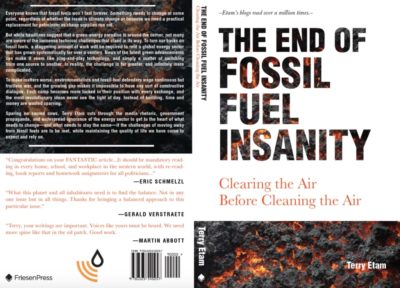
At the peak of the energy wars, The End of Fossil Fuel Insanity challenged the narrative, facing into the storm. Read the energy story for those that don’t live in the energy world, but want to find out. And laugh. Available at Amazon.ca, Indigo.ca, or Amazon.com.
Email Terry here. (His personal energy site, Public Energy Number One, is on hiatus until there are more hours in the day.)