Environmentalists, the old fashioned kind, used to hold their rusty Subarus together with an assortment of bumper stickers, little rectangular slogans randomly overlaying decaying metal. A memorable one was the exhortation to go outdoors and ‘hug a tree’, thus causing a generation of nature lovers to be declared ‘tree huggers’ in a sometimes snarky way. (The phrase isn’t used much anymore, except oddly as advice to children if they become lost in the woods – to ‘hug a tree’ and stay put).
I bring this up because the phrase or accusation might be making a comeback soon – a tree is one aesthetic object that AI won’t be able to fake. We are going to need things like that. We are going to need all the nature we can get. Hug a tree might become a new motto as an antidote to AI’s seemingly inexorable march to dissolve everything we currently hold dear and replace it with automation and synthetic reality.
AI is now in the process of smashing through various pleasant cultural aspects, ‘enhancing our abilities’ according to some people, ‘destroying originality and freely feasting on historical artistic efforts’ according to others.
A fake band roared up the charts, fake band members cranking out fake music behind a fake picture, all good enough that it fooled Rolling Stone, and you’d think they would be the hardest to fool.
Or was it fake? What is a fake? A copy of an original. Is AI-generated music in, say, the style of Ed Sheeran, a fake copy of his music, or a synthetic attempt to capture the heart and soul of it? Is that different than derivative bands, to the extent that anyone seeks on purpose to be a derivative of Ed Sheeran?
It’s an old question, one I first contemplated long ago in a university philosophy class on Aesthetics, taught by a hilarious little grey-haired pot head that used to put his feet on the desk and ask if there was anything we wanted to talk about and if not we could leave and he would still pass everyone because why not (his final exam was cheerfully consistent; choose two of a list of twenty questions to answer, write a page on each, and the 20th question was “Make up your own two questions.” I respected that, oddly; he really wanted people to think, and chose to learn more in that elective than most others).
It might seem odd to say but the class was actually valuable, extremely so. Here I am talking about it decades hence. We pondered, if we chose to stay awake (also optional, thanks blessed prof), whether an exact replica of a work of art was actually a work of art. These conversations spiralled out into all sorts of fascinating possibilities. What if the original were destroyed and all that remained was the exact replica? Would that be art? Is an aesthetic object art, because it is pleasing to the eye? A kitten is an aesthetically pleasing object, is that art?
At the end of the day, it doesn’t really matter; what matters is our appetite for such stuff. Someone captures an amazing pic, and we admire it, or share it, or pay money to frame it and hang it on the wall. And because there is a that someone special out there, don’t hang kittens on the wall regardless of qualification. There would be no quicker way to solve the debate as to whether it was art or not.
If AI can crank out 1,000 variants per second, is there anything special anymore? Not really. Such art will be the equivalent of cheap hotel art, stuff that is so bland that no one is even interested in stealing it.
Same goes for novels. AI will steal what it can from the landscape, and crank out endless variations minutely different. It will be a tidal wave of junk.
But maybe so what? If we’re going to look at the negative side of all this, then surely we have to look at the positive side. That was the downfall of the climate movement, trumpeting any negative impact of hydrocarbons while refusing to acknowledge the benefits, even though everyone on earth could see them with their own eyes, a thousand times a day.
It is easy to rage at cell phones and social media and AI. They’re rotting our brains/destroying youth/whatever. Possibly, in some instances. But what have these things brought us? Nothing but a shop of horrors? Of course not. We enjoy countless benefits from our devices, and no one wants to truly live without. Perfect? Of course not. What is. And it’s the same with AI. Raging at it, or being terrified of it, is to focus on only one aspect of its potential.
AI will take on many forms. One of those forms is catalogued above, the ability to debase art in the same way art has been debased for a long time. Another will be automation of certain tasks and occupations, causing extinction of certain occupations, which, again, has been happening since people hunted animals with spears or arrows.
AI will open up new realms, it seems almost certain, and speculating on what those might look like is very hard. Nvidia’s website has an excellent blog that chronicles various subjects that are being transformed with AI: Faster image processing for autonomous vehicles. Nasdaq, the stock exchange, is using AI to develop deeper investment insights and quality of decisions. American Express prevents fraud and foils cybercrime. Architects using AI for outdoor designs.
All good stuff, and hard to say these things are wiping out employment. They are likely broadening the scope of certain jobs, not necessarily eliminating them.
Overall, one thing is often overlooked in doomsday scenarios: the fact that people demand, and likely always will, the human touch, or the human element. Beethoven is still popular. People read and appreciate the classics. No one pretends that a Zoom call is the same as meeting someone for coffee, even though Zoom is a big improvement over a phone call.
Even much-maligned cell phones enable human contact to a far greater degree than before. Kids are lost in their screen and not interacting with humans? You sure about that? During the most recent tragic Blue Jays game my friend in Toronto and I sent about 100 texts collectively. And I maintained two other conversations at the same time plus the live one with those in the same room as me. Kids are always in touch with each other. That was not possible a generation ago.
Maybe a wall of fakery forces us back to touching what is real again. Maybe we want to see real pieces written by real authors. Maybe we go see real live music with guitars plugged into amps and not into computer banks or other shenanigans. Only when we’re at risk of losing things do we appreciate them appropriately.
It is highly likely we will adapt to AI’s worse characteristics, because it will also have good ones, and because it appears we are going to be forced into the experiment anyway. Necessity is the mother of invention, in many ways. We just don’t know how this will all go.
The biggest challenge may be the thing that seems most real about AI projections – the prodigious energy it will require. No matter which way AI goes, it seems quite clear that the buildout will happen, as fast as possible, and the call on energy is going to be something else.
But as far as the rest of the speculation…It is easy to let the imagination run wild to the downside, we seem hardwired to do that regardless. It is easy to conjure up worst case scenarios where robotic AI takes over everything, produces everything, and we lay on day beds blob-like, “enjoying” Elon Musk’s favoured Universal High Income, never having to do anything, wired to the system by VR headsets and lord knows what sort of disgusting porn devices the industry will inevitably come up with, dead to humanity for all intents and purposes.
Maybe that happens. But most humans I know would refuse such an existence. And the young people I know do things like, last summer’s odd craze, go on a mountain hike in summer in time to catch the sunrise. Do the math on that one…it meant leaving the city at 2 or 3 in the morning, and it is wacko, but many made it happen, and bless their little hearts for it.
Go outside and hang out in the trees. Real ones. There’s nothing like it and never will be.
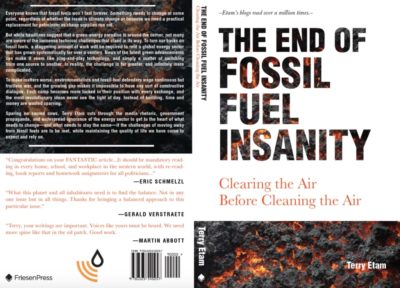
The ideal Christmas present, or well not bad if you can’t think of anything else. At the peak of the energy wars, The End of Fossil Fuel Insanity challenged the narrative, facing into the storm. Read the energy story for those that don’t live in the energy world, but want to find out. And laugh. Available at Amazon.ca, Indigo.ca, or Amazon.com.
Email Terry here. (His personal energy site, Public Energy Number One, is on hiatus until there are more hours in the day.)