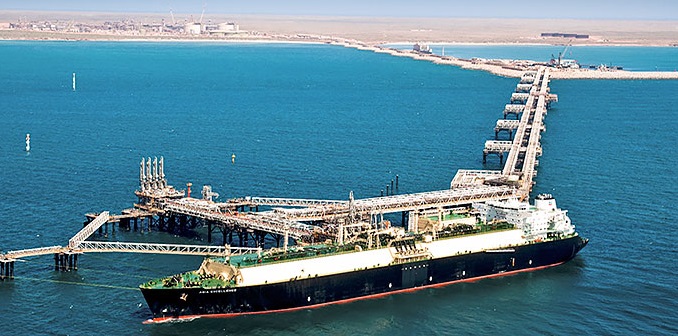
 Australia will make exporters of liquefied natural gas from the country’s east coast keep up to a quarter of their output for domestic use from 2027, under a scheme unveiled on Monday to curb price spikes and help fill a long-forecast supply gap.
The centre-left government of Prime Minister Anthony Albanese said it would work with exporters to design a system that puts a lower limit on the amount of gas held domestically, with a minimum local allocation of between 15% and 25%.
The announcement puts a number on a policy that the government has flagged through 2025 amid persistent warnings about a shortage of gas supply on Australia’s east coast, where most of its 27 million population lives.
“More affordable Australian gas for Australian users will support our economy and our transition, while remaining a reliable energy partner to our region,” said Climate Change and Energy Minister Chris Bowen.
The proposal will only affect new contracts agreed by the LNG exporters, not their existing contracts, Bowen said.
Australia exports far more gas than it consumes, and the competition regulator warned on Monday that the expected local shortfall had widened, with output dropping from legacy fields off the south coast.
The scheme was recommended by a gas market review ordered by the government in mid-2025, which was also published on Monday.
The review said a gas reservation scheme would put downward pressure on prices and urged the government to consider ending a A$12 ($7.94) per gigajoule price cap in place since 2022.
Bowen, in his statement, said the gas reservation scheme would be based on the review recommendation but he did not say whether the government would phase out the price cap.
The scheme would impact three LNG export plants in Queensland, particularly Gladstone LNG (GLNG), which is operated by Santos and backed by Korea Gas Corp (KOGAS), TotalEnergies and Malaysia’s Petronas. It has typically relied on third-party domestic gas to meet export commitments.
A GLNG representative was not immediately available for comment.
Rival export consortia Australia Pacific LNG (APLNG), led by Origin Energy with ConocoPhillips and Sinopec, and Queensland Curtis LNG (QCLNG), led by Shell with CNOOC and MidOcean Energy, were also not immediately available for comment.
“This recommendation simply puts in place a sensible regime that should have always been there,” said Energy Users Association of Australia CEO Andrew Richards.
(Reporting by Byron Kaye in Sydney, Helen Clark in Perth and Sneha Kumar in Bengaluru; Editing by Rashmi Aich and Sonali Paul)