Buddhists say that life is suffering. Don’t we all just feel full of life these days?
Everything feels crazy and painful, or infuriating, or all of the above. I can’t tell you how many people say they just tune out, especially the news.
Tuning out and going for a walk in nature is a great way to deal with it all, but that isn’t always an option. So what to do then. Well, there are ways to get through it all intact…
Growing up near a small rural town, where country people gathered from a 20-mile radius, all the locals are held together by an underlying truth – that the people in the next town over are complete idiots. They run their stupid little enclaves in stupid little ways. Many a coffee row session is enlivened by tales of Stupidtown’s incompetence.
And yet all of that, one hundred percent of it, would get put aside when, say, a certain provincial football team took to the field. On those occasions, there were no divisions, it was one united army against anyone all comers.
Small town Sask is but one example of this; the same phenomenon happens amongst competing large cities, and I’d name two right here in Alberta except a Sask transplant shouldn’t muddle in it. It’s born in you. But again, we can also unite under a common banner when the threat is from the right level.
You might notice a troubling lack of common sense in such chains of influence, and you would be right. Also troubling is how this tendency largely governs how we are governed. This tribal tendency is far more common than we think, and it clouds judgement in very unhelpful ways.
By roundabout way, here’s an example of two high profile figures acting in ways that galvanized populations into admiration, or hatred, all with one act. The point of the exercise here is to specifically refrain from jumping into one camp or the other, from immediately framing the person in question as a moron from the next town. They might well be morons, but no matter. Focus on the problem at hand, then on solutions, then at some point down the road – at a voting booth, for example – decide who the morons are.
One of the people in this comparison is a US Supreme Court Justice, and the other is a Canadian federal cabinet minister. You can mash up these two people any way you like, popularity wise; this particular US Supreme Court Justice recently participated in the majority opinion that shot down President Trump’s use of emergency powers to impose tariffs. The Canadian cabinet minister publicly defended some very dubious legislation.
Just based on those simple descriptions, our heads are filled with enough auto-context to know almost automatically whether we love those people or loathe them. That is how all the trouble starts. That’s how we wind up spending every day pissed off at everything. A better way is, as I quoted here a few weeks ago but willing to be repetitive because it is so important, is to follow the advice of Warren Buffett: “You will continue to suffer if you have an emotional reaction to everything that is said to you. True power is sitting back and observing things with logic. True power is restraint. If words control you that means everyone else can control you. Breathe and allow things to pass.”
US Supreme Court Justice Neil Gorsuch didn’t shoot down tariffs because Orange Man Bad, although it is taken as that. The WSJ had an excellent dissection of his thinking, that Gorsuch made “an effort to encourage Congress to reclaim its proper authority under the Constitution’s separation of powers.” Gorsuch wrote: “Our founders understood that men are not angels, and we disregard that insight at our peril when we allow the few (or the one) to aggrandize their power based on loose or uncertain authority…We delude ourselves, too, if we think that power will accumulate safely and only in the hands of dispassionate ‘people . . . found in agencies.” The WSJ article notes that this applies equally when liberal Presidents impose vaccine or energy mandates, based on no clear law. Gorsuch is viewed as a hero by some for helping stop tariff action, and as a villain by others for doing exactly that… but listening to his logic, it’s really not about tariffs at all. It is about checks and balances on power.
Meanwhile, up in Canada, a brouhaha rightly erupted when a tiny little clause was found in a great big government bill. The clause authorized ministers to ‘grant temporary exemptions from the application of provisions of certain Acts of Parliament…with the aim of facilitating the design, modification or administration of regulatory regimes to encourage innovation, competitiveness or economic growth.” That’s a mouthful, and at a glance doesn’t sound so bad, especially as part of something as nobly entitled as the Red Tape Reduction Act. Who wouldn’t like that. But hey wait a minute, said clever readers; the bill actually gives ministers the right to exempt themselves from pretty much any law, except criminal code ones, at the sole discretion of the minister. Who might be a genius or might be a smooth-talking slimy criminal (the only job requirements are to get elected, and to be tolerable enough to the leader to eventually land a cabinet post. Not a very high bar.).
Minister of Canadian Identity and Culture (now that’s a freaking scary portfolio…Minister of identity?? Minister of culture?? We need someone to govern and control our identity? But anyway) Marc Miller defended the addition of the blanket-immunity-from-law clause by saying, clumsily and unwisely, that “it is a useful tool to have” and that Canadians, bizarre as this sounds, need not worry that it will be abused because “I think Canadians expect us to act reasonably.”
I can assure you most emphatically Minister Miller, we do no such thing. We generally expect the opposite. If you act reasonably, we do cartwheels. But no one anywhere on earth thinks it is a good idea to allow federal ministers at their discretion to override any law, on the grounds that “Canadians expect ministers to act reasonably.”
Over these two scenarios, there is more than enough material here to get anyone’s blood boiling over. But there are ways to contemplate these things other than in a murderous rage.
Keep in mind the principles behind what is going on in both these situations. Stay calm. It can be done.
In the US, the US administration is seeking to address economic challenges that are rattling the very foundations of the country: unstoppable government spending that consistently and wildly exceeds income, national debt levels heading for unsustainable territory, and a manufacturing/industrial heartland that has been gutted and abandoned as the US (and the rest of the west) turned manufacturing and metals/minerals processing over to China, who used a cheap labour force, a governing ‘meh’ towards environmental slop, and a massaged currency to attract all the manufacturing business. All these ingredients together have caused a monstrous headache for the US, and, with a sense of urgency, the US administration is seeking to rectify the problems. The US Supreme Court said, in essence, government policy is not being decided here, but the structure of decision-making is – it must be respected. Congress must have a say.
In Canada, the reason for creating such a dangerous clause as Miller poorly defended/articulated is not a bad one: Canada is so clogged with regulatory junk that it is ridiculously difficult to build anything. The point of the clause is to enable the government to do what it said it was going to do: Build major infrastructure projects quickly.
That is indeed a noble cause; the just-step-around-the-law clause is an effort to expedite construction of major projects. Which everyone wants. But it is hard to see how it is a wise choice. The idea that politicians will be morally upstanding because we expect them to is just so laughable as to be dementia-grade.
The problem in Canada is that there are too many regulations. That is what needs to be focused on, even if it is challenging to tackle that. If the laws can be ignored so that the feds can do what they want, then either the laws aren’t that serious in the first place, or there should be a level playing field so that others can build stuff too, not just the feds’ pet projects.
The equivalent in the US framework would be the Supreme Court telling a US president that it was carving out a rule stating that he/she could do anything they want whatsoever, as long as it doesn’t break a criminal law. It is inconceivable.
Now the hard part: none of the above is necessarily a critique of either US Supreme Court Justices, of Trump’s tariff (and other) policies, or even of Marc Miller’s self and/or position. The point of bringing all these things together is to push for an orientation to think about things, and not go into attack mode. I think it is safe to say that 99% of the population would be triggered int apoplexy by praise or criticism of the US Supreme Court, Donald Trump, or Marc Miller. There is indeed much to get wild about, that is indisputable.
The question is, is it wise to get into that state? Under what scenario or situation does being in a state of blind rage improve one’s decision making?
Observe and catalogue: Can I do anything about it, or not. Yes, you can do something; you can vote in your next election for whomever you think will best handle what is in their control. And that is about it. We should all be old enough by now to know that convincing other people to change politics is like teaching a cow to curl. In each instance there will guaranteed be a giant mess to clean up. So stay calm, and think bigger picture.
The US has awakened to the reality that its financial path is not sustainable, and is trying to turn an aircraft carrier around in 20 minutes and in an impossibly tight space, so to speak. The debt situation is getting out of control, and any spike in interest rates would decimate the government’s ability to fund anything, because interest payments would soar to an unsustainable percentage of the government’s budget. And, as Elon Musk found out when he went DOGEing, most government expenditures cannot be cut – social welfare entitlements, interest payments, military…the actual discretionary spending amount of the government is rather small. Mass firing of employees only leads to chaos. And yet the economic levers must be shifted in frantic ways that do not bend reality in order to re-shore American industry. It is a monumental task, and fixing it is not easy. For anyone.
Here in Canada, we have our own problems. Oh Lord do we have problems. But at a minimum, the country has awakened to the reality that it needs to build stuff, fast, and is likewise trying to find a way out of the suffocating quicksand of regulatory overload. But in some ways we are in as bad a spot as the US in terms of getting where we want to go.
Here’s a very sad tale of Canada’s foot-on-the-throat industrial development prowess, summarized well by some web guy that calls himself the Food Professor (he really is): In 2005, a Turkish businessman started making yogurt in New York state, preferring his recipe to anything else (Chobani Yogurt). A lot of people agreed and the business took off. Around 2010, Chobani sought to expand in Canada. He bought land near Kingston, Ontario and set out to build a factory. Chobani eventually gave up on the Canadian investment due to “regulatory and supply management barriers” and built instead in the US. Today the company buys about 9 percent of all milk produced in NY state, and process 1.6 billion pounds of milk per year there also. They now have the world’s largest yogurt plant in Idaho, and is expanding in New York by over 2 million square feet.
There is no clearer picture of how Canada’s regulations are harming our economy. Our government is right to recognize a problem, but they need to think things through just a little bit (ok, a lot) more.
Both Canada and the US have allowed themselves to fall into very deep economic holes, and there is no easy or quick way out. When the problem is ignored or not dealt with effectively for a very long time, the path out of danger might not be apparent, it might not be fun, and it might not be popular. And the path chosen might be dead wrong. But that’s what the debate should be about – what is the best path forward, when no one actually has a map. And as we can see from the two above examples, attempts to short circuit several decades worth of built-up problems does not work very well. (Late breaking news in Canada is that the federal government has listened to opposition critiques and agreed to limit, somewhat, the ability of ministers to override laws at their whim. The solution is far from perfect – for example, whereas the older version of the bill allowed a minister to override laws in any industry if determined in the public interest, the new ‘improved’ version limits this override to ‘only clean technology or financial technology sectors’ which is just about as bad as the original, for a prime minister that set in motion a global organization to starve the hydrocarbon industry of capital and insurance (GFANZ). But, again, that is what Carney said he would do, in his book, and so as devastating as those ideological guidelines may be, that is what Canada voted for.)
Or then there’s Mexico. Between that criminal fiasco and Europe’s sleep-walking de-industrialization due to green madness, Canada has some very stark examples of what not to do. Please leaders, think things through.
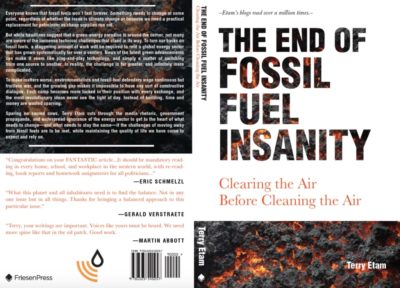
At the peak of the energy wars, The End of Fossil Fuel Insanity challenged the narrative of imminent fossil fuel demise, facing into the storm. And now everyone is coming around to this realization as well. Read the energy story for those that don’t live in the energy world, but want to find out. And laugh. Available at Amazon.ca, Indigo.ca, or Amazon.com.
Email Terry here. (His personal energy site, Public Energy Number One, is on hiatus until there are more hours in the day.)