Long in tooth and soul
Longing for another win
Lurch into the fray
Weapon out and belly in
– Invincible by Tool (similarly for quote at bottom)
I slept through history class as often as possible, though in hindsight I can see value in knowing some of that stuff. My rebellion was mainly against being tested on persnickety elements like exact dates of major events rather than the overall meaning in the context of the time. In defense of my teachers, maybe they did cover exactly that, but since I was asleep how would I know.
So I’m not sure, but this might be the first time in history when three seventy-somethings are squaring off to determine the global architecture for the next half-century. Even if there is precedent for that, it is new to realize that the trillions sunk into conventional armaments might not be the security blanket they thought.
The whole world is watching with bated breath to see what comes next, and no one knows. To really know, you would need to understand their psychology and inner motives, the tools/weapons that they have at their disposal, their belief in the tools they have at their disposal, and their single-minded determination to win.
There is a natural tendency to watch actions and say: “You’d have to be crazy to do that. What an idiot.” We all say that, looking through our own personal lens, where our nightmares or knowledge shape reactions. An average consumer might be dead set against the war because gasoline prices are up. Market analysts ask, what happens if the Strait is closed for months and we run short of sulphur? Or whatever.
It is less aggravating, but harder, to look at the trees instead of the forest. It can also be a much more fruitful task; what is the point in evaluating individual actions that look odd or dumb or whatever without considering the context in which they are made, and the motives of those who put them in motion?
Here’s a weird quick detour to provide a pertinent example from a very different field. Max Verstappen hops into a Formula 1 car and drives around corners faster than any other competitive driver (or he did before this year’s stupid regulation changes). He is acutely aware of what will happen to him if he misjudges a corner while going around it on the very limits; the consequences are life and death (less so today, a better example might be the legendary Gilles Villeneuve, who lost his life because his teammate had set a faster qualifying time than he and that could not stand). A normal human would sit in that same car and if they had the chance to drive it for a hundred feet would think, nope, I will not put my life at very serious risk to see how fast this thing can go around a corner. It would seem like the dumbest idea ever. Yet that is the essence of an F1 driver, every day.
Humans are driven by different things that can make no sense to someone that doesn’t see the world the same; one person’s dumb idea is another person’s reason for living. And that fact is relevant to understanding what is going on in the world, and can even make sense of these crazy wars.
Normal analysts look at events and decide whether something is smart or dumb, using individualized heuristics like, there is no way X should be done because of Y risk. But those people are not cut from the same cloth, or in the same position, or even thinking of the same game as the people moving those mega-geopolitical chess pieces.
At this point in history, we have three global leaders that are looking to rewire global architecture, and also who want to go down in history as one of The Greats. That trait is not of marginal interest; it is front and center to everything.
Some of it is just comedic. US President Trump could peel a hard boiled egg and would declare that no one in the world has ever seen anything like it, no one’s ever done it better. Russian president Putin not very long ago used to have minions make hilarious videos of little vignettes designed to burnish his legend, such as of him riding a horse shirtless, or a little hockey fantasy where he gets on the ice with professional hockey players, who stood their like pylons as old shaky legs ‘deked’ around them like a new born calf, pushing a 3-mph shot into the net past a playing-dead goalie (none of the players/pylongs wanted a one-way ticket to Siberia). It was beyond absurd to watch. In the background is China’s President Xi Jinping, taking it all in silently and with dignity, yet with no less a sense of desire for power/glory as the other two. Xi never degrades himself in public, and tells world leaders you can say what you want, but only in public.
Looking past the funny stuff, things get serious. Much is at stake. As has been consistently spelled out by brilliant analysts like Velina Tchakarova, we are now in Cold War 2.0, with China and Russia are joining forces militarily and economically to create a multipolar world, at the expense of American hegemony. Thirty years ago, American global dominance was undisputed, after the fall of the Berlin Wall and before the rise of China. A large reason for that was the US’ desire for global trade and oil, which led them to become the global police force, keeping all international shipping lanes open. With the advent of the shale revolution in the US, the country is now the world’s largest exporter of oil and natural gas, and under new management the country also has a very strong desire to ‘re-shore’ manufacturing, to rebuild America’s hollowed out industrial base.
It’s not just a battle for control though, it is an existential fight between forms of governance. One one side, the, the US and allies represent the fight for democracy, the fight for free markets and open economies. On the other side are two superpowers that like to shut off the internet when the talk gets ugly, where command and control of the population is a cornerstone, where ‘elections’ yield winners with 98% of the vote in open mockery of real choice. (I know which side I’m on, despite imperfections, just in case anyone thinks comparing the three entities and their leaders means equating them.)
The battle for control, however, is going to be much different than anything seen before. What is coming into clear focus is that the trillions invested in global military architecture over the last decades is being upended at warp speed by drone technology that costs a fraction of conventional armaments. The pace of development (and threat thereof) is astonishing.
Consider the Ukrainian war. For the past few years, it has looked inevitable that the Russian military juggernaut would simply wear down the much smaller Ukrainian fighting force. Who would expect otherwise? Russia is a military superpower, manufacturing their own jets, cutting edge rockets, and a nuclear arsenal big enough to deter anyone. Russia actually expected the Ukrainian war to last no more than a few days.
Well, that’s not working out so well. While Russia may have had a head start with Iranian drones, Ukraine has been forced to adapt and has raced past them. The story of how that happened is pretty remarkable and gives new meaning to the phrase necessity is the mother of invention.
Consider the trajectory of Ukrainian Robert Brovdi, an ex-grain trader who joined the war as a civilian volunteer sent to fight on the front, as documented in the Economist. Brovdi noticed how the outmanned Ukrainians had no idea where Russians were firing from, and he had the idea to bring some basic drones to the trenches, which helps spot Russians. Drone operators passed the information on to artillery teams. Within a year, a group of soldiers began experimenting, strapping grenades to them. Nw, Ukraine is now a global leader in wartime use of drones, to the point that the US and Middle Eastern countries have asked for Ukrainian assistance in the Iranian conflict. Ukraine just signed ten-year mutual defence agreements with Saudi Arabia and Qatar.
Look at these comments from one of the major Ukrainian drone manufacturers: “In 2025 alone, Ukrainian drones carried out 819,737 confirmed strikes. They accounted for 90% of all combat losses of the Russian army—more than all other types of weapons combined…Russian electronic warfare has rendered GPS-guided Western munitions (Excalibur, GMLRS, etc.) almost ineffective. Expensive and complex systems designed for wars with air superiority and conventional “peer-on-peer” conflict have become easy targets for drones costing $500–2,000 that attack them from above…This is industrial Darwinism in real time. We iterate weekly. We lose factories to missile strikes and rebuild them within weeks. We print parts in basements and deploy 100,000 strike systems per month, while your engineers still require 3–5 years and hundreds of millions of euros to certify even minor upgrades.” (The drone co founder was chastising a large European weapons manufacturer that belittled Ukraine’s “housewives with 3D printers” making drones. The Euros backpedaled real fast.)
So now we have the three titans looking, on one hand at square mile after square mile of hyper-expensive and thoroughly impressive military might, and on the other hand at rag tag special ops groups with skillsets honed by playing Call of Duty or Grand Theft Auto for countless nights now decimating all that mega-hardware with dirt cheap drones. (In early March, unknown drone operators flow drones over a major air force base in Louisiana, effectively grounding a squadron of B-52 bombers. Cages rattled.) (And a year ago, a Chinese business announced that the Chinese government had placed an order for nearly a million drones.)
AI may be changing everything, but the real pillars of power, the military might, is changing even faster.
Other countries and former power blocks are in a state of confusion. Canada seeks to expand trade away from its largest natural trading partner, of most significance with China, but yet can see this titanic power struggle going on. Europe is a complete disaster after de-industrializing on the green altar (even shuttering clean baseload nuclear facilities in what is surely the energy blunder of the century, thus far), now being forced to seek more oil and gas from Russia at the very same time it wholeheartedly backs Ukraine’s efforts to shred Russian oil and gas infrastructure. As much as it sounds like it, this isn’t a joke. It is the consequence of getting hung up on ideology or the cult of personality, or the fight against same.
It is so hard to say where things go from here, because the jockeying for fundamentals is the most intense game of chicken I’ve ever seen since waking up in history class. China has masterfully built the world’s biggest factory, dominant in manufacturing but also more critically dominant in metals/minerals capability. Russia has…well, they have a lot of raw materials and a lot of attitude, and used to have a lot of bodies, but as of late they appear to be the proving ground for net battlefield technologies that look like they are going to render much of the trillions of dollars worth of global military infrastructure obsolete (remember that last June, Ukraine smuggled 117 drones deep, deep into Russia, hidden in fake roofs of garden sheds, and launched them to disable an estimated $7 billion worth of Russian military aircraft. The drones and sheds together wouldn’t have been worth a million. And Ukrainian technology has advanced at an amazing rate in the past 9 months.). It is unclear what. Russia will have in a year if this keeps up, with their oil infrastructure now taking a pounding.
And what of the third of the troika, the US. It’s very hard to catalog the US’ assets and strengths in a few sentences, but what seems to be the key chess pieces are the US’ access to a vast supply of cheap energy, and energy is the basis of everything. On the oil side, the US has a surplus of light oil, and has Canada’s vast reserves directly connected for heavy requirements. On the natural gas side, while costs may rise with all the new LNG/data centre demand, US and Canadian natural gas reserves are immense and plentiful for the indefinite future.
Almost equally as relevant is a sitting US president whose style has knocked out one of the key platforms upon which both Russia and China built their empires; the assumption that American leadership would operate under standard operating procedure. Add that together with the way drone technology is rewriting the military landscape and we have a truly fascinating, dangerous global situation that is quite unpredictable.
The stakes are incredible, for all players, depending on how long these key critical supply chains are disrupted. This is not Covid; Covid was demand destruction, meaning reduced demand, which dampened the impact of lockdown-induced supply chain problems. This time around it is different, the world is facing actual physical shortages of key inputs to most important industries (Australian farmers are already announcing that they are running short of both fertilizer and diesel. Farming without those two is swimming without water. “Crops could be halved,” say the headlines, and if that should be enough to get one’s attention.)
The potential is also huge. At present, a significant number of Middle Eastern countries is working hand in hand with, it still blows my mind to say it, Israel; all are determined to do something about Iran’s leadership, which has repercussions for all three of the big parties in a big way. Don’t forget that Ukraine recently landed in the Middle East to help partners fight Iranian drones, forging new alliances that no one expected even a year ago as well.
Winners write history, the saying goes, and all three know that. Our way of life could be dominated by western free enterprise democracies, or by Russia/China-style command and control structures. For three people on this planet, the former may be as important as the latter.
Cry aloud, bold and proud
O’ where I’ve been
But here I am
Where I end
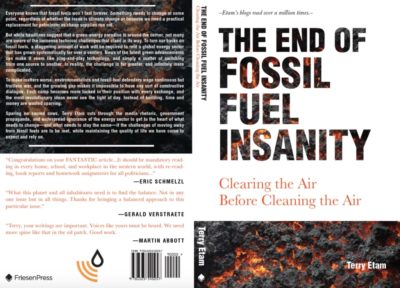
At the peak of the energy wars, The End of Fossil Fuel Insanity challenged the narrative of imminent fossil fuel demise, facing into the storm. And now everyone is coming around to this realization as well. Read the energy story for those that don’t live in the energy world, but want to find out. And laugh. Available at Amazon.ca, Indigo.ca, or Amazon.com.
Email Terry here. (His personal energy site, Public Energy Number One, is on hiatus until there are more hours in the day.)