Among the several hundred browser tabs open on various devices – not joking, you should see my annoyed devices – are an assortment of (very) random pieces that are too interesting to abandon.
The odd part is when some event happens in real time that pulls a bunch of these together into some previously non-existent coherence. Not necessarily cause and effect but more like second or third order consequences that were beyond me to spot until humanity’s unfathomable complexity upchucks a clear example. During the energy wars of a few years back, this was an easy sport like shooting fish in a barrel; documenting some insane energy policy and flagging it for down the road to see the consequences (“No business case for LNG” being one a heartbreakingly obtuse example).
Several random articles leapt into formation again recently. The chain reaction started with an interesting article written last July that has earned a long-term parking slot on my browser of choice. In honour of the US’ upcoming 250th anniversary as a nation, a writer went back through his collection of history books to try to piece together what it was like to live in 1776, in an article entitled oddly enough What Was It Like to Live in 1776?
It is a fascinating article, bringing up aspects and solutions that we can’t even imagine today, in all facets of life. Take one of the most basic: light. Pre-electricity, particularly in parts of the country/world where days get short in winter, candle light was it, and we’re not talking Lavender Sandalwood Tangerine with citrus-y floral notes and blah blah blah. Think home made candles derived from animal fat that churned out thick black smoke and Smells That No One Wanted To Capitalize, consumed in vast quantities, relentlessly. Or how about drinking and eating, which the author labels as, with considerable proof, ‘dangerous affairs’. Heat and bacteria spread health challenges without abandon, dirt and filth were everywhere, and the ‘exhaust’ from transportation was deposited here there and everywhere, unavoidably intermingled with daily life. A cut could be life threatening due to the risks of infection and no medication. Even Coca Cola wasn’t yet available as a magical elixir. The list of daily life events goes on and on, each and every one horrifying in its own way.
Then skipping over to another tab, sitting right beside but a world away, is an article from KCRA3 News in Sacramento, Calif. The article is entitled: “Chevron Executive: ‘I think we have a state of emergency in California’ ”. In a last-minute decision, California lawmakers including Governor Newsom hastily voted to extend stringent environmental laws for another 20 years, including a rapid crackdown setting “more aggressive limits on emissions between now and 2030” and then on top of that reducing the amount of credits emitters can purchase. In other words, these regulations can’t be successfully met by carrying on operations and generating or buying offset credits elsewhere, it is an absolute demand to reduce emissions.
The Chevron executive’s comment relates to the challenge of operating an oil refinery in California under such burdens. In an interview with the station, he says, “I know Chevron and my competitors are having trouble running a business in the state of California. If they add this burden of a tax on our refineries, I think it’s a matter of time. It’s not whether or not they’ll close, it’s when…” In reply, California legislators gave the equivalent of a raspberry and voted for the legislation anyway. As such, California is in danger of losing all its refineries.
For the fuel-rich US, you might think that isn’t a big problem, but it is, because the same eco-warriors that joyously dance around the energy funeral pyre have blocked development of any hydrocarbon infrastructure, and indeed have gone out of their way to kill off oil production in the state. As a result, 70 percent of the state’s oil is shipped in from other countries.
What is even worse is that with refineries closing, California is relying more and more on imported shipments of gasoline, placing the state even more at risk because oil is more widely available than gasoline in times of scarcity.
You can see where this is going. A few months ago, relying on ship-bound oil supplies for California’s needs was problematic in that it added expense. Fast forward to today, and relying on ship-bound petroleum supples is turning into a potentially catastrophic situation.
Which brings me to yet another tab, this one a commentary from Japan’s Prime Minister, Sanae Takaichi. Japan also relies very much on ship-bound oil imports, and she grasps the situation quite well. In a lengthy post on Twitter/X, Takaichi outlines her cabinet’s efforts to ensure stable supplies of critical materials including oil and, just as importantly, anything made from oil. She outlines steps taken to conserve oil consumption and redirect it to bottlenecks and industries at risk if oil supplies falter.
A fascinating point of Takaichi’s post is how she drills right into the specifics of what an oil shortage impacts. “For example, regarding A-heavy oil necessary for sterilizing “pediatric catheters” essential for nutritional supplementation in premature infants, and “ethylene oxide gas” necessary for sterilizing other medical devices, we have resolved “bottlenecks” in the distribution chain.” Or: “For materials such as chemical products derived from naphtha, medical-related supplies, food packaging containers, garbage bags, and semiconductor-related materials, we are surveying and grasping the periods during which manufacturing producers can continue supply for each item.”
For the hydrocarbon industry and even more so for its workers, it is a very great thing indeed to see the leader of a G7 nation state so clearly and directly, from the leader straight to the world, that they understand where stuff comes from. The X post is brilliantly uncluttered by junk thought, by ideological grandstanding, by a pure reflection of reality.
Lest you want to cut California some slack because they are La-La-Land, that we shouldn’t expect such crystal clear energy/supply chain thought from a population so far removed from extractive industries, do know that Prime Minister Takaichi was once a drummer in a heavy metal band.
As a Canadian, I have no right to be picking on California’s legislative choices, but the state is and has been a leader at the forefront of energy insanity, and the power of the state’s economy and choices have rippled into Canada and infected the brains of our politicians for some time. The states of California and Washington have actually taken steps to link carbon markets with Quebec.
With the news yesterday that the Iran war is over (LOL), maybe some will move on and assume the world will go back to normal, oil prices will fall, ships will begin moving through the shooting range again, all the precious raw materials will refill inventories everywhere, fertilizer will head out onto the fields just like it is supposed to, and we’ll all be content like we were 4 months ago (LOL).
But not many will revert so easily. Most have had a glimpse into the abyss, what exactly could happen if supply chains are disrupted. Covid actually gave us the first glimpse, and it was terrifying, but it was mostly on the demand side – everything stopped moving, oil consumption plummeted, people stopped consuming many things (except toilet paper which somehow became emblematic of the whole fiasco). Supply was disrupted, but only insofar as factories shut down for health reasons; if industrial supplies got critically low, those factories were always able to reopen.
The Iran war showed a different facet of vulnerability, what could happen if demand remained constant but inputs disappeared. It was not a fun thing to contemplate.
And so these past few weeks have proven a wake up call to the world. Who can and should be trusted to be truly reliable long-term suppliers? Who will have the same faith in the reliable access of those choke points that everyone did last year?
These circumstances have created a golden pathway for Canada to assume global leadership in resource development, the world is desperate for what this country has in abundance. No one living in the Great White North is familiar with the sound of incoming rockets or drones, unless they heard it from wherever they came from.
Will Canada rise to the occasion? Or will it continue to chase away investors with vigour? Talk is cheap, but carbon taxes are not, and Canada just raised theirs last week, to a number that is getting absurd ($110/tonne CO2e). Come on in, investors! Get fitted with your iron boots. (Canada is of course not alone in such thinking, there is the Californian example above, and even in the midst of the Iran war, five EU ministers just the other day called for another windfall tax because of physical shortages. One gets tired of saying it but that doesn’t make it less true: You just can’t make this stuff up. No one would believe it. Penalize production and subsidize demand – is there a dumber idea in economics? Possibly. But it would be hard to find.)
Canada is quite complacent about it all, with plentiful oil and natural gas reserves, and a surplus of many important raw materials. Imagine Prime Minister Takaichi’s post coming from a senior Canadian federal politician. You just can’t. We get platitudes grand (so-far) toothless plans, and hand wringing about what people are saying on the internet. Japan gets concrete plans showing that they are paying attention to detail.
Sometimes it takes a crisis to sharpen the thinking. I wonder what Canada’s will be to catalyze the same effect here.
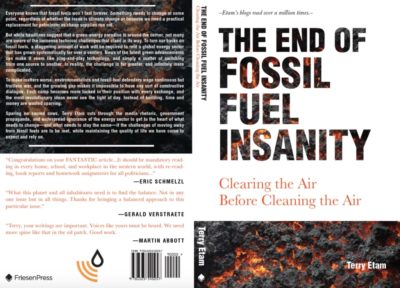
At the peak of the energy wars, The End of Fossil Fuel Insanity challenged the narrative of imminent fossil fuel demise, facing into the storm. And now everyone is coming around to this realization as well. Read the energy story for those that don’t live in the energy world, but want to find out. And laugh. Available at Amazon.ca, Indigo.ca, or Amazon.com.
Email Terry here. (His personal energy site, Public Energy Number One, is on hiatus until there are more hours in the day.)