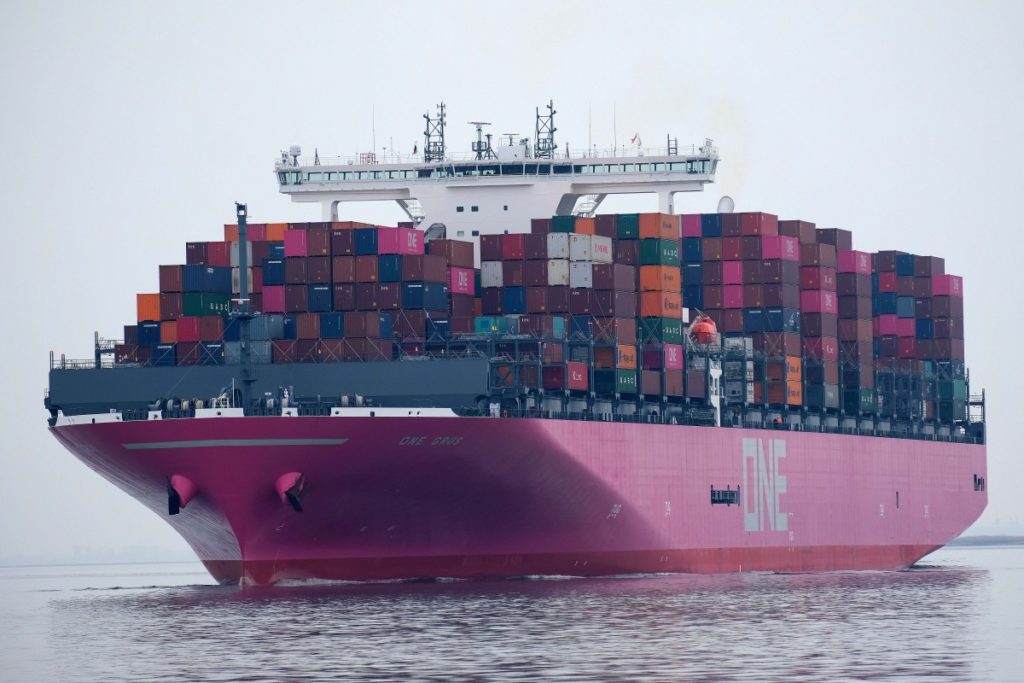
 The cost of shipping a container of goods from Asia to the United States has doubled since the start of the Iran war, driven by spiking fuel prices and an uptick in demand from importers who are worried costs will only rise further as the conflict wears on.
“If you want to know how seriously to take the threat of an energy crisis, look at container shipping rather than oil markets because the risk is priced into the spiraling freight rates far more clearly,” said Peter Sand, chief analyst at freight pricing platform Xeneta.
The dynamic threatens to feed into already high inflation rates in the United States, and reflects a major challenge for the U.S. administration of President Donald Trump after it started its war on Iran.
U.S. Energy Secretary Chris Wright said on Friday that lowering fuel prices will ultimately take a resolution with Iran to get more oil flowing through the Strait of Hormuz.
The off-contract spot rate to send a 40-foot container from Shanghai to Los Angeles was $4,565 on Thursday, while the Shanghai to New York rate was $5,505, according to the latest weekly Drewry World Container Index (WCI).
Asia-to-U.S. spot rates reported by both Xeneta and Drewry are up almost 100% from levels at the end of February, when the Iran conflict began, but still well below the $16,000 peak early in the COVID pandemic, which sparked spree buying by homebound consumers.
BUNKER FUEL SPIKE
Hostilities stemming from the U.S. and Israeli attacks on Iran have raged for more than 100 days with no immediate end in sight, choking the flow of oil through the Strait of Hormuz — normally the conduit for almost 20% of the world’s supply. Global oil inventories and emergency reserves are rapidly depleting as a result. Fuel analysts and maritime experts warn it could take around a year for bunker fuel supplies to return to normal even if Trump is able to quickly clinch an Iran deal.
While there is currently no widespread shortage of the tar-like, bottom-of-the-barrel “bunker” fuel used by marine vessels, supplies are reduced and are being redirected to areas less affected by the Iran war.
Those disruptions, coupled with some frontloading by shippers, helped send the cost of that very-low-sulfur fuel oil (VLSFO) on Tuesday up 55% to $845 across 20 major fueling hubs since the start of the Iran war, according to data from global marine fuel price publisher Ship & Bunker.
Prices varied wildly. They stood at $1,211 in Fujairah, a key refueling point in the United Arab Emirates for ships carrying oil and fuel from the Gulf; $770.50 in the key hub in Singapore; $676 in Europe’s hub in Rotterdam; and $918 in Los Angeles, home to the busiest U.S. container port.
Bunker fuel can account for as much as 60% of a container ship’s voyage cost, so even small swings in cost can quickly send freight rates above what underlying demand would justify, analysts said.
“If Hormuz remains closed or only partially usable into the second half of 2026, shortages are to be expected, not necessarily everywhere, but in key grades and key locations,” said Gisele Widdershoven, founder of Blue Water Strategy, a maritime and energy advisory firm. Sea-Intelligence Maritime Analysis estimated the Middle East conflict has already added $5.5 billion in bunker fuel expenses since late February, with container carrier Hapag-Lloyd alone spending as much as $50 million extra each week to keep ships moving.
Carriers, which also include MSC, Maersk and CMA CGM, have shifted some of that cost to customers through emergency fuel surcharges on spot shipments. On July 1, many vessel operators will roll those costs into their customers’ annual contracts.
“Importers are once again racing the clock” to avoid higher costs, said Steve Hughes, CEO of HCS International, which specializes in automotive sourcing and shipping.
FACTORIES SQUEEZED
The fuel disruptions could also mean reduced output from Asian manufacturing plants, meaning higher prices and less availability of some of the products U.S. importers hope to purchase, said Zac Rogers, lead author of the Logistics Managers’ Index, which offers an early gauge of U.S. business activity.
Essentially, “there will be less fuel for moving ships around, as well as less fuel to run the factories that are generating the components that are filling these ships up,” he said.
Some vehicle part suppliers have been frontloading raw materials used to make plastics and resins as a hedge, said Collin Shaw, president of MEMA Original Equipment Suppliers.
In South and Southeast Asia, it is becoming more costly to replace the Middle East crude oil and liquefied-natural-gas-derived products in everything from plastic packaging to synthetic fabric. Some factory owners could be forced to choose between losing money or shutting down, said Henning Gloystein, the Eurasia Group’s managing director of energy, climate and resources.
At the same time, so-called “feeder” ship services that shuttle goods from those factories to major ports for global distribution are at risk of being pared back to preserve fuel for more profitable shipping routes, he said.
“There is a fuel shortage by cost rather than by supply,” Gloystein said. “The effect is the same.”
(Reporting by Lisa Baertlein; Additional reporting by Kalea Hall and Mike Colias; Editing by Rich Valdmanis and Aurora Ellis)