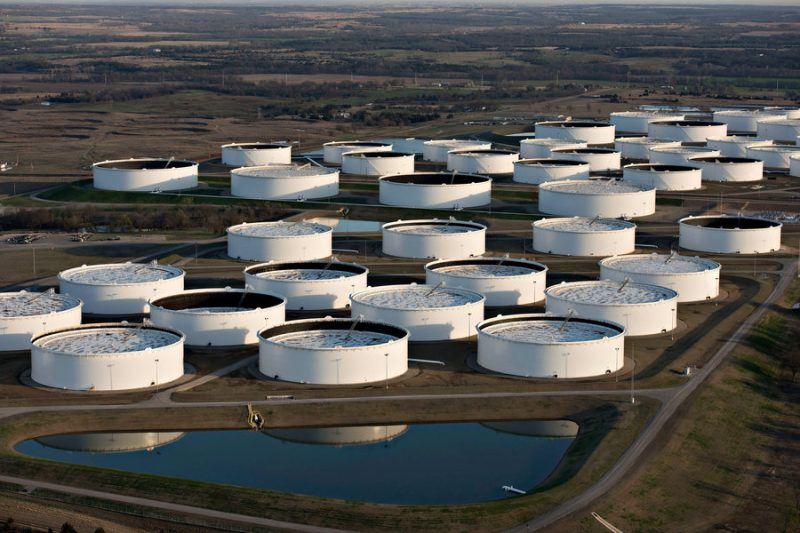
 Revived tanker movement through the Strait of Hormuz pushed U.S. crude prices below $70 a barrel briefly on Wednesday even though inventories at the country’s crude storage hub in Cushing, Oklahoma have dropped to their lowest in 12 years. Stocks of oil at Cushing fell to about 19 million barrels last week, the lowest level since 2014, the U.S. Energy Information Administration reported on Wednesday. Still, the price of West Texas Intermediate, or WTI, the benchmark used to price domestic crude, traded as low as $69.63 a barrel before settling at $70.34. Inventories at Cushing, among the largest storage hubs in the world, typically reflect supply conditions, and any tightness would generally push up prices. U.S. crude prices have indeed risen as high as $119.48 since the U.S.-Israeli war began at the end of February, but releases from the government’s strategic petroleum reserves have helped limit the price spike.
“Fundamentally we should be higher considering Cushing, replacing lost barrels, issues that continue with leaving and entering the Strait (of Hormuz),” said Carl Larry, sales manager at energy market analytics company Enverus.
“The move lower in prices is more of a continuation of sentiment sellers. Money that is looking to keep pushing futures lower in hopes of finding weak support and capitalizing on the rebound,” Larry added. Strong export demand from the U.S. Gulf Coast and weak flows of imported crude from Canada due to unplanned production outages there have depleted volumes stored at Cushing. They now stand below the 20-million-barrel threshold that traders and analysts consider the minimum for normal operations. When oil in a tank at Cushing falls to below 10% or 20% of capacity, it becomes difficult to remove. It also spurs quality concerns as water and sediments often settle at the base of storage tanks.
STRATEGIC PETROLEUM RESERVE
The U.S. government’s release of oil from its emergency reserve has provided a cushion for supplies across the country. The releases are part of the government’s agreement to release 172 million barrels from the facilities to plug a gap in global supplies and control prices during the Iran war.
The U.S. Gulf Coast looks relatively well supplied thanks to the strategic petroleum reserve releases and weakening export fundamentals, analysts at research firm Energy Aspects noted last week. Inventories along the Gulf Coast stood at around 239.8 million barrels at the end of last week, the lowest since mid-February, before the war began, according to EIA data. U.S. exports eased to about 4.7 million barrels per day from record highs of 6.4 million bpd touched in April.
The market understands that the marginal barrel is in Gulf Coast exports and not at Cushing anymore, a senior trader said.
CUSHING’S SIGNIFICANCE ERODES Lower U.S. crude prices also reflect the waning importance of Cushing as more oil production heads to the Gulf Coast for exports. Shale oil output has surged in the Permian basin in Texas and New Mexico, the largest U.S. oilfield. Yet much of that oil is now heading to storage closer to Gulf Coast export ports, or to refiners in the region, rather than to the flagship Cushing storage hub.
“It seems not that long ago when supply reports at Cushing were anticipated with bated breath, today it’s one of the least followed barometers in the energy sector,” said James Cordier, head of investment strategy at investment firm OptionSpreaders.com. U.S. exports should ease and more oil should flow towards Cushing next month, analysts and traders said, noting that more supply has been unlocked globally as stranded tankers exited the Strait of Hormuz after the interim peace deal between the U.S. and Iran.
Stocks at Cushing are estimated to build by around 800,000 barrels next week, according to Energy Aspects.
(Reporting by Arathy Somasekhar in Houston; Editing by Nathan Crooks and David Gregorio)