Plunger lift optimization isn’t just about cycle times and arrival windows. At its core, it comes down to one fundamental decision: are you running the right plunger for your well?
It sounds simple, but in practice, it’s one of the most commonly overlooked sources of production loss and unnecessary cost in plunger lift operations.
The wrong plunger affects everything downstream — off-time requirements, fluid fallback, cycle reliability, and ultimately how many MCF or barrels you’re leaving on the table every month. Additionally, since plunger swaps feel like a small operational decision, they often don’t get the rigorous engineering analysis and time that they deserve.
Two recent examples from Ambyint’s field optimization work illustrate just how much it matters.
Scenario 1: Two-Piece to Fast-Fall — More Production, Fewer Headaches
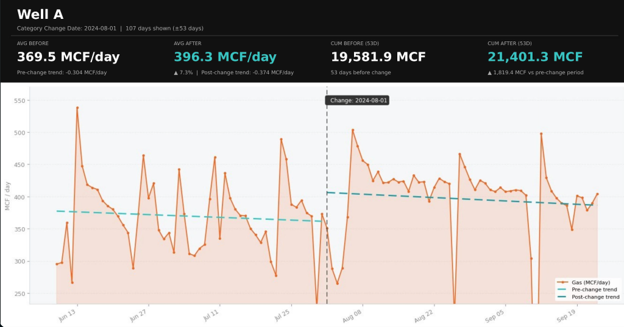
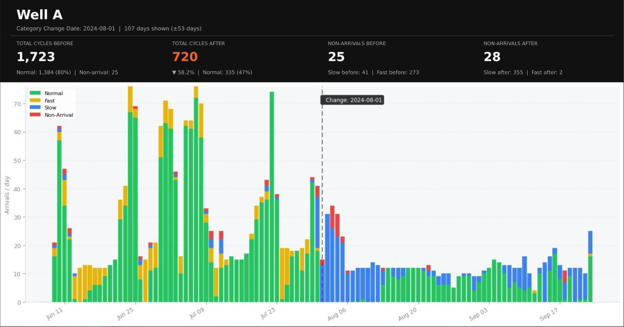
On a 7,000 ft (2,100 m) well, an Ambyint SME identified that the existing two-piece (ball and sleeve) plunger required more than 6 minutes of off-time to build enough pressure for reliable surfacing. That excessive off-time was a signal: the plunger wasn’t suited to the well’s conditions.
After recommending a switch to a fast-fall conventional plunger, the producer completed the swap and saw immediate results.
Cycle times became more consistent, arrival reliability improved and the mechanical failure modes specific to two-piece designs — premature sleeve release from the lubricator, sleeve-catches-ball-before-bottom events — were eliminated entirely. Production increased, maintenance simplified, and annual plunger costs dropped as a byproduct of fewer daily cycles.
Scenario 2: Fast-Fall to Bar Stock — Same Production, Lower Cost
On a 6,500 ft (2,000 m) well, the same analysis revealed the opposite opportunity. The well’s minimum off-time had extended to the point where a solid bar stock plunger could do the job just as well as the existing fast-fall conventional — at a fraction of the cost.
The producer’s operations team reviewed the recommendation and made the change. Post-swap there was no loss in productivity, and no change in cycle reliability. With the previous plunger requiring replacement twice a year, the switch to bar stock reduced plunger costs by over $600USD annually.
This is the other side of the optimization equation. It’s not always about upgrading to a more sophisticated plunger, sometimes the right answer is simpler and cheaper — and the data tells you when.
What These Cases Have in Common
In both scenarios, the decision came down to matching the plunger to actual well conditions: depth, off-time requirements, cycle behavior, and what the well was asking for. Not a general rule or a spec sheet default, but the specific data from that specific well.
That’s exactly the problem Ambyint’s free Plunger Lift Recommendation Calculator was built to solve.
Input five data points from your last five cycles — flow rate, afterflow time, off-time, solids presence, and tubing irregularities — and get a precise plunger lift recommendation in under 60 seconds.
Try the free Plunger Recommendation Calculator
This article is sponsored content, written and paid for by the advertiser. We do not endorse or take responsibility for the accuracy of the information presented. It has not been reviewed by our editorial team, and the opinions expressed are solely those of the sponsor.