Anyone suggesting we ‘advance’ trade discussions with the US by threatening to cut off or otherwise hinder energy supplies should be locked in a cage with a wolverine and a suppository and a mandate. I wish I was joking. But I’m not. The idea is so…bad.
People. People. Stop hyperventilating. Stop throwing out panicked and insane ideas. Stop. Think.
As a starting point, maybe think twice about threatening the energy supply of the most powerful nation on earth, the one that we overwhelmingly rely on for trade. Instinctively, it is just a very bad idea, and it will bring out the strongest response imaginable.
We are tying ourselves in knots trying to figure out how to navigate a new world order being thrust upon us by a powerful neighbour that is looking to course-correct and reindustrialize. A global reorganization like that is not going to be comfortable. Navigating these waters cannot be construed as easy by anyone. To reposition the country we have almost by necessity to be kicked out of our comfort zones, hard.
The message seems to be sinking in. Everyone from Carney on down, including the wave of seniors that support him, all agree that we need to build more infrastructure so as to be able to access more markets. That situation in itself seems like a Godsend after the past decade of indescribable stupidity (the new house is not built on the firmest of structures though; Carney’s fans are in large part the same cohort that kept Trudeau in power. But anyway, we’ll take it for now. What choice do we have anyway, here in the hinterlands).
Now comes the hard part though. Many new fans of infrastructure construction are somewhat lacking an understanding of what it takes to actually build infrastructure. A formidable network and framework of quasi-thoughtful roadblocks are now firmly in place that, one by one, illuminate the challenge.
I say quasi-thoughtful because often the objectives of the anti-construction network often have good intentions. Preservation of wildlife habitat, for example. As an isolated concept, who wouldn’t be in favour of that? Would you, or would you not, like to see all wildlife habitat preserved for any endangered or at-risk species? As a standalone question, most people would choose to see preservation. And this attitude shows up in a million little decisions every day across the land.
But that question is dangerously over-simplified, because it fails to consider consequences. Over-simplified discussions don’t get into the cold hard reality of trade-offs. Let’s up the ante a bit: Would you want to see all wildlife habitat preserved for any endangered or at-risk species, if it impacted your lifestyle at all?
At this point the word ‘hesitancy’ starts to appear. What exactly do you mean, ‘impacted’? Are you saying live without sushi? Or a car?
And then it gets more complex, because trade-offs are kind of a tricky topic. But if we are going to build big infrastructure in this country, we have to meet them head on. Not everyone is going to be happy, but then, does anything at all make everyone happy these days?
There is a ‘social infrastructure’ that has built up either entirely or in large part for the sole purpose of preventing physical construction. Or maybe a broader and more all-encompassing description would be, whose sole purpose is to prevent private enterprise from succeeding. Wealthy people bad!
That might sound overly bombastic, but it is not – immerse yourself in the outflow of almost any social science academic journal and you will see that it the massive academic infrastructure that simply loathes business. There is a reason places like New York City are voting in communists, a bizarre phenomenon whereby citizens vote for long term strangulation. The reason isn’t that they are stupid, it is that they have been pickled in the brine of thought of grievance culture and that odd hatred for one part of society that is expressed as benevolence for another.
Entire social strata of influential people are the product of such schooling, guilted into it. Narrative enforcement is severe, particularly if you want to get ahead in a social science field.
To make a Major Projects Office truly fly, that infrastructure has to be dealt with, in one way or another. Cold hard truths need to be instilled, willfully, about the value of energy security, the value of control of supply chains, the value of agriculture, the value of mining, and the fact that these necessities have an impact that we all need to recognize. There is clearly a change of tone in Canadian leadership, with respect to, say, pipelines, but it shouldn’t and can’t be couched as just sheer pragmatism. If it is, what happens when Trump goes away? Does the governing intelligentsia go back to hating hydrocarbons again? Because we can see the social infrastructure that is lying quietly in the weeds for the opportunity to spring forth again, like mosquitoes after a rain. That is one reason many of us remain so skeptical of the current Canadian federal leadership – when it was all the rage five years ago, there was no impediment to the flow of funding to stop hydrocarbon development, and our current prime minister was leading the charge.
People understandably become very confused. What are they supposed to do with all those old placards and protest signs from five years ago? Are pipelines evil or not? What is the principle at stake? Why should they want to help develop major infrastructure when they were told a scant half-decade ago that it was the last thing they should do? Is this newfound enthusiasm built only on a current trade predicament and a dislike for a sitting US president? It seems to be, and many are smarter than that, to be told to think one way and then the opposite for, in the daily march of life, marginal reasons.
There is a clear line of thinking based on economic principles that needs to be the starting point of building infrastructure, and there is no evidence that this is happening at all, which explains the lack of progress. The line of thinking includes making a clear defence of market economies as the bedrock principle; if this is the starting point, many of the other issues lose their power. But we don’t do even that.
But that’s just the half of it. Next, governments have to get serious, I mean really freaking serious, about cutting red tape and overregulation.
We’ve always kind of sensed the problem in Canada, or you definitely have it trying to build something substantial. It is hard to catalogue the myriad ways things can go off the rails though. You don’t really know until you try, just how many regulations there actually are, and the time drag of each.
But look at that, bless their hearts, the feds have actually done us the favour of counting all the regulations. By department. Better sit down. This is going to hurt.
The federal government now publishes an “Administrative Burden Baseline”, requiring departments to establish a baseline count of regulations that burden business. Health Canada lists, for example, that in 2025, the total count of regulations that they acknowledge impose administrative burdens on businesses is 21,384. Employment and Social Development Canada clocks in at a far more impressive 31,537 burdensome regulations. Hold my beer, says Transport Canada; our count is 31,704. All hail the champ!
To their credit, the feds did create this mandatory reporting requirement so as to illuminate just how big and burdensom the bureaucracy is. There is also much noise about the need to reduce red tape. They even have a Red Tape Reduction Action Plan as well, right there on the federal website.
That’s the good news, and when you hear that you just know…the Transport Canada Administrative Burden page, the one that shows the count of 31,704 burdensome regulations (and remember that ‘burden’ is their word), the page also discloses that Transport Canada’s burden count increased by 213 from 2024 to 2025. Lord tunderin’. What would the increase have been without the Red Tape Reduction Action Plan?
Health Canada provides a bit more nauseating detail. Not only did their regulations increase by 346 from 2024 to 2025, but their tally has grown from the 2014 baseline of 15,649.
And those are just the federal burdens. Each province has its own unique truckload of hurdles of which there is no hope of cataloguing in entirety; many overlap and are slightly different yet no less real. As at the federal level, there is a recognition that over-regulation is problematic, and provinces are indeed working together to better things.
Take alcohol for example: nine provinces recently announced a landmark agreement that will allow “Canada-wide Direct-to-Consumer alcohol sales”, per the news release headline. That’s great news, but in the big scheme of things, alcohol is probably about as frivolous as it gets. The fruit doesn’t get much lower. Changing a health, safety, or transport standard can arguably be difficult because it means walking back research and approvals. Changing alcohol sales standards is, in the big scheme of the universe, totally irrelevant. And even despite that fact, the problem still isn’t solved: Per the news release, Quebec and Yukon have not yet signed on. Working hard on it! “With the aim of signing the agreement in the near future.” Oh for crying out loud. Quebec, yes we get that truculence, but Yukon? I’m surprised they have laws at all. Survival kind of trumps everything up there, including bureaucratic dithering about…what exactly? Is their liquor industry at risk? Both tool sheds?
It doesn’t get easier than alcohol, and yet this is the sole breakthrough after 18 months of seriously putting their shoulders into it. The feds document for us how regulations continue to grow, not shrink. So, trade enthusiasts…maybe we should start here? And get really serious? Tear down all that infrastructure?
Not all regulatory burdens are problematic or consequential, of course, and some are very important, but the the sheer number of the things remains the biggest part of the problem, because businesses must be aware of all the regulations, as well as complying with the appropriate ones, because they need to know which apply. And even if each regulation is small, it is the cumulative burden that kills investment appetite.
Armies of government departments and institutions have been empowered in tens of thousands of minuscule ways that have great power overall in the cumulative sense. Very much like bees. You can look at one bee, and think that its sting is the equivalent of one silly rule or regulation that new major projects need to deal with. One bee sting is an irritant but not truly problematic. But what about thirty-one thousand bee stings? We avoid those situations like the plague. And so do businesses.
The country needs to get serious about these sorts of things first rather than looking for lunatic ways to enter trade combat. The suggestion to withhold energy is tempting but even on basic humanitarian grounds a terrible idea. Ironically, many in the oil patch have voiced that exact same sentiment, towards Ottawa over the past decade: Wouldn’t it teach those ignoramuses a fantastic lesson to cut off supplies of all hydrocarbons, in all forms, for a week and then maybe it would be clear how valuable they are. That is a true statement no matter who utters it, and for whatever reason.
But no serious person in the oil patch ever set about putting in motion the wheels to do that, or to constrict flows so as to cause pain. People in the oil patch understand probably better than anyone just how critical fuel supplies are, and do not seriously contemplate such an anti-human act.
People like to rail against the “Laurentian Elite”. Lord knows I do. Yet inside that little world, there is, from what I can gather, a sense that it is not so, that while acknowledging a community of sorts, the people within are worldly and have a more complete vision of what it takes to run a country. There is a logical tendency to swim in the waters where such things are discussed, where the big brains and the big money gather to compare notes on state-level development. The WEF is a great example.
There really should be a trend the other way though. We don’t need grand global architects. We need more soul searching at home. The status quo worked for a good little while, but it doesn’t any longer. Solutions are to be found with more serious introspection of what we can do better, not how we can try to get back to where we were. That world is gone. The US will re-reshore, re-industrialize, one way or another. They more or less have to, because controlling your own fate is a necessity. There’s no point in crying about it. The good news for Canada is that we remain in an absolutely great position to continue with our greatest trading partner, and with everyone else. We have what the world needs, what can’t be AI’ed. We just have to unclog our arteries to make it happen.
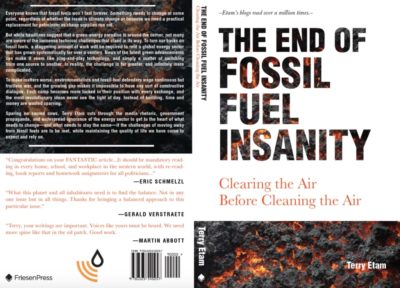
At the peak of the energy wars, The End of Fossil Fuel Insanity challenged the narrative of imminent fossil fuel demise, facing into the storm. And now everyone is coming around to this realization as well. Read the energy story for those that don’t live in the energy world, but want to find out. And laugh. Available at Amazon.ca, Indigo.ca, or Amazon.com.
Email Terry here. (His personal energy site, Public Energy Number One, is on hiatus until there are more hours in the day.)