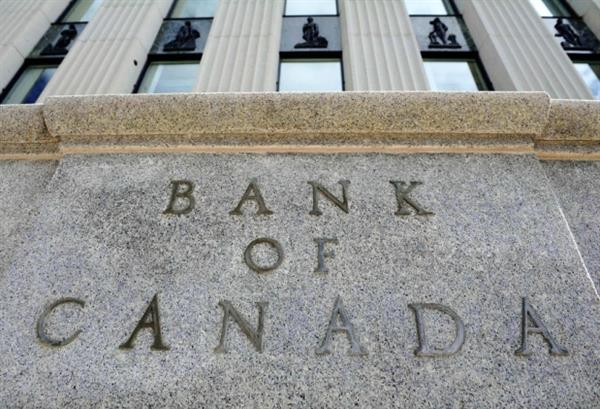
Trade uncertainty and slowing immigration levels could restrict how high the Bank of Canada’s benchmark interest rate goes next year, according to a new report published by Capital Economics on Wednesday.
The report argues that the risks plaguing Canada’s growth prospects will likely rein in inflationary pressures — limiting the degree of monetary policy tightening needed to keep prices in check.
The Bank of Canada has held its benchmark interest rate at 2.25 per cent since last October as it gauges how the U.S. trade dispute and war in Iran are affecting its outlook.
The central bank will issue updated forecasts for the economy and inflation at its next interest rate decision on Oct. 28.
Financial markets have increasingly shifted to favour rate hikes sooner than later as high oil prices stoke fears of persistent inflation.
The Bank of Canada has so far found few signs that gas price pain is broadening to other parts of the consumer basket but monetary policymakers have made clear they’re prepared to raise rates if inflation threatens to spread.
Capital Economics forecasts the central bank will raise rates to 2.75 per cent with a pair of quarter-point hikes starting next year.
That would bring the policy rate to the middle of what the Bank of Canada considers its neutral range — the point at which borrowing costs are neither stimulating nor suppressing growth.
Capital Economists’ outlook for a cumulative half-point increase is well short of the roughly 1.25 percentage points of total hikes markets now expect before the end of 2027, the report’s authors note. Recent rises in global bond yields, meanwhile, are helping tighten financial conditions and take some pressure off the central bank to hike.
Capital Economics expects that the Bank of Canada’s preferred core inflation metrics will start to pick up steam early next year, but that rise should be limited by downward forces hampering the economy like U.S. tariffs and trade uncertainty and weak population growth.
The report authors argue that while U.S. President Donald Trump’s recent Section 338 tariffs and Canadian product bans are unlikely to have wider impacts on the economy, the re-escalation in trade tensions is likely to delay any lasting renegotiation of the Canada-U.S.-Mexico agreement.
Revisions from Statistics Canada last week also showed that the population did not recently shrink on an annual basis as first thought. Capital Economics suggested that could lead the federal government to tighten immigration levels even further to hit its population targets.
“This would be a drag on household consumption and potentially stall the recovery in the housing market, though the unemployment rate would also likely fall faster than we expect,” the report read.
A soft labour market is also helping to contain inflation from wage growth, the economists noted.
StatCan reported Tuesday that economic growth stalled in July but likely picked up again in August. Growth has been volatile over recent quarters as tariffs and other geopolitical shifts disrupt typical trade flows.
Capital Economics expects real gross domestic product will rise just 1.5 per cent next year and normalize to two per cent in 2028 as infrastructure and artificial intelligence projects gain steam.
The outlet’s economists also argue that some growth prospects have been rosier in recent weeks, making note of the federal government’s expanded tax incentive aimed at stimulating business investment.
But efforts to attract private investment to Prime Minister Mark Carney’s aggressive infrastructure agenda are only likely to gain steam toward the end of 2027 at the earliest, according to Capital Economics.
This report by The Canadian Press was first published Sept. 30, 2026.