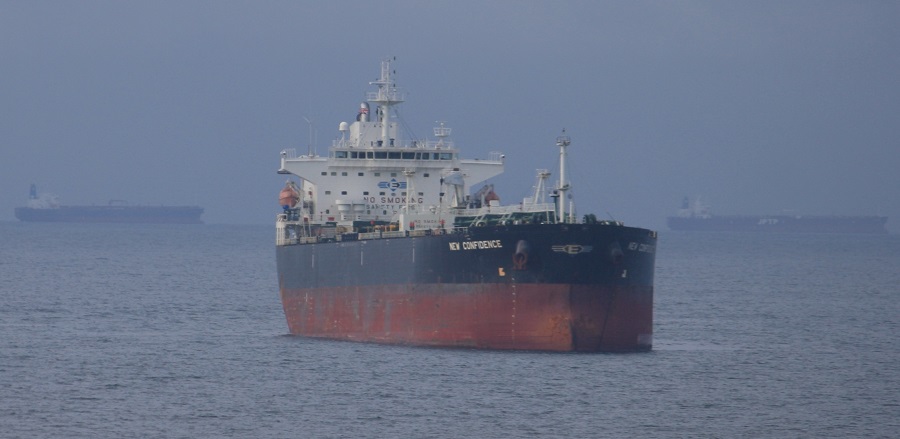
 Asian refiners are turning to options such as using smaller tankers and vessels on long-term charter, and buying Middle East crude on delivered basis to cut feedstock costs as freight rates hover near records, company officials said.
Spot rates for oil tankers hit all-time highs in early October as Middle East producers ramped up exports in September using a shuttle service and ship-to-ship transfers to move oil out of the key waterway of the Strait of Hormuz.
That tied up vessels in the Gulf while the risk premiums for such shipments climbed as ship attacks have increased.
About 80 very large crude carriers (VLCCs) were tied up shuttling through the strait, Vitol’s head of Asia Kieran Gallagher told an industry conference last week.
That tightened supplies and pushed the cost of shipping US crude to Asia to $40 a barrel, he added.
High shipping costs have cooled demand from Asian and European refiners for supply from outside their regions, such as from the US and Africa, widening spot discounts for these cargoes, traders said.
“Freight is too expensive so crude from Africa and the US can’t really come over (to Asia),” Formosa Petrochemical’s President K Y Lin told Reuters.
“There are not many firms chartering ships except (Middle East) producers,” he said, adding that Asian buyers are using ships leased on long-term charters to keep costs down.
Unlike conditions at the start of the Iran war, when crude supply was tight, freight has become a major factor in determining the economics of crude purchases, a South Korean refining source said.
The Korean refiner is using a mix of spot and long-term chartered vessels and smaller Aframax-sized tankers to ship crude while it also has term cargoes coming in and inventories to draw on, the source said.
The sources declined to be identified as they are not authorised to speak to media.
In Europe, refiners are turning to short-haul supplies within the region, pushing the North Sea dated Brent benchmark to record premiums of more than $20 a barrel last week.
At the same time, some of the west African crude differentials have tanked to all-time lows of minus $20 a barrel to offset high freight costs, several London-based traders said.
SHIPPING COSTS CHIP AWAY OIL REFINERS’ MARGINS
Oil exports via the Middle East Gulf slowed as attacks rose on tankers in the Strait of Hormuz.
To increase exports, Middle Eastern producer Abu Dhabi National Oil Co (ADNOC) has sold cargoes loading in the next two months on delivered basis to China and India, while Saudi Aramco also sold delivered cargoes to Asian buyers for next month, traders said, absorbing shipping costs.
Some Asian refiners have taken to using smaller Aframax-sized tankers that load about 600,000 barrels each versus 2 million barrels aboard a VLCC as the shipping cost per barrel came on par, traders said.
For example, state Taiwan refiner CPC has bought six Aframax cargoes last week instead of its usual monthly purchase of two to three VLCCs, traders said.
South Korea’s top refiner, SK Energy, has chartered Aframax tanker Samos to load US oil in early November for $23 million, according to a shipbroker. CPC and SK Energy did not immediately respond to requests for comment.
While shipping costs have taken out a chunk of refiners’ gross margins estimated at above $40 a barrel, Formosa’s Lin said the refinery still needs to maintain run rates to meet contractual obligations.
Net refining margins were still above $10 a barrel after accounting for freight and insurance costs for Middle East oil, he added.
Morgan Stanley analysts said European refiners have delayed scheduled maintenance in the fourth quarter as they want to benefit from current high margins.
“Buyers can afford to pay. Record refining margins and very low stocks make crude demand insensitive to freight,” they said in a note.
(Reporting by Florence Tan, Siyi Liu in Singapore, Joyce Lee in Seoul, Nidhi Verma in New Delhi, Robert Harvey in London and Arathy Somasekhar in Houston; Editing by Clarence Fernandez)