For decades, Alberta’s energy industry has excelled at finding and developing new reserves. Yet one of the province’s largest opportunities may not involve drilling a single new well.
Across Alberta, an estimated 45,000 shallow gas wells remain in various stages of maturity, decline, or underperformance. Many continue to produce, but often at rates well below their true reservoir potential. Others have been written off as uneconomic despite still containing recoverable reserves.
The challenge isn’t necessarily what’s left in the reservoir.
It’s whether conventional production methods are capable of recovering it.
One Alberta company believes the industry’s biggest missed opportunity lies in hydraulically challenged wells that conventional artificial lift systems simply cannot optimize efficiently.
According to Optimum Petroleum Services Inc. (Optimum PSI), conventional lift systems can leave significant recoverable reserves behind due to hydraulic inefficiencies, often resulting in premature abandonment decisions and stranded value. The company’s approach centers on unlocking that remaining production through advanced downhole technologies specifically designed for mature wells.
The Traditional Response: Expensive Workovers
When mature wells begin underperforming, operators typically have a limited set of options.
Many resort to workovers, recompletions, cleanouts, or other interventions aimed at restoring production. While these approaches can be effective, they often come with significant costs, operational downtime, and uncertain outcomes.
Production teams are increasingly being asked a difficult question:
Can we achieve the same – or better – results without mobilizing expensive equipment and disrupting production?
That question has led some operators toward intelligent downhole optimization technologies that focus on addressing the root cause of production inefficiencies rather than repeatedly treating the symptoms.
From Workovers to Intelligent Optimization
Optimum PSI’s optimization strategy revolves around two complementary technologies: the Sonic Stimulation Tool (SST) and the Smart Well Optimization Tool (SWOT™).
The SST is designed to restore flow by targeting plugged perforations. Using a piston-and-anvil system, the tool generates sonic energy that exceeds fracture pressure at the perforation face, reopening flow pathways without requiring fluids or proppants. Deployed via coiled tubing, the tool stimulates the entire perforated interval and restores productivity across the wellbore.
Think of it as restoring the reservoir’s ability to communicate with the well.
Once flow pathways are re-established, the second phase begins.
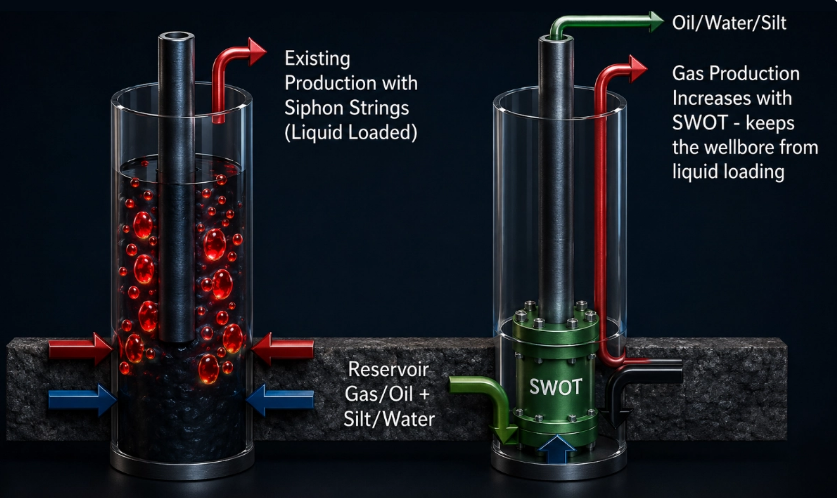
The SWOT™ system functions as an intelligent downhole production management platform. Rather than relying solely on surface measurements, the tool continuously monitors fluid levels, downhole pressure, and flow conditions in real time using integrated IoT technology. The system separates gas and fluids downhole, reducing surface infrastructure requirements while providing operators with direct insight into reservoir behaviour.
The result is not simply increased production.
It’s improved reservoir and drilling management.
By effectively “listening” to the reservoir, operators gain the ability to optimize production strategies, better understand remaining reserve potential, and make more informed field-development drilling decisions by avoiding interwell interference.
Why Engineers Are Paying Attention
For technical teams, the appeal extends beyond production gains.
One of the industry’s persistent challenges is determining whether declining performance stems from reservoir depletion, hydraulic restrictions, fluid loading, interwell interference, or operational inefficiencies.
Conventional surface-based approaches often provide only part of the picture.
By gathering real-time downhole data while simultaneously optimizing flow conditions, intelligent systems can provide a more complete understanding of well performance and remaining reserve potential. According to Optimum PSI, operators can also reduce field visits, remotely identify underperforming wells, and improve overall field efficiency through centralized monitoring and optimization.
Stuck pigs in low-pressure pipelines are eliminated as the driving pressure to operate the SWOT tool is an external source of gas. SWOT artificial lift is not dependent on reservoir pressure. The gas to power the SWOT is recycled and not vented to the atmosphere. Methane emission goals are not in jeopardy.
In mature assets where margins matter, those operational efficiencies can be just as valuable as incremental production.
The Economics Matter: Finding New Value Without New Wells
For executives and asset managers, the appeal is straightforward.
Every barrel or MCF recovered from existing infrastructure typically carries a lower capital cost than production from a newly drilled well. When optimization technologies can extend well life, improve recovery, and reduce operating costs, the economic case becomes increasingly compelling.
As Jim Gettis, President of Optimum PSI, explains:
“Some of Alberta’s most valuable production opportunities aren’t waiting to be discovered. They’re waiting to be recovered from wells that already exist.”
If Alberta truly has tens of thousands of shallow gas wells producing below their potential, the industry’s next major production gains may not come from discovering new resources.
They may come from recovering the reserves that were already discovered years ago, but never fully produced.
In a competitive market increasingly focused on capital efficiency, perhaps the smartest well is not the next one drilled. It’s the one already in the ground.
45,000 wells represent a lot of unanswered questions.
Which wells still have recoverable reserves? Which ones need intervention? Which are being abandoned too soon?
The SWOT™ Overview and Case Study shows how Alberta’s top producers can use real-time downhole intelligence to find those answers.

This article is sponsored content, written and paid for by the advertiser. We do not endorse or take responsibility for the accuracy of the information presented. It has not been reviewed by our editorial team, and the opinions expressed are solely those of the sponsor.